You're busy closing jobs, managing crews, chasing payments, and answering calls. Then someone tells you to “post more on social.” So you upload a finished bathroom, get a few likes, and go right back to work. No clear lead. No booked estimate. No proof it was worth the time.
That's the problem with most social media advice for contractors. It treats social like a branding hobby. You need it to act like a lead channel. If it doesn't help you earn trust locally, start conversations, and support booked work, it's noise.
For home-service businesses, social media marketing services for small businesses only make sense when they're built around local proof, fast response, and disciplined follow-up. Not pretty graphics for the sake of pretty graphics. Not random posting. Not vague monthly reports.
Table of Contents
- Is Paying for Social Media Marketing Worth It
- What Social Media Marketing Services Actually Include
- Which Social Media Channels Matter for Contractors
- Typical Service Packages and How Much They Cost
- KPIs That Matter and Measuring Real Business Impact
- How to Choose the Right Provider and Avoid Red Flags
- Your Next Steps DIY Plan vs Hiring an Agency
Is Paying for Social Media Marketing Worth It
Yes, if you treat it like a system and not a side chore.
Most contractors don't fail at social media because the platforms don't work. They fail because they post when they remember, promote themselves too hard, and never connect social activity to booked estimates. That approach burns time and creates zero accountability.
The case for investing is strong. Social media is the dominant advertising channel for small businesses, with 77% of small businesses actively using social media for core functions and 75% advertising on social media, while the same 75% rate it as effective, according to Small Business Trends, Intuit QuickBooks, and related data compiled here. If your competitors are using it seriously and you're treating it like an afterthought, you're giving away attention in your own market.
There's also a practical reason to care. The top three marketing channels used by small businesses are social media marketing, social media advertising, and search advertising, according to LocaliQ's small business marketing statistics. Social isn't a side dish anymore. It's part of the main course.
Practical rule: If your social media can't support trust, visibility, and lead flow, it needs a better operator or a simpler strategy.
For contractors, the right standard is straightforward. Your social presence should make local people think three things fast: these people do real work, they do it well, and they respond. If you want a stronger pipeline beyond posting finished jobs, this guide on lead generation for contractors is a smart companion.
What Social Media Marketing Services Actually Include
A contractor hires a social media provider, pays for three months, and gets a feed full of holiday graphics, stock photos, and vague captions about quality service. No local targeting. No follow-up on messages. No clear tie to estimates or booked jobs. That is a posting service, not marketing.
Strategy comes first
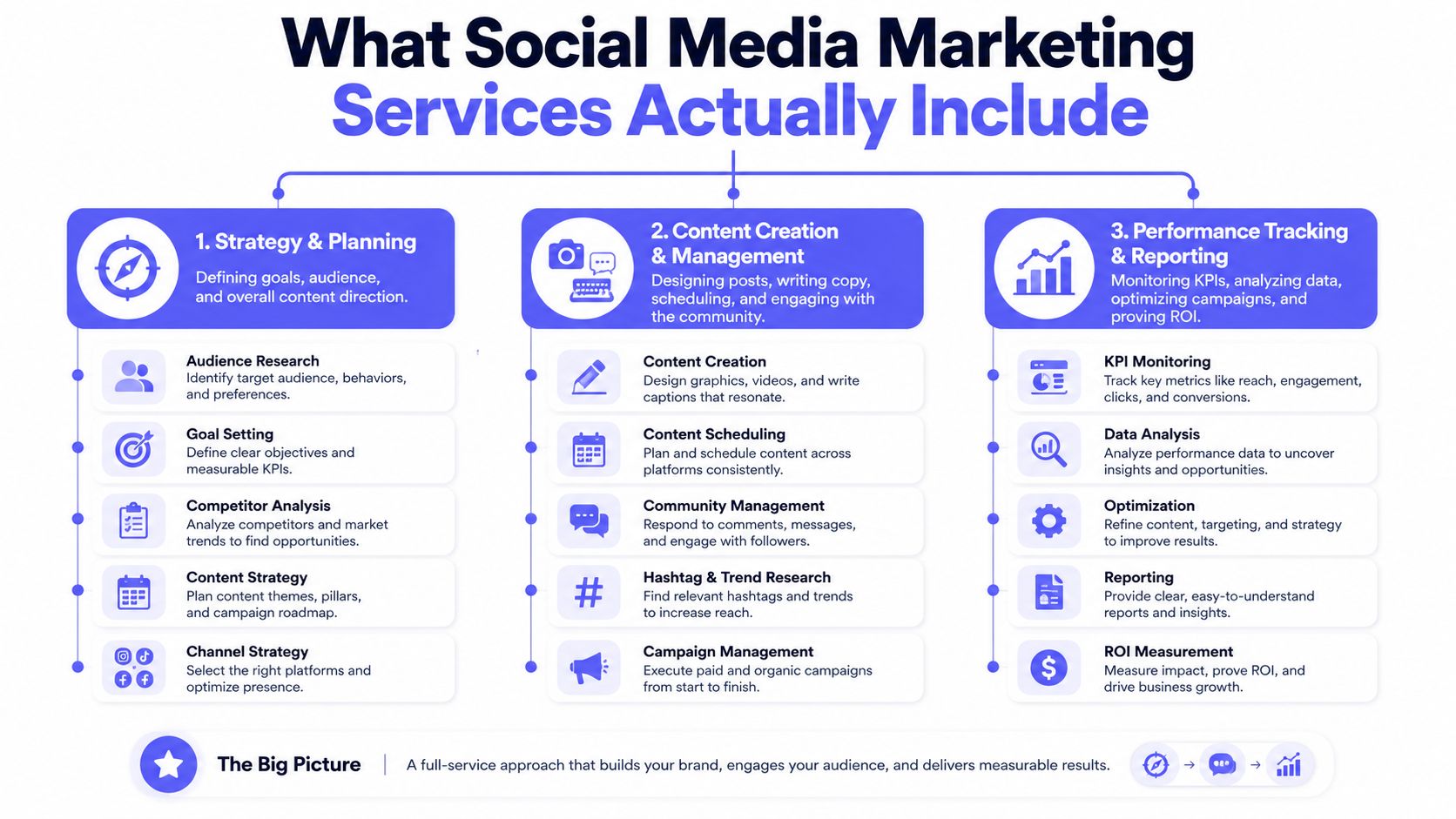
Good social media work starts with a plan tied to revenue. For home-service contractors, that means choosing the services you want to push, the service areas that matter, the type of customer you want more of, and the proof that gets a homeowner to contact you.
A real strategy should answer questions like:
- Which jobs deserve the budget. High-ticket installs, repeat-service plans, emergency calls, or profitable repair work.
- Who the target buyer is. Homeowners, property managers, commercial clients, or referral partners.
- Which local markets matter most. Specific ZIP codes, cities, or neighborhoods where your crews can win and stay efficient.
- What content will persuade them. Before-and-after photos, jobsite walkthroughs, homeowner tips, testimonial clips, financing explanations, or warranty messaging.
- What the next step is. Call, message, form fill, or inspection request.
This planning should also line up with your local search presence. If your provider treats social and search like separate worlds, they are missing how homeowners shop. Your social content should support the same service pages, locations, and trust signals that drive local SEO for contractors.
Without that foundation, you get random posting and weak leads.
Execution is where providers earn their fee
Owners usually focus on posting. That is only one part of the job.
The first piece is content creation and management. A provider should turn your job photos, crew videos, customer reviews, and field updates into posts that show competence. Contractors win with proof. Finished projects, in-progress shots, short videos explaining the fix, and clear captions about scope, timeline, and result will outperform generic brand fluff almost every time.
The second piece is community management. Your social pages function like a front desk. Prospects ask about timing, price ranges, financing, service areas, and availability. Those messages need a response fast and in plain English.
Slow follow-up costs jobs.
The third piece is paid advertising and reporting. Organic posting builds familiarity. Paid campaigns put your best proof in front of local homeowners, retarget past site visitors, and keep your company visible during longer buying cycles. Reporting should show leads, response speed, top-performing content, cost by campaign, and what the provider plans to change next month.
If a proposal does not clearly include strategy, content production, inbox and comment response, ad management, and reporting, it is incomplete. You are paying for motion instead of lead generation.
Which Social Media Channels Matter for Contractors
You do not need to be everywhere. You need to be strong where local buyers can see your work, check your credibility, and contact you without friction.
Facebook and Instagram deserve most of your attention
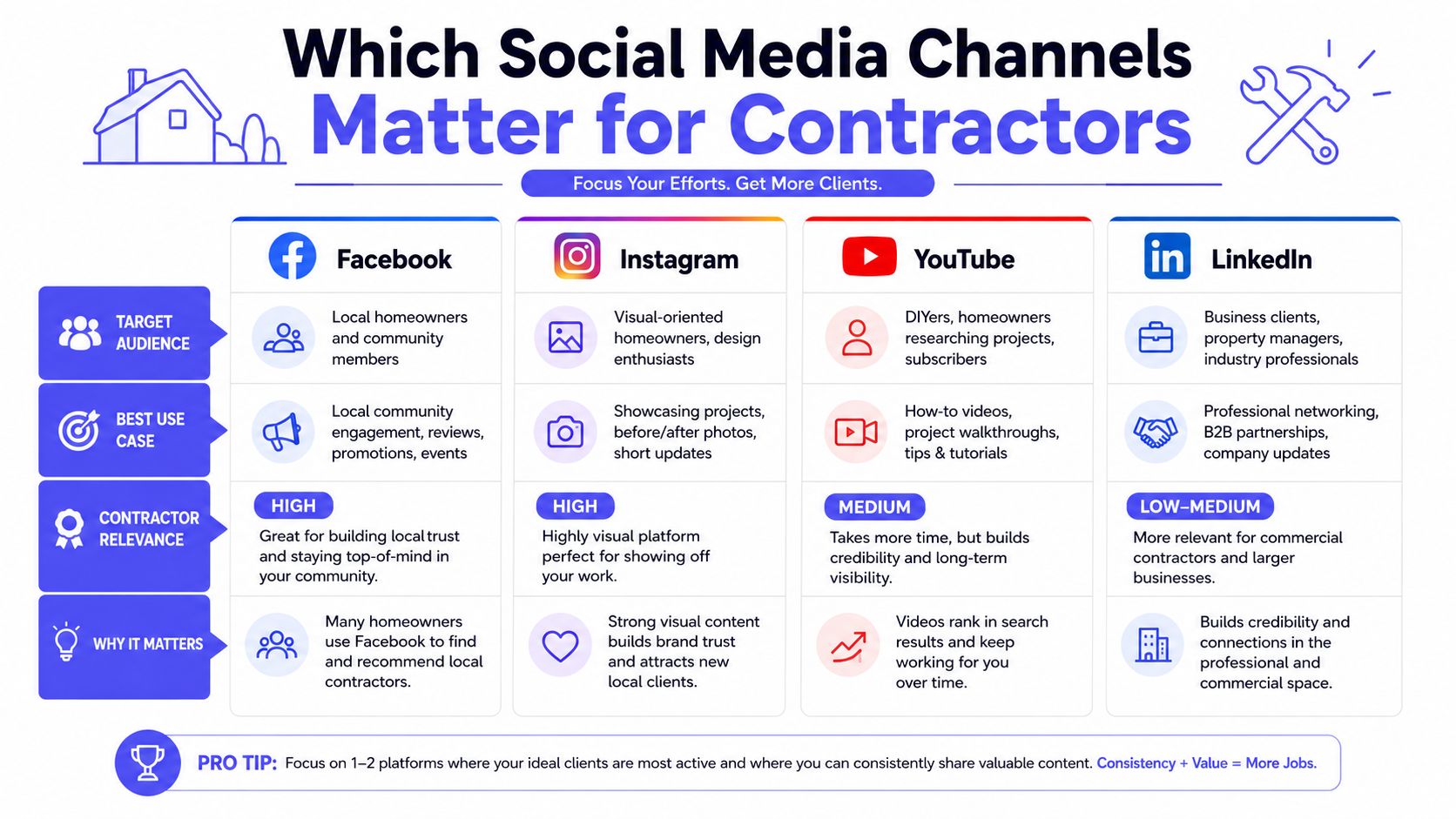
For most home-service contractors, Facebook and Instagram are the core pair.
Facebook still matters because local trust often forms there. Community groups, neighborhood recommendations, tagged customer posts, reviews, project albums, and comment threads all help. If somebody's comparing roofers, remodelers, or restoration firms, a lively Facebook presence still carries weight.
Instagram works because contracting is visual. Finished kitchens, roof replacements, bathroom remodels, siding upgrades, water damage rebuilds, and clean mechanical installs all translate well in a feed. Approximately 67 percent of small business respondents in the U.S. use Instagram for social media marketing, according to Statista's SMB platform usage data. That should tell you something. Businesses keep using the platform because it earns attention.
Here's the contractor version of platform priority:
- Roofing and exterior trades usually win on Facebook and Instagram because visual proof is easy to capture.
- Remodelers can build a strong portfolio on Instagram and use Facebook for local credibility.
- HVAC, plumbing, and electrical can use both platforms, but educational content matters more because much of the work isn't naturally glamorous.
- Restoration companies need fast updates, proof of responsiveness, and trust-building content more than polished branding.
For many contractors, adding a local search strategy to social creates a stronger one-two punch. This guide on local SEO for contractors fits that approach well.
Reels and short video punch above their weight
If your provider says “we'll post video” but can't tell you what kind, they're bluffing.
Short-form video is the format that deserves attention. Short-form video delivers the highest ROI among video formats at 41%, according to Business.com's review of small business social media trends. For contractors, that can be a quick attic walkthrough, a time-lapse of a replacement, a “what we found behind the wall” clip, or a simple explanation of what homeowners should watch for.
You do not need glossy production. You need clarity, movement, and proof.
A few contractor-friendly short video ideas:
- Jobsite walkthroughs that explain the problem in plain English
- Before-and-after reveals with one useful takeaway
- Crew introductions that make your business feel real
- Maintenance tips that build trust before the sale
LinkedIn matters only for a narrow slice of contractors
Most residential contractors don't need to pour energy into LinkedIn.
But if you target commercial work, property managers, insurance relationships, architects, or higher-end referral partners, LinkedIn can support credibility. It's not usually the place to generate a flood of homeowner leads. It is a useful place to show professionalism, partnerships, certifications, and larger project capability.
Pick one primary platform and one support platform. Most contractors who try to manage four channels end up weak on all four.
Typical Service Packages and How Much They Cost
A plumbing company in a midsize city hires the cheapest social media help it can find. Three months later, the page looks busier, but the phone is not ringing more often. That happens because many contractors buy posting, not lead generation.
Social media pricing gets muddy on purpose. Agencies bundle random tasks together, keep scope loose, and make it hard to compare bids. Don't buy the label. Buy the work, the response time, and the reporting tied to leads.
For home-service contractors, there are usually three practical package levels. Only one or two make sense for most shops.
What each package should do
A content-only package covers post creation, captions, scheduling, and light profile maintenance. Buy this if your sales pipeline already comes from referrals, Google reviews, and repeat customers, and you mainly need a credible social presence when homeowners check you out.
A content plus ads management package is the starting point I'd recommend for many contractors who want more local leads. It combines regular posting with paid campaign setup, creative testing, audience targeting, retargeting, and reporting. That gives you two things at once. A page that looks legitimate and a system that can produce inquiries.
A full-service package adds faster optimization, more content production, inbox handling, stronger creative direction, and tighter reporting. This tier is for companies that answer leads fast, have someone owning follow-up, and are ready to treat social like a sales channel.
According to WebFX's social media pricing guide, small and midsize businesses commonly pay monthly agency fees that range from a few hundred dollars for limited management to several thousand dollars for broader service. For contractors, that spread usually comes down to one question. Are you paying for posting, or are you paying for lead generation and campaign management?
Cheap social media usually buys activity. It rarely buys booked estimates.
Social Media Marketing Service Packages
| Service Tier | What's Included | Best For | Estimated Monthly Cost (Agency Fee + Ad Spend) |
|---|---|---|---|
| Content Only | Content calendar, post design, captions, scheduling, basic profile upkeep | Contractors who need credibility and consistency more than immediate paid lead flow | $500 to $1,500 per month |
| Content + Ads Management | Everything in Content Only, plus Meta campaign setup, audience targeting, ad creative, monitoring, and monthly reporting | Contractors who want local lead generation with measurable testing | $1,500 to $3,000+ per month, including agency fees and ad spend |
| Full-Service | Strategy, content, paid campaigns, community management, inbox response support, optimization, reporting, and regular creative updates | Established contractors who need a serious growth partner and can handle lead volume | $3,000 to $7,000+ per month, depending on content volume, response support, and ad budget |
Those ranges are broad because scope matters. A roofer running one citywide campaign and posting four times a month will pay less than an HVAC company shooting weekly video, running multiple offers, and needing someone to manage Facebook and Instagram messages daily.
Use a simple filter before you sign anything:
- Ask how many original pieces of content are included each month. Recycled templates get old fast.
- Ask who manages ad creative and testing. If nobody owns testing, performance stalls.
- Ask whether inbox replies are included. Slow response kills lead value.
- Ask what happens if you provide the photos and videos. That can reduce cost without hurting results.
- Ask how reporting ties back to calls, forms, and booked jobs. If they stop at reach and engagement, keep looking.
One more opinion. Contractors usually overspend on posting volume and underspend on ad management. Eight average posts will not outperform a tighter plan with solid creative, a live offer, and someone watching lead quality every week.
KPIs That Matter and Measuring Real Business Impact
Likes don't pay your estimator. Comments don't cover payroll. Reach doesn't matter if the phone stays quiet.
The image below captures the right mindset. Look at performance like an operator, not a fan.

The numbers that deserve your attention
For contractors, the useful KPIs are boring. That's good. Boring metrics usually make money.
Track these first:
- Qualified leads. Not raw messages. Real prospects in your service area asking about work you want.
- Cost per lead. What you paid to generate one legitimate inquiry.
- Phone calls and form submissions from social. If your provider can't tie activity to contact actions, push harder.
- Booked estimates. Leads matter, but appointments tell you more.
- Return on ad spend. If ads are running, you need a clear picture of what came back.
There's also a financial benchmark worth knowing. Successful small businesses allocate 10 to 15% of revenue to social media marketing and achieve a 3 to 5x ROI within 90 days through targeted campaigns, according to Secuodsoft's analysis of small business social media growth.
That doesn't mean you blindly spend that percentage tomorrow. It means serious businesses budget for social intentionally and expect it to earn its keep.
What good reporting looks like
A useful report should answer five questions:
- What content pulled the best response
- Which campaign generated actual inquiries
- Which service or offer got traction
- What audience was most responsive
- What changes happen next month because of the data
If your provider sends follower counts, impressions, and a few screenshots, that's not enough.
A good social media provider should be able to explain performance in plain English. What worked, what failed, what changed.
For social media marketing services for small businesses, accountability is the whole game. If results can't be measured against leads, calls, or revenue, you're buying theater.
How to Choose the Right Provider and Avoid Red Flags
Plenty of contractors waste money. They hire a provider who knows social media jargon but doesn't understand local service sales. Then they get pretty content, weak follow-up, and no clear business outcome.
The provider you hire should understand that your business runs on timing, trust, and lead quality. They should know the difference between an emergency restoration prospect, a remodel lead, and a seasonal maintenance inquiry. Those aren't the same buyer. They don't need the same message.
Questions to ask before you sign anything
Interview providers like you'd interview a key employee. Ask direct questions and wait for direct answers.
What experience do you have with home-service businesses
If they've only worked with ecommerce brands or influencers, be careful. Contractors need local targeting, proof-heavy creative, and fast response systems.How do you handle local strategy
You want to hear about service areas, neighborhood targeting, localized content, and ad geography. Generic “brand awareness” talk is weak.Who creates the content and where does it come from
Ask whether they work from your real photos, jobsite videos, customer reviews, and service pages. Stock-heavy content usually underperforms for contractors.Who responds to comments and messages
Ignoring social media responses can be costly, as 73 percent of consumers say they'll switch to a competitor if a brand fails to respond on social media, according to Sprout Social's social media statistics. Response time is not a side issue.What do your monthly reports include
If the answer is mostly impressions, likes, and follower growth, keep looking.What happens if campaigns underperform
You want to hear about testing, creative changes, audience adjustments, and budget reallocation.
A smart hiring process also means checking reputation carefully. This guide on how to spot fake reviews is useful when you're evaluating agencies that look polished online.
Red flags that should end the conversation fast
Some warning signs are obvious. Others get hidden behind smooth sales calls.
Watch for these:
- Guaranteed results. No serious provider can guarantee exact outcomes in a changing market.
- One-size-fits-all packages. A roofer, remodeler, and HVAC company should not get the same exact strategy.
- No mention of community management. If nobody owns comments and messages, opportunities will leak.
- No access or transparency. You should know what's running, what's posted, and where the money goes.
- Heavy focus on vanity metrics. If they celebrate likes more than leads, they're telling you what they value.
The right provider won't just sell activity. They'll show you how their work supports local trust, fast response, and qualified demand.
Your Next Steps DIY Plan vs Hiring an Agency
Here's the clean decision.
Handle social in-house if you or someone on your team can consistently gather project photos, shoot short video, respond to messages fast, and review performance every month. If that person exists, start simple. Pick one main platform, post real project proof, answer every message, and keep your focus narrow.
Hire an agency if your team keeps pushing social to the bottom of the list, your pages look inactive, your response times are weak, or you want to combine content with paid local campaigns. That's when outside help starts making financial sense.
A simple DIY plan looks like this:
- Choose one core goal. More estimate requests, better local credibility, or stronger repeat visibility.
- Pick one primary platform. Usually Facebook or Instagram.
- Build three content buckets. Completed work, customer proof, and simple education.
- Assign response ownership. Someone must check comments and messages daily.
- Review actual lead impact monthly. Not just post performance.
If you hire, keep the first 30 days disciplined. Define target services, target areas, lead handling rules, content access, and reporting expectations before anything launches. Good onboarding saves months of cleanup.
The right move is the one you can sustain. Social media rewards consistency, responsiveness, and proof. If you can't deliver that in-house, buy help. If you can, keep it lean and focused.
If you want a better way to grow without fighting shared leads and random spam, take a look at Hand Vetted Co.. You can also review How It Works, see Our Standards, or check the FAQ. The model is simple. One exclusive match, one verified professional, and a cleaner path to qualified opportunities.