Before you sign anything, ask these questions. That “great deal” on a kitchen remodel can turn into a financial nightmare if the business is uninsured, unlicensed, or sloppy about paperwork. A low quote means nothing if you end up paying for damage, dealing with permit problems, or fighting over work that was never clearly defined.
Learning what questions to ask a contractor often happens only after problems arise. By then, you're stuck. The smarter move is to use a simple framework up front. Ask questions that protect your money, your safety, your timeline, and your peace of mind.
That means getting past vague promises. You want documents, names, dates, and a process you can verify. You also want to know how this business handles real pressure: hidden damage, permit issues, scheduling problems, and callbacks after the job is done.
This checklist isn't about being difficult. It's about being smart. We'll walk through exactly what to ask, why it matters, and the red flags to watch for, with extra notes for roofing, HVAC, and renovation projects.
Table of Contents
- 1. Are you licensed and insured in my state?
- 2. Can you provide references from recent projects similar to mine?
- 3. What's included in your written estimate, and what costs are not?
- 4. How long have you been in business, and do you have verifiable ratings or reviews?
- 5. What's your warranty on materials and labor, and what does it cover?
- 6. How do you handle unexpected problems discovered during the project?
- 7. What's your payment schedule, and what guarantees back it?
- 8. Will you pull permits and handle inspections, or is that my responsibility?
- 9. How long will the project take, and what could cause delays?
- 10. What makes you different from other contractors, and why should I choose you?
- 10-Question Contractor Comparison
- Your Next Step From Questions to Confidence
1. Are you licensed and insured in my state?
Start here. If a business can't prove active licensing and current insurance, stop the conversation.
You should ask for physical copies of their license, general liability insurance, and workers' compensation coverage, then verify expiration dates with the state board or insurance provider. That's the baseline advice from American Financing's contractor interview guidance. Don't rely on a verbal “yeah, we're covered.”
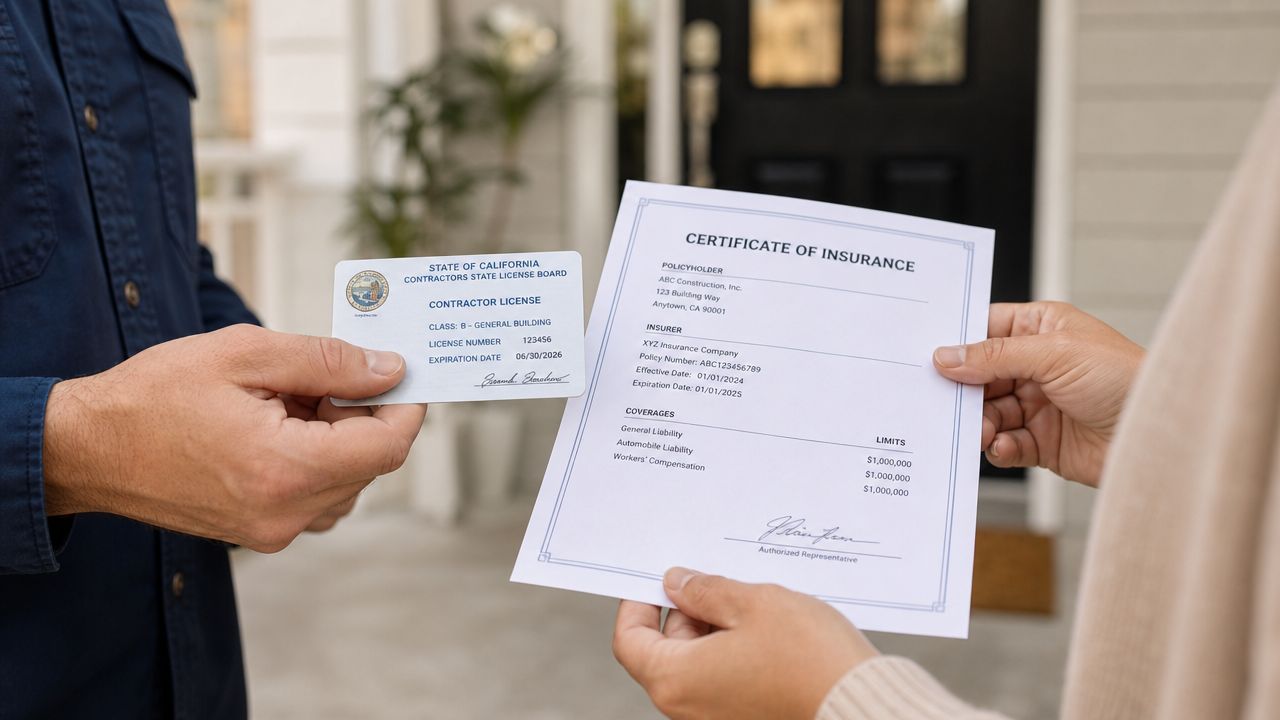
A serious pro can hand this over fast. A flaky one stalls, gets defensive, or says they'll send it later. That's usually your warning.
What to ask for in writing
- License number: Ask for the exact license number tied to the business name on the contract.
- Insurance details: Request the Certificate of Insurance and ask for the workers' comp policy number too.
- Coverage verification: Review the contractor insurance requirements so you know what a real policy should include before work starts.
According to Webster Groves guidance on hiring a contractor, homeowners should ask for a Certificate of Insurance that lists the policy number, insurance company name, and coverage limits, and failure to provide it is a primary red flag.
Practical rule: No license proof. No insurance proof. No job.
For roofing, HVAC, and renovation work, this matters even more because those jobs involve code requirements, safety risks, and subcontractors moving through your property. If someone falls off your roof or damages your mechanical system, you don't want to find out after the fact that the business wasn't properly covered.
2. Can you provide references from recent projects similar to mine?
Don't ask for “references” in the abstract. Ask for recent jobs that look like your job.
If you're replacing a roof, ask for recent roof replacements in a similar climate and home style. If you're installing HVAC, ask for work done in homes similar in size and system type. If you're remodeling, ask for projects in homes around the same age, because old houses hide different problems than newer ones.
Ask for real comparables
You want at least three contacts you can call. Then ask the questions that expose their genuine experience.
- Timeline honesty: Did the project start and finish when they said it would?
- Cost control: Were there surprise charges, and if so, were they explained clearly before work continued?
- Communication: Did the business keep them updated, or did they disappear for days at a time?
- Would they rehire: Would they hire the same company again without hesitation?
Call people when the conversation feels less staged. Early evening usually works better than mid-morning, when the business may be hovering.
Ask one question most people skip: “What annoyed you during the job?”
A perfect answer usually isn't real. A balanced answer usually is.
For a roofing example, a good reference should be able to tell you whether cleanup was thorough and whether nails and debris were left behind. For HVAC, ask whether the system was fully tested and explained after installation. For renovations, ask whether the crew protected floors, sealed off dust, and respected the home while the project was live.
A business that does strong work should have no problem putting you in touch with recent customers who had a similar scope.
3. What's included in your written estimate, and what costs are not?
The estimate protects your money before the job starts.
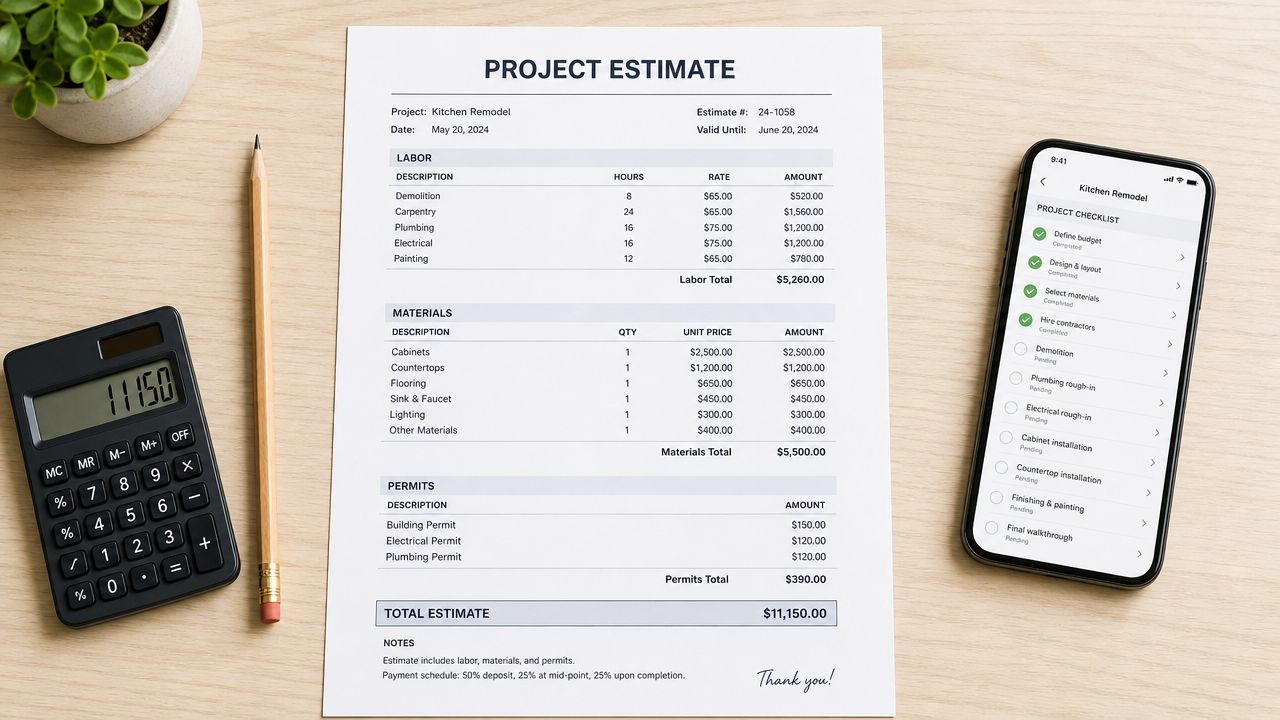
If a contractor hands you a one-page quote with a lump sum and little else, you have no real way to compare bids, challenge surprise charges, or hold anyone to scope. A useful estimate should tell you exactly what you are buying, what the contractor assumes is true today, and what will cost extra if those assumptions are wrong.
What a useful estimate should cover
Look for line items, not vague categories. You want labor, materials, permits, cleanup, disposal, equipment, and any allowances called out clearly. You also want exclusions stated in plain English. If something is missing, assume it can become an extra charge later.
The details change by project type. For roofing, the estimate should list the shingle brand and product line, tear-off, flashing, underlayment, disposal, and whether rotten decking is priced separately. For HVAC, it should identify the exact equipment model, duct modifications, electrical work, startup, testing, and thermostat scope. For renovations, it should spell out demolition, finish materials, trim, paint, debris removal, and whether protection for floors and dust containment are included.
If you need a reality check before comparing numbers, use a home renovation cost calculator and review a contractor background check process before you sign anything.
Ask the question that exposes change orders
Say it plainly: “What is not included here that homeowners often assume is included?”
Then keep going. Ask what conditions could raise the price, who approves added work, and whether you will get a written change order before that work starts. That process matters. Without it, “unexpected” becomes a blank check.
A good contractor will answer directly and put it in writing. A weak one will stay vague, use allowances to hide real costs, or gloss over common problem areas such as deck rot, code upgrades, bad ductwork, water damage, or outdated wiring. That is exactly where budgets get blown.
One more rule. Match estimates line by line before you compare totals. The cheapest bid often looks cheap because it leaves out disposal, permit handling, finish work, or material quality. You do not save money by buying an incomplete scope.
4. How long have you been in business, and do you have verifiable ratings or reviews?
This question isn't about chasing the oldest business in town. It's about figuring out whether the company has a track record worth trusting.
A business that's been around for years has had time to build systems, fix mistakes, and protect its reputation. A newer company might still be excellent, but you should look harder at who runs it, what their background is, and whether their online reputation matches what they say in person.
What to verify
Read reviews across more than one platform. Look for patterns in complaints. One angry review doesn't tell you much. A string of complaints about missed appointments, sloppy invoicing, or unfinished punch lists tells you plenty.
Then ask a direct follow-up: “Has this business ever operated under another name?” You're not being rude. You're checking for restarts after bad reviews or licensing trouble.
If you want another layer of screening before you even start making calls, review how contractor background checks can help surface issues that don't show up in a sales pitch.
- Look for consistency: Recent reviews matter more than old praise from years ago.
- Read the responses: How a business answers criticism tells you how they'll handle stress on your project.
- Match the review to the work: Great feedback on small handyman jobs doesn't prove they can manage a full renovation.
For example, a roofing company might have glowing comments about emergency tarp work but no proof it can manage a full replacement cleanly. An HVAC business may be excellent at service calls but disorganized on full system installs. A remodeler may photograph beautiful kitchens while still having a poor reputation for schedule control.
You're hiring the business behind the photos, not the photos.
5. What's your warranty on materials and labor, and what does it cover?
A warranty only helps if it's specific. “We stand behind our work” sounds nice. It doesn't tell you who pays when something fails.
Ask for written warranty terms before you sign. You need to know what the business covers on labor, what the manufacturer covers on materials or equipment, what gets excluded, and who you call if something goes wrong.
Separate labor from product coverage
Material warranties and labor warranties aren't the same thing. A shingle manufacturer may cover the product while the installer covers workmanship. An HVAC manufacturer may cover parts while the installing company decides whether labor is included on a callback.
That distinction matters. If your system stops working because it was installed poorly, a manufacturer warranty won't solve your problem.
- Ask what triggers a claim: What counts as defective workmanship?
- Ask who handles service: Do you call the business, the subcontractor, or the manufacturer?
- Ask about transferability: If you sell the property, does the warranty follow the next owner?
A roofing example is straightforward. If flashing was installed wrong and water gets in, that's usually a workmanship issue. If the material itself fails under normal use, that may fall under the product warranty instead. For HVAC, ask whether startup, calibration, and testing are included in the install warranty. For renovations, ask who owns warranty responsibility if multiple trades touch the same area.
The best warranty answer isn't the longest one. It's the clearest one.
Also ask the uncomfortable question: “What happens if your business closes?” If the answer is silence, vague language, or finger-pointing toward a manufacturer, you've learned something useful before the check clears.
6. How do you handle unexpected problems discovered during the project?
Every real project uncovers something. Rot under roofing. Wiring behind a wall that shouldn't stay. Ductwork that's in worse shape than anyone expected.
The right question isn't whether surprises happen. It's what the business does the moment they find one.
You want a change-order process, not improvisation
Ask this directly: “If you find hidden damage, do you stop work and call me before doing anything extra?”
The only acceptable answer is yes. You want photos, a written explanation, updated cost, schedule impact, and your approval before work continues beyond emergency stabilization.
If a business says, “We'll take care of it and sort it out later,” that's how small discoveries become ugly invoices.
This is especially important in renovations because multiple trades can be affected by one hidden condition. Open a wall for plumbing and now electrical has to move too. In roofing, deck damage can change material quantities and labor. In HVAC, a planned equipment swap can turn into a duct or electrical correction.
Ask for one real example
Don't settle for policy language. Ask them to describe a recent project where something unexpected was discovered and how they handled it.
Listen for specifics. Did they document the issue? Did they pause for approval? Did they explain schedule impact clearly? A seasoned project manager doesn't panic when scope changes. They follow a process.
For larger jobs, you also need daily accountability. A dedicated on-site supervisor or project manager should be assigned each day to direct trades, manage quality control, and serve as your point of contact. According to Beeler Construction's guidance on hiring a commercial contractor, the absence of that role is a sign of poor organization and weak accountability. That applies to large residential projects too.
7. What's your payment schedule, and what guarantees back it?
This question protects your money more than almost any other.
A contractor's payment schedule shows who is carrying the risk. If they expect you to fund the job heavily before they have delivered materials, labor, or measurable progress, you are acting like their bank. That is a bad deal.
The right structure is simple. Pay in stages tied to work you can verify.
Make every payment earn its place
Ask for a written schedule that connects each draw to a clear milestone. Avoid vague terms like “progress payment” unless the contract defines exactly what progress means. If the milestone is unclear, the argument comes later, right when you are trying to get the job finished.
Use this standard:
- Deposit: Limited to a reasonable amount for scheduling, permits, or special-order materials
- Mid-project payments: Tied to visible, completed phases
- Final payment: Held until punch-list items are done, closeout documents are delivered, and the job is substantially complete
That last payment matters. It is your means to get the loose ends finished.
Ask what protects you if something goes wrong
Do not stop at the payment schedule. Ask what backs it.
You want clear answers on change orders, refunds for undelivered materials, warranty documentation, and lien waivers from subcontractors and suppliers. If they use subs, this is not optional. A contractor can be paid by you and still leave a supplier unpaid. That is how homeowners get dragged into lien problems on work they thought was already covered.
The Federal Trade Commission's guidance on hiring a contractor advises homeowners to get payment terms in writing and avoid paying the full amount upfront. That is the baseline, not the gold standard.
Match the schedule to the kind of project
The right milestones depend on the job.
For roofing, a reasonable schedule often ties payments to material delivery, dry-in or tear-off completion, and final completion after cleanup and inspection. For HVAC, hold the last payment until startup, testing, and documentation are complete. For renovations, use phase-based draws tied to framing, rough-ins, drywall, trim, or other clearly visible stages.
Calendar dates are weak triggers for payment. Completed work is the better trigger.
Ask one question that exposes sloppy operators
Ask this directly: “What documents do I get before each payment and before final payment?”
A solid contractor will answer fast. They should mention an updated invoice, a milestone description, change-order totals if any, and final paperwork such as lien waivers, warranty documents, inspection sign-offs if applicable, and a punch-list process.
A weak contractor will talk in circles.
If the answers are fuzzy here, expect billing disputes later. And billing disputes are never just about billing. They slow the project, sour communication, and make it harder to get warranty help after the crew leaves.
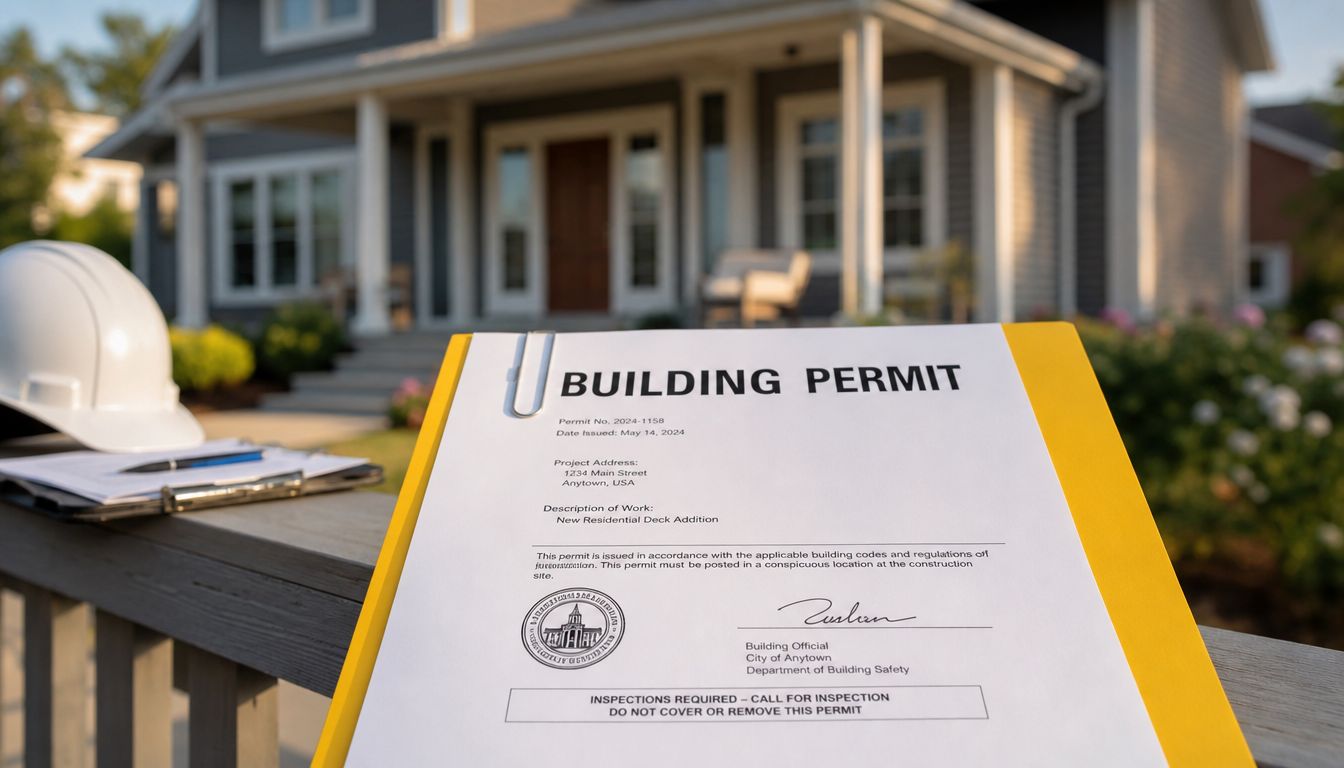
8. Will you pull permits and handle inspections, or is that my responsibility?
The business should pull the permits. Not you.
If they ask you to pull permits yourself, or suggest skipping them to “save money,” walk away. Permits protect you. They create a record that the work was reviewed and give you a cleaner path if you refinance, sell, or file a claim later.
Go beyond “yes, we handle permits”
It's common to stop after hearing “yes.” Don't.
Ask, “What was your company's permit denial rate in the last 12 months, how many projects required revised permits after initial denial, and how do you adjust bids when climate-resilience codes change mid-project?” That question gets you far closer to real permit competence than a simple yes or no.
The verified data for this article notes a real gap here: many homeowner guides ask if a business handles permits but don't ask for denial or revision history, even though changing local code rules can complicate residential work.
Project-specific permit issues
For roofing, ask whether the permit scope includes any climate-resilience requirements that could affect materials or installation details. For HVAC, ask whether mechanical and electrical inspections are both included when required. For renovations, ask who handles revised plans if the inspector requires changes.
When the property was built before 1978, ask one more safety question during permit discussions: is the remodeler an EPA Lead-Safe Certified Renovator? According to the National Association of Home Builders checklist for finding and hiring a builder or remodeler, that certification is required for projects in pre-1978 homes that disturb more than six square feet of interior painted surfaces or 20 square feet on exterior surfaces.
If they don't know that rule, they shouldn't be cutting into your walls.
9. How long will the project take, and what could cause delays?
The project starts on Monday. By Friday, nobody shows up, materials are missing, and you still do not know whether the delay is normal or a warning sign. That is what this question protects you from.
Ask for a real schedule in writing. You want a target start date, major phases, and a clearly defined completion point. “About two weeks” is not a schedule. It is a sales answer.
A contractor who runs jobs well can explain the sequence without fumbling. They should be able to tell you what happens first, what depends on inspections or material delivery, and who is responsible for keeping trades on track. If they cannot explain the plan clearly before the contract is signed, expect confusion once your house is opened up.
Ask for a schedule you can manage against
Get specific:
- What is the planned start date?
- What are the major phases of work?
- What date do you expect substantial completion?
- What events could push that date back?
- Who updates me, and how often?
- Who is in charge of coordinating subs and inspections?
Those answers protect your timeline, but they also protect your money and your peace of mind. Delays often trigger extra costs, missed work, storage problems, and long stretches of living in a mess.
Project type matters here.
For roofing, ask how weather, material delivery, and inspection timing affect the schedule. A roof may be installed quickly once the crew is on site, but the calendar can still slip if shingles are backordered or rain keeps resetting the start.
For HVAC, ask whether the quoted timeline includes permit approval, equipment availability, electrical work, and system startup. The actual install might be short. The waiting around often is not.
For renovations, ask for the critical path. Cabinets, tile, drywall, plumbing trim, countertops, paint, and inspections all stack on top of each other. One missed handoff can throw off the entire job.
Subcontractor management is another pressure point. Many delays come from scheduling conflicts between trades or from work that has to be redone because one crew left problems for the next. Ask one blunt question: If a sub falls behind, who fixes the schedule? You want one accountable person, not a chain of excuses.
The Federal Trade Commission's guidance on home improvement contracts also recommends getting start and completion terms in writing. That matters because vague timing language gives you very little to enforce if the job drifts.
A contractor does not need to promise a perfect calendar. They do need to show they control the schedule, communicate changes fast, and know the few things most likely to knock your job off track.
If they cannot explain where time gets lost, they probably lose a lot of it.
10. What makes you different from other contractors, and why should I choose you?
This sounds like a soft question. It isn't. It tells you how the business thinks.
Some will lean on price. Some will lean on experience. Some will talk about communication, project management, or specialty knowledge in older homes. Listen carefully, because their answer usually reveals what they prioritize when tradeoffs show up.
Strong answers sound specific
A good answer points to a real operating difference. Maybe they specialize in older homes and know how to uncover issues early. Maybe they assign one project manager from start to finish. Maybe they document change orders clearly and keep clients updated on schedule shifts.
A weak answer sounds like empty chest-thumping. “We're the best.” “Everyone else cuts corners.” “We're the cheapest.” None of that helps you make a smart decision.
Push for an example
Ask them to give you one recent example of that difference showing up on a job similar to yours. If they claim communication is their edge, what did that look like in practice? If they claim quality control is better, who checks the work and when?
For roofers, a strong differentiator might be how they manage flashing details, cleanup, and inspection coordination. For HVAC businesses, it might be better startup and testing discipline. For remodelers, it might be tighter supervision and cleaner change-order management.
This is also where a matching platform like Handvetted can save time. Instead of sorting through a pile of businesses making the same promises, you can start with one professional who already cleared licensing, background, rating, and human-review standards. If you want to understand that process, the How It Works page, Our Standards page, and FAQ are worth a quick look.
10-Question Contractor Comparison
| Question | 🔄 Implementation complexity | ⚡ Resource requirements | ⭐ Expected quality | 📊 Expected outcomes | 💡 Ideal use cases & key advantages / tips |
|---|---|---|---|---|---|
| Are you licensed and insured in my state? | Low | State license, COI, quick board lookup | ⭐⭐⭐⭐⭐ (Foundational) | Protects from liability; legal recourse | Ask for license & insurance proof; verify on state site immediately |
| Can you provide references from recent projects similar to mine? | Medium | Contact info, time to call/visit 3+ refs | ⭐⭐⭐⭐ | Real-world insight on quality, timelines, communication | Request ≥3 recent, scope-matching refs; call off-hours and ask specific questions |
| What's included in your written estimate, and what costs are not? | Medium–High | Detailed itemized bid, permit & warranty details | ⭐⭐⭐⭐ | Clear scope; fewer surprises; apples-to-apples comparisons | Require written, itemized estimates; get contingency & hidden-damage policy in writing |
| How long have you been in business, and do you have verifiable ratings or reviews? | Low | Online review platforms, BBB, time to evaluate | ⭐⭐⭐⭐ | Signal of stability and consistent performance | Check multiple platforms, read responses, look for 4.5+ with volume |
| What's your warranty on materials and labor, and what does it cover? | Medium | Warranty docs, manufacturer terms, transferability info | ⭐⭐⭐⭐ | Post-completion protection; resale value | Get written warranty terms, confirm labor vs parts and transferability |
| How do you handle unexpected problems discovered during the project? | High | Change-order policy, communication protocol, contingency funds | ⭐⭐⭐⭐ | Controls scope creep; prevents unauthorized work and billing surprises | Require stop-and-notify, written change orders, agree on contingency % (10–15%) |
| What's your payment schedule, and what guarantees back it? | Medium | Contracted milestones, lien waivers, escrow or staged payments | ⭐⭐⭐⭐ | Financial protection; incentive to complete; reduced lien risk | Never pay full upfront; tie payments to milestones; obtain lien waivers before final payment |
| Will you pull permits and handle inspections, or is that my responsibility? | Medium | Permit fees, application time, inspector scheduling | ⭐⭐⭐⭐⭐ | Code compliance, inspection oversight, proper documentation for resale | Confirm contractor pulls permits, include costs in estimate, get final approvals before final pay |
| How long will the project take, and what could cause delays? | Medium | Written schedule, material lead times, permit/inspection windows | ⭐⭐⭐⭐ | Clear expectations; better coordination; identified delay risks | Require a phase-by-phase timeline, ask about delay remedies and communication plan |
| What makes you different from other contractors, and why should I choose you? | Low | Time for interview, examples from recent projects | ⭐⭐⭐ (Variable) | Helps assess fit and priorities alignment | Listen for value vs. price focus; ask for a specific recent example demonstrating their differentiator |
Your Next Step From Questions to Confidence
The point of asking what to ask a contractor isn't to win some negotiation game. It's to protect yourself before a project gets expensive, messy, or stressful.
The right questions do four things. They protect your money by forcing clear estimates, sane payment terms, and written change-order rules. They protect your safety by confirming licensing, insurance, permit handling, and lead-safe practices where required. They protect your timeline by exposing who is managing the work, how the schedule is built, and what happens when delays hit. And they protect your peace of mind by showing you whether the person in front of you is organized, transparent, and accountable.
If a business answers clearly, shows documents fast, gives recent references, and puts real terms in writing, you're in a much better position. If they dodge, rush, or get irritated by reasonable questions, you've probably just saved yourself a bad project.
Use the framework in order. Start with license and insurance. Then move to references, estimate details, warranty, change-order process, payment schedule, permits, timeline, and differentiation. Don't skip to price first. Cheap gets expensive fast when the work is poorly managed.
For roofing, focus hard on insurance, cleanup standards, permit handling, and how they deal with hidden deck issues. For HVAC, focus on license status, equipment details, testing, and permit coordination. For renovations, push hardest on change orders, supervision, lead-safe requirements for older homes, and contract language. On bigger jobs, that written contract matters enough that legal review is worth it.
You should also trust the signals around the answers. Fast documentation is a good sign. Vague reassurance is not. A business that can explain its process in plain English usually runs a better project than one hiding behind sales talk.
If you'd rather skip the legwork, Handvetted is built for exactly this problem. The platform matches you with one licensed, background-checked, 4.5+ star rated professional, and every match is exclusive, not blasted out to a pile of competing businesses. That doesn't replace your questions. It gives you a better place to start asking them.
The next step is simple. Pick your project. Write these questions down. Ask every one before you sign anything, pay a deposit, or let materials hit your driveway.
If you want a faster path to a trustworthy pro, Hand Vetted Co. can match you with one verified business for your roofing, HVAC, restoration, or renovation project. You won't get passed around to multiple companies, and you can start the conversation with a professional who's already been screened for licensing, background, ratings, and fit.