Professional carpet cleaning usually costs $0.25 to $0.50 per square foot or $40 to $125 per room, and the U.S. average is around $182 per service. That's the right starting point, but it's also why carpet cleaning feels confusing. Two quotes can look wildly different until you know what's included.
If you're pricing a cleaning right now, you've probably already seen the problem. One company quotes by the room. Another wants square footage. A third gives a suspiciously low promo price, then adds on stain treatment, deodorizing, stairs, and furniture moving after they arrive. That's where people get burned.
The average price for carpet cleaning is useful for budgeting, but it's not the whole story. Real pricing depends on the job setup, the carpet itself, and whether you're paying for a light maintenance clean or a deeper restoration-style service. The good news is that once you know the pricing models and the common add-ons, bad quotes get easier to spot.
Table of Contents
- So How Much Should Carpet Cleaning Really Cost
- The National Average Price for Carpet Cleaning
- Beyond the Basics What Really Drives Your Final Cost
- DIY Carpet Cleaning vs Hiring a Professional
- How to Get a Carpet Cleaning Quote You Can Trust
- Smart Ways to Save on Professional Carpet Cleaning
So How Much Should Carpet Cleaning Really Cost
You call two carpet cleaners for the same three-bedroom house. One says $129. The other says $340. Both claim that price is standard. That gap is why this question gets confusing fast.
A workable answer starts with a range, but the range is only the starting point. Residential carpet cleaning often gets priced by the room or by square footage, and small jobs regularly run into a company minimum charge, as noted earlier. The quote that matters is the one that matches the actual condition of your carpet and the work required in your home.
The mistake I see all the time is treating carpet cleaning like a fixed-price service. It is not. A lightly used guest room, a pet-stained hallway, and a furnished family room do not create the same labor, drying time, or risk for the cleaner. A cheap quote can be fair. It can also mean the company is pricing the basic pass and planning to add charges once they see traffic lanes, spotting, deodorizing, stairs, or furniture to move.
Practical rule: If a company gives you a low headline price but will not clearly spell out what is included, you do not have a real quote yet.
A reliable estimate should tell you what cleaning method is being used, whether spot treatment is included, whether heavy soil costs extra, and whether the price changes once the crew is inside the house. Those details matter more than the headline number because they explain why one quote is low and another is high.
Use national averages to set your expectations. Use the job details to judge whether your quote makes sense. That is how you avoid overpaying, and it is also how you avoid the too-good-to-be-true price that turns expensive on appointment day.
The National Average Price for Carpet Cleaning
A company quotes $99 for three rooms. Another says $240 for the same house. Both numbers can be legitimate, and both can also be misleading if you do not know how the job is being measured.
The baseline numbers for typical residential jobs
In residential work, carpet cleaning is usually priced one of two ways. Per room or per square foot.
A useful benchmark for whole-home pricing is $0.25 to $0.50 per square foot, with many companies applying a $100 to $150+ minimum for smaller visits. For a standard 1,600 to 2,000 square-foot house, that often puts the total somewhere around $125 to $575, as noted earlier.
That spread is wide for a reason. It reflects real differences in job size, layout, soil level, and how much setup the crew has to do before cleaning starts. In practice, the national average is less useful as a target price than as a reality check. If your quote lands far outside the normal range, ask what is included and what is not.
Per-room pricing stays popular because it is simple to explain over the phone. Square-foot pricing is usually the better tool for comparing quotes, especially when the home has oversized rooms, open-plan areas, or awkward spaces that do not fit neatly into a room count. If the carpet has water damage, odor issues, or contamination concerns, standard cleaning pricing may stop applying altogether, and you may need a carpet and floor restoration service rather than a routine maintenance visit.
Why minimum charges affect the real average
Small jobs expose one of the biggest pricing misunderstandings.
A cleaner still has to block out the appointment, drive to the property, unload equipment, inspect the carpet, pre-treat spots, and pack everything back up. That overhead exists whether they clean one room or six. So a hallway, landing, and one bedroom can produce a quote that feels high on a per-room basis but is perfectly normal as a minimum-service job.
This is one reason national averages confuse homeowners. The average may sound reasonable, but your actual quote depends heavily on whether your job is large enough to spread that setup cost across more square footage.
| Pricing model | Common use | What to watch for |
|---|---|---|
| Per room | Straightforward residential jobs | Room size limits may apply, and extra-large rooms may count as two |
| Per square foot | Whole-home cleaning or irregular layouts | More accurate, but only if measurements and included areas are clear |
| Minimum charge | Small appointments | Normal business practice, especially for short visits with travel and setup |
Why commercial pricing often looks cheaper
Commercial carpet cleaning usually comes in lower per square foot than residential work. The reason is productivity, not generosity.
Crews can move faster through open office areas than through furnished bedrooms, stairs, hallways, and family rooms. Newpoint's overview of average commercial carpet cleaning prices shows that pattern clearly, with lower per-square-foot pricing for larger business spaces than you would usually see in homes.
That gap does not mean residential customers are being overcharged. It means houses are slower, more interrupted jobs, and residential quotes have to cover that labor.
Beyond the Basics What Really Drives Your Final Cost
Two homeowners can both ask for “carpet cleaning” and get quotes that are nowhere near each other. In practice, that usually comes down to job conditions, not random pricing.
Cleaning method changes the labor
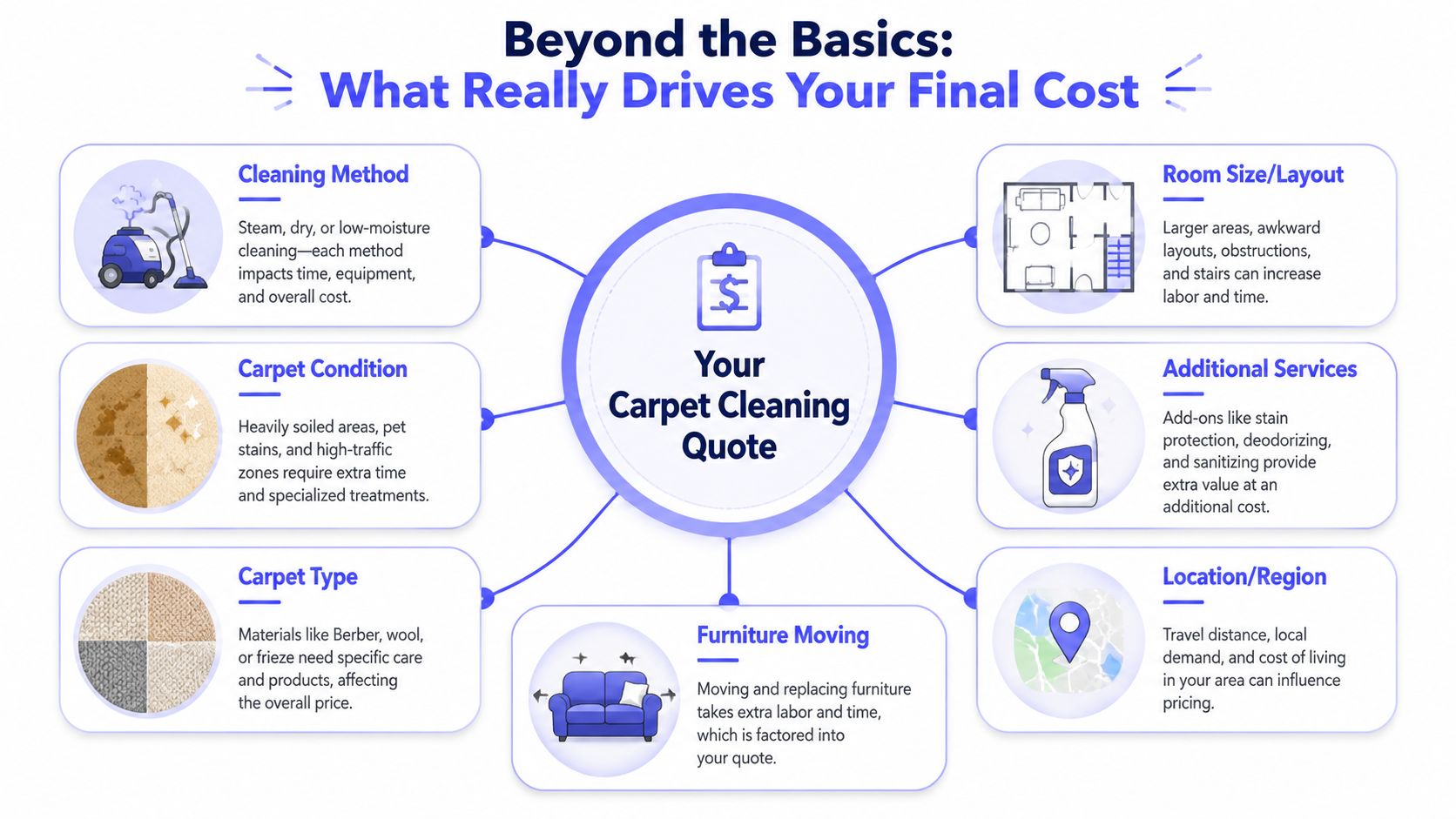
The first thing to pin down is how the company plans to clean the carpet. Hot water extraction, low-moisture cleaning, bonnet cleaning, and specialty fiber methods do not take the same time, use the same products, or leave the same drying timeline.
That matters because a quote is really an estimate of labor, equipment use, and risk. A company cleaning lightly soiled synthetic carpet in an easy-to-reach area can move fast. A company cleaning delicate fibers or heavily used rooms has to slow down, test products more carefully, and spend more time on extraction.
If the estimate does not say which method is included, it is incomplete. That is often where “cheap” quotes turn into add-ons once the crew arrives.
Carpet type and condition matter more than people expect
Material changes the plan. So does wear.
Standard synthetic carpet in decent shape is usually straightforward. Wool, Berber, older carpet, and dense plush styles can require a more careful approach because they respond differently to moisture, agitation, and spotting chemicals. The dirt level also changes the workload. Traffic lanes, neglected rooms, and recurring pet areas usually need extra pre-treatment and slower cleaning passes.
I have seen this mistake more than once. A homeowner compares two prices without noticing that one company priced a maintenance cleaning and the other priced a restoration-level job.
If your carpet has odor, contamination, severe staining, or signs of past water issues, routine cleaning may not be the right category at all. In that case, it makes sense to look at companies that handle carpet and home restoration services instead of basic maintenance only.
Specific treatments are where quotes spread out
A lot of quote confusion starts here. Base cleaning is one line item. Problem-solving is another.
Spot treatment may be included for minor issues, but specialty stain removal, pet odor treatment, deodorizing, and protector application are often separate charges. Some of those add-ons are reasonable. Some are padded. The difference is whether the company explains what the treatment is for, which areas need it, and what result is realistic.
Watch for line items tied to:
- Pet spots and odor treatment beyond normal cleaning
- Heavy traffic lanes that need stronger pre-spray or repeated extraction
- Fabric or stain protector sold as an upgrade after cleaning
- Deodorizer added automatically instead of offered as an option
- Specialized stain work for ink, rust, wine, or other stubborn spots
Clear quotes separate these items before the appointment. Weak quotes keep the language vague and leave the technician to price the actual work on site.
Layout and access can change the quote
Square footage does not tell the whole story. Production speed matters just as much.
An empty condo with wide access and open rooms is faster to clean than a furnished two-story house with tight stairs, fragile decor, and several small carpeted areas broken up by hard flooring. Crews lose time moving furniture, protecting corners, running hoses, and working around obstacles. That labor shows up somewhere in the price.
This is why the most reliable quote is based on specifics. Room count helps. Measurements help more. Photos, fiber type, soil level, stairs, furniture, pet issues, and access details help most.
DIY Carpet Cleaning vs Hiring a Professional
In this situation, people often try to save money and accidentally create more work for themselves.
Where DIY makes sense
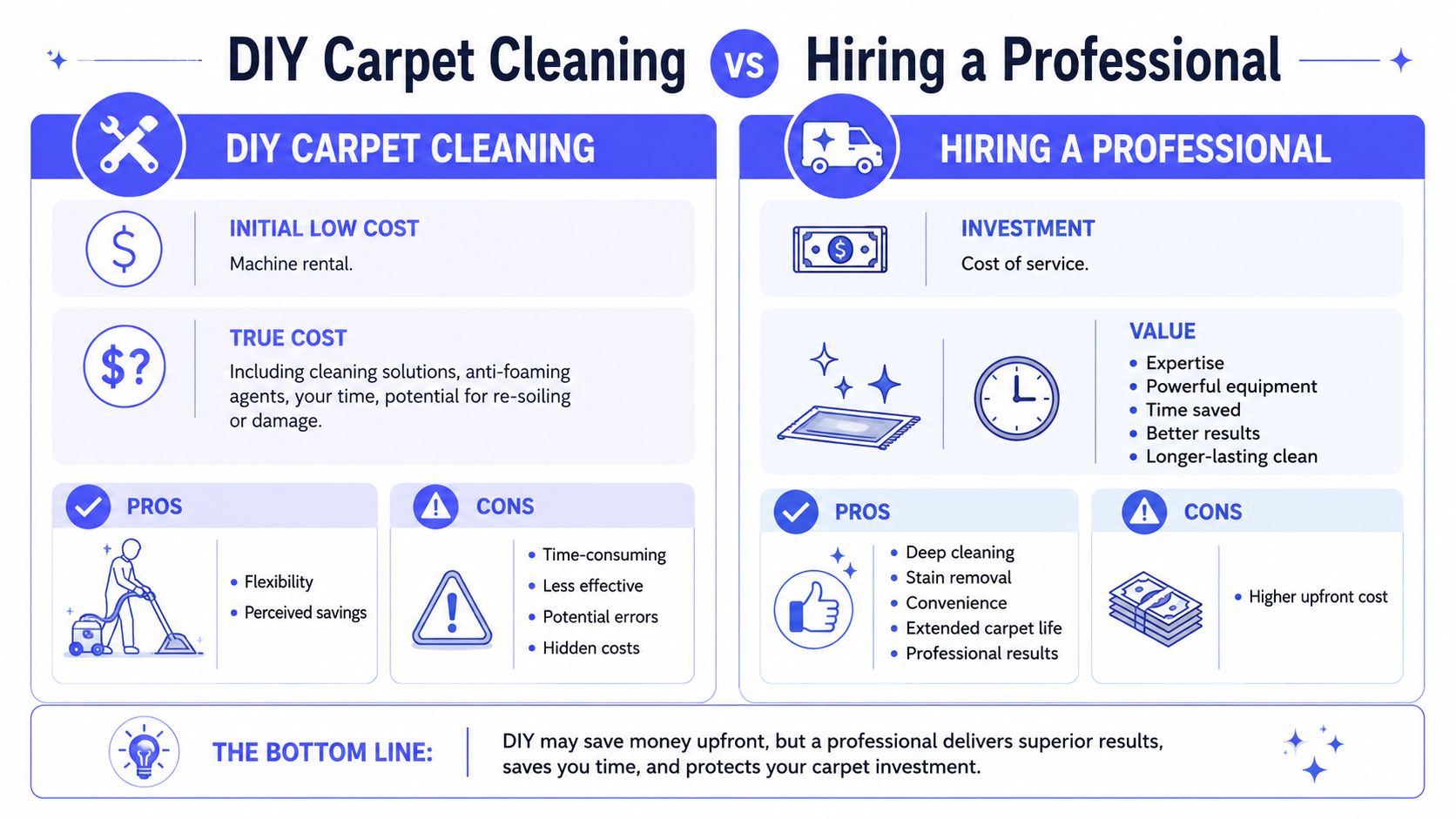
DIY carpet cleaning can work for a light refresh in a small area, especially if the carpet isn't badly soiled and you're mostly trying to improve appearance.
The appeal is obvious. You control the timing, you handle the job on your own schedule, and the upfront cash outlay can feel easier than hiring a company. For a guest room or a touch-up before visitors arrive, that can be enough.
But DIY only works well when expectations are realistic. It's maintenance, not magic.
Where professionals usually earn the price
A professional service is usually the better value when the carpet has real wear, visible stains, odor problems, or a lot of square footage. Better equipment matters. So does knowing how to treat different fibers without over-wetting the carpet or leaving residue behind.
Here's the side-by-side view you need:
| Factor | DIY | Professional |
|---|---|---|
| Upfront cost | Lower at first glance | Higher upfront |
| Time | You do the pickup, setup, cleaning, and cleanup | The crew handles the work |
| Results | Fine for a surface refresh | Better for deeper cleaning and stain treatment |
| Risk | Easy to use too much water or detergent | Lower if the company knows the fiber and method |
| Convenience | Flexible, but labor-intensive | Much easier on large or messy jobs |
If your main goal is “good enough for now,” DIY can be reasonable. If your goal is actually clean carpet, professionals usually win.
Another issue is quote quality. Some people choose DIY because they don't trust service companies, which is understandable. If that's the sticking point, the better move isn't always doing it yourself. It's finding a provider you can screen properly. That's the whole pitch behind services that pre-check businesses for quality, like why people use Handvetted, instead of chasing the cheapest ad they saw first.
How to Get a Carpet Cleaning Quote You Can Trust
You call two companies for the same three-bedroom house. One says $149. Another says $340. Both claim they clean the whole home. That price gap is where people get stuck.
The problem usually is not the carpet. It is the quote.
One company may be pricing a basic pass with minimal spot treatment and strict room size limits. Another may be including pre-spray, heavier stain work, deodorizing, and more technician time. On paper, both can look like "whole-house carpet cleaning." In practice, they are different jobs.
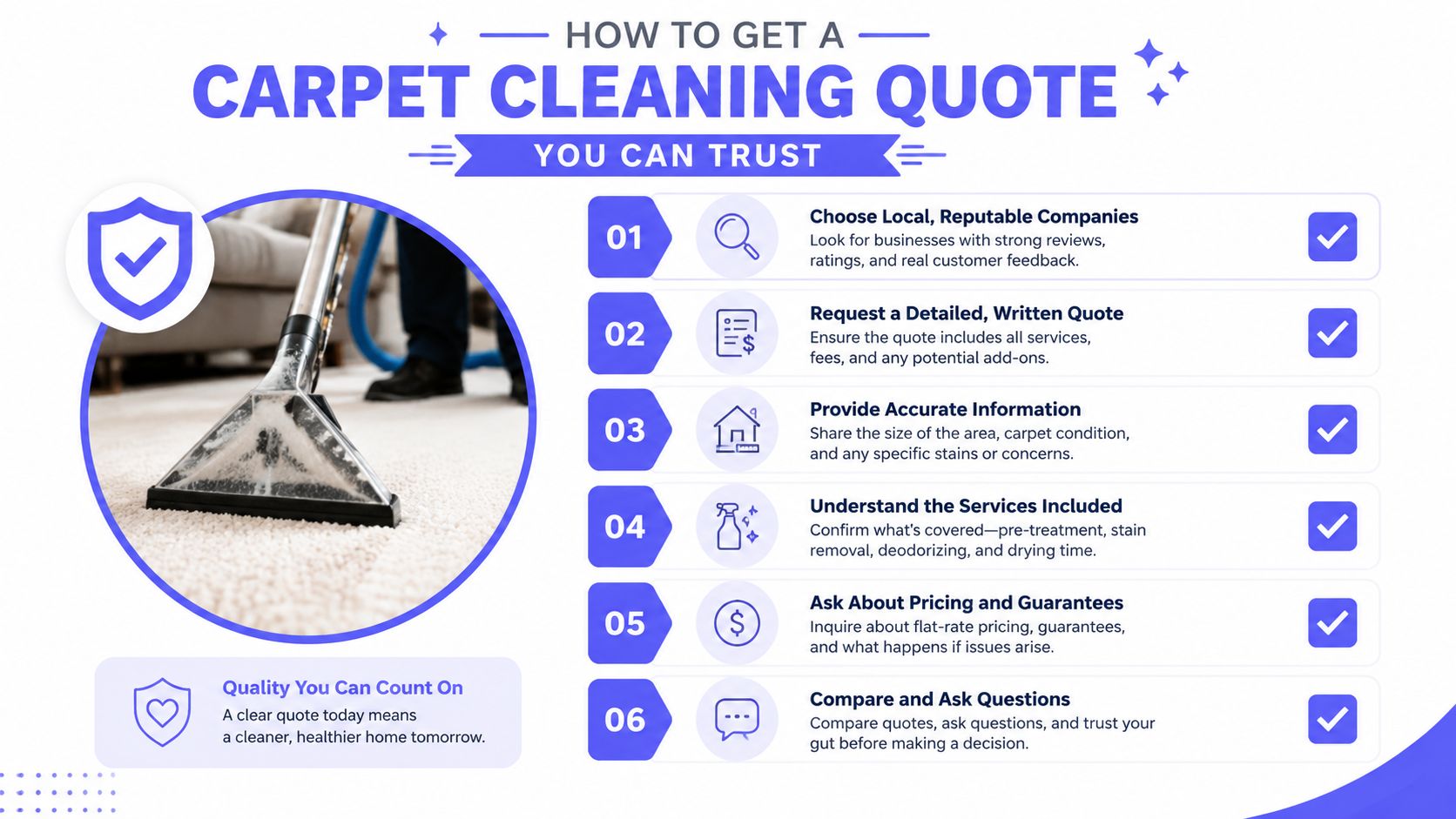
That is why a trustworthy quote needs enough detail to tell you what you are buying before anyone pulls a hose through the front door.
Why the same job gets different quotes
Quote differences usually come from pricing method, scope, and job assumptions.
Some companies price by room. Some price by square foot. Some advertise a low entry number, then add charges for stairs, hallways, pet odor treatment, furniture moving, or heavily soiled areas. Local labor costs and travel also affect the final number, but the bigger issue for homeowners is simpler. Two estimates often describe different levels of service.
I have found that cheap quotes are rarely a problem by themselves. Vague quotes are.
A fair estimate spells out whether it includes pre-treatment, spot cleaning, drying expectations, and any conditions that would trigger extra charges on site. If those details are missing, the number is not reliable yet.
Questions that expose weak quotes fast
Ask these before you book:
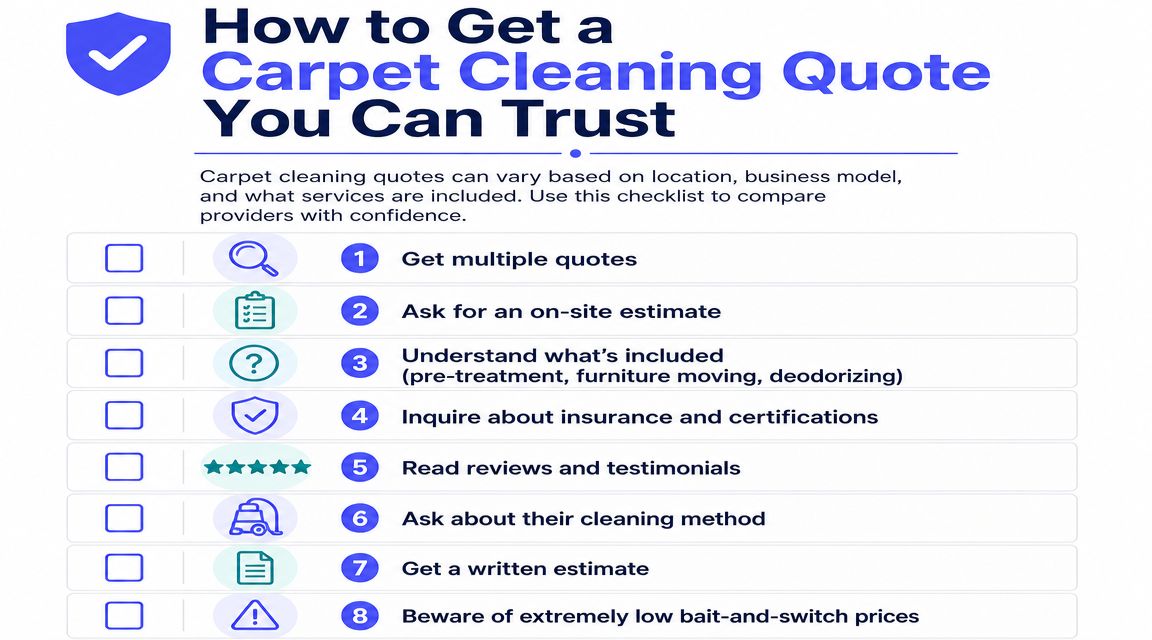
- What is included in the base price? Ask about pre-spray, spot treatment, deodorizing, and whether closets, hallways, or stairs count separately.
- How are you measuring the job? Per room and per square foot pricing can produce very different totals.
- What would raise the price after arrival? Get the list in advance, especially for pet issues, stain treatment, protector application, and furniture moving.
- Which cleaning method are you using? The answer should be clear and specific, not just "our premium process."
- Will you confirm the total before starting work? A good company will review the scope on site and get approval before adding services.
- Can you send the estimate in writing? Text or email is fine. You just need a record of what was promised.
- Are you insured, and what happens if I am unhappy with the result? Good companies answer this without hesitation.
Here is the standard I use after managing rental turns and hiring plenty of home service vendors. If the quote does not name the method, the areas included, the likely add-ons, and the conditions behind the price, it is not ready to trust.
If you want less screening work up front, read how Handvetted matches you with a verified service pro. It narrows the field, which helps. You still need to ask smart questions, but you spend less time sorting through thin quotes and sales-heavy follow-up.
Smart Ways to Save on Professional Carpet Cleaning
Saving money on carpet cleaning isn't about chasing the lowest number. It's about making the job easier to price and easier to complete.
Start with prep. Clear small items off the floor, move fragile decor, and make sure the crew has access to the areas being cleaned. If the company asks you to do light prep, do it. Jobs go smoother when technicians aren't spending the first part of the visit just creating workspace.
Then look for smarter packaging rather than cheaper labor.
- Bundle the work if you have more than one carpeted area that needs service. Whole-home pricing can be more sensible than booking a small job now and another one later.
- Ask whether per-room or square-foot pricing fits your layout better. Big rooms often benefit from one model, chopped-up spaces from another.
- Be honest about stains upfront. Hidden problems don't save money. They just create awkward repricing when the crew arrives.
- Schedule before the carpet gets bad. Maintenance cleaning is usually easier to quote and easier to perform than rescue cleaning.
One more thing. Read the estimate line by line. The best value is the quote that matches the actual work needed, not the quote that looks cheapest before the add-ons appear.
If you want help finding a verified pro without filling out forms for multiple businesses, Hand Vetted Co. is built for that. You get matched with one licensed, background-checked, highly rated professional, and your request isn't shared around like a lead list.
Composed with the Outrank tool