In 2026, the average U.S. home appraisal costs about $359, with most standard assignments falling between $314 and $425. Canadian fees often sit near CAD $400, while major metropolitan areas and complex properties can push well past $600, sometimes exceeding $1,000.
That spread is the answer to the average cost for appraisal. You're usually paying a few hundred dollars for a routine residential valuation, but the final quote depends on the property, location, purpose, loan program, and amount of analysis required. A small conventional refinance and a rural multi-parcel estate may both involve “a home appraisal,” yet they're very different assignments.
Table of Contents
- What the Average Cost for Appraisal Looks Like in 2026
- What Drives Your Appraisal Fee
- Regional Price Ranges From Coast to Coast
- When You Actually Need an Appraisal
- Beyond the Home, Auto, Jewelry, and Specialty Appraisals
- The Appraisal Gap, the Hidden Cost Most People Miss
- Smart Ways to Prepare and Possibly Lower Your Fee
What the Average Cost for Appraisal Looks Like in 2026
A routine U.S. appraisal sits in the mid-hundreds, while a coastal condominium or rural estate can move into four figures. The difference comes from the assignment, not from one universal national price. Property type, loan program, region, and research difficulty shape the quote.
An appraisal is a licensed professional's opinion of a property's value under defined conditions. The appraiser inspects the property, reviews comparable sales, studies the local market, and prepares a report for the lender, buyer, owner, court, insurer, or another intended user.
For standard U.S. single-family work, published benchmarks cluster around the figures described in Redfin's home appraisal cost guide and the NerdWallet appraisal overview. Those figures describe a routine assignment, not a promise that every borrower will receive a similar quote. A refinance on an ordinary home may fit that pattern, while a property with unusual features can sit far outside it.
Canada shows the same distribution. Standard residential appraisals commonly fall around CAD $300 to $500. Toronto can reach CAD $1,500, and Ontario can range from roughly CAD $300 to $1,000, according to BrokerLink's Canadian appraisal guide. A separate Ontario-focused source places professional residential reports at CAD $900 to $2,500 or more, particularly when the assignment requires a regulated or specialized report.
Three quotes that show why averages mislead
| Scenario | Property Type | Loan / Purpose | Typical Fee (USD) |
|---|---|---|---|
| Midwest refinance | Single-family home | Conventional refinance | $314–$425 |
| Coastal purchase | Urban condominium | Purchase financing | $600 or more |
| Rural valuation | Multi-parcel estate | Complex lending or estate review | $1,000 or more |
These examples illustrate the spread, not guaranteed quotes. A familiar home with nearby comparable sales gives the appraiser a shorter research path. A coastal condo may require specialized local knowledge and closer comparison of sales. A rural estate with multiple parcels, unusual improvements, or scarce comparable sales requires more investigation.
The assignment's purpose also changes the work. A lender may need a standardized mortgage report. An estate, divorce, tax appeal, or litigation matter may require more explanation of methods and conclusions. Purchase appraisals support a lender's collateral decision, while refinance work may be replaced by an appraisal waiver for some borrowers.
The fee is a distribution shaped by property type, assignment complexity, location, and loan program. The same address can produce different costs when the intended use or required report changes.
What Drives Your Appraisal Fee
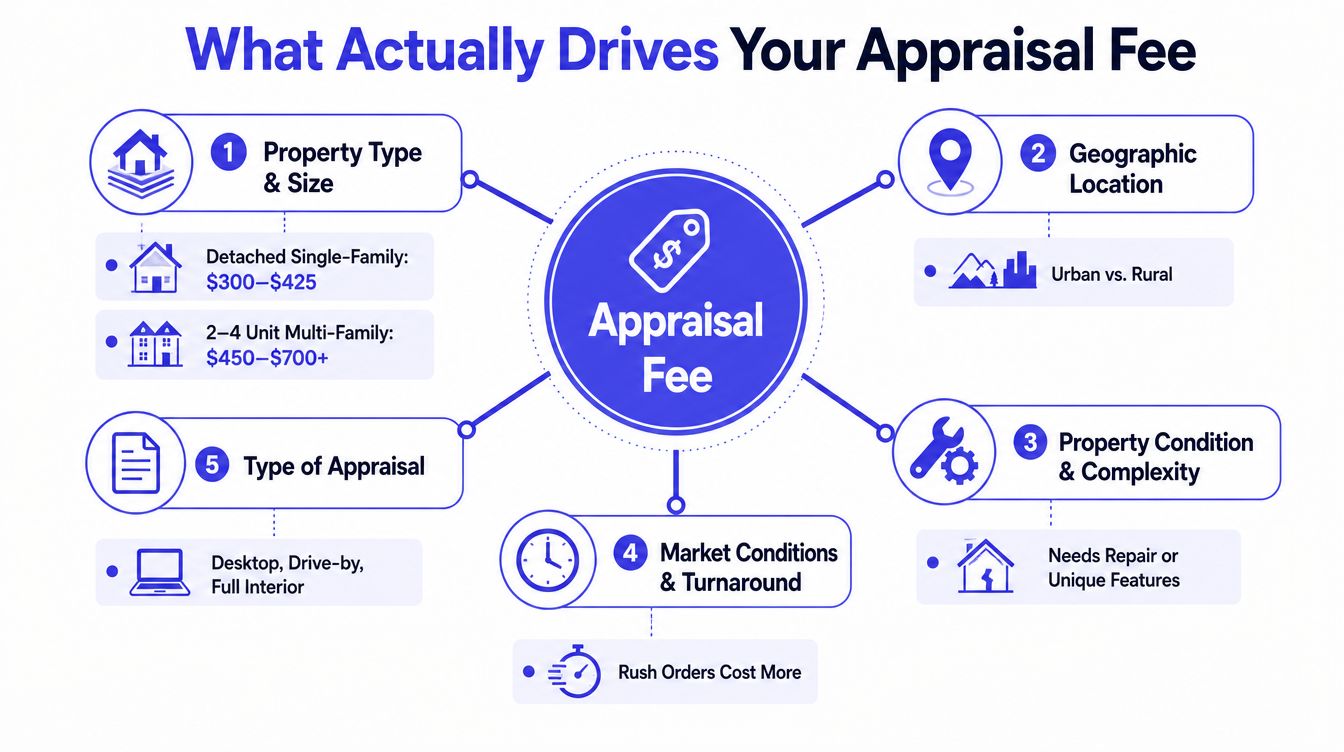
A standard residential appraisal often falls around $300 to $600, while larger or more complicated assignments can reach $1,000 to $2,000, according to Thumbtack's appraisal cost information. Those figures describe a range, not a guaranteed quote. The final fee reflects the property, assignment, location, and loan requirements.
The property itself sets the starting point. A detached single-family home with ordinary construction and nearby comparable sales gives the appraiser a relatively direct research path. A 2-to-4-unit property, acreage, mixed-use building, or unusual structure requires more inspection, documentation, and analysis.
Size adds work, but it is only one part of the calculation. A larger home takes longer to inspect and document. A multifamily property also raises questions about each unit's condition, rental income, expenses, and comparable investment properties. Those extra tasks can push the fee above a routine single-family assignment.
Complexity changes the scope
Unique layouts, non-conforming additions, mixed-use zoning, extensive acreage, and limited comparable sales increase the research burden. A property may look ordinary from the street yet require additional verification when permits, parcel boundaries, or improvements are unclear.
The assignment's purpose changes the report as well. A lender may need a standardized mortgage report, while an estate, divorce, tax appeal, or litigation matter may require fuller explanations of methods, assumptions, and conclusions. The intended audience can therefore affect the fee even when the address remains the same.
Practical rule: Give the appraiser the property's full story before accepting a quote. Unreported details can lead to revisions, more research, or another inspection.
Location and loan program affect pricing
Rural assignments may involve longer travel and fewer nearby comparable sales. Dense metropolitan markets can also cost more because demand, scheduling pressure, and complicated property conditions increase the appraiser's workload. Metropolitan quotes may begin around $600 and exceed $1,000 for larger or more complex homes.
Loan programs can impose different requirements. Conventional, FHA, VA, and USDA assignments may use different forms, addenda, scope expectations, and property eligibility standards. VA appraisals are often priced higher than conventional or refinance assignments, as described in Thumbtack's loan-type comparison.
The lender may order through an appraisal management company, or AMC, instead of letting you choose the appraiser directly. Rush requests, local availability, and AMC panel pricing can change the final amount. Ask what the quote includes before comparing the lowest number with another service.
Regional Price Ranges From Coast to Coast
Geography can rewrite the price of the same basic assignment. A standard home in a market with many qualified appraisers and abundant comparable sales may cost less than a similar home in a high-demand city where travel, scheduling, and analysis take longer.
The national U.S. benchmark remains in the mid-hundreds, with the Redfin data showing an average of $359 and a common homeowner range of $314 to $425. Metropolitan quotes can rise to $600 or more, particularly for larger or more complex properties.
| Region | Typical Range (USD) | Typical Range (CAD) | Cost Driver |
|---|---|---|---|
| U.S. standard markets | $314–$425 | Comparable mid-hundreds band | Routine single-family scope |
| U.S. major metros | $600–$1,000+ | Higher urban pricing | Scarcity and complexity |
| Canada standard markets | Comparable mid-hundreds band | CAD $300–$600 | Standard residential work |
| Toronto and parts of Ontario | Higher than standard | Up to CAD $1,500, with some Ontario reports at CAD $900–$2,500+ | Urban demand and regulated reports |
A national U.S. average is useful for a first estimate, but it won't tell you what a specific appraiser in San Francisco, Seattle, Boston, or New York will charge. Major urban markets can carry higher fees because appraisers manage dense neighborhoods, expensive properties, unusual building types, and demanding lender schedules. Canadian markets such as Vancouver can show similar pressure.
Lower-fee markets such as Cleveland, Indianapolis, and Winnipeg may offer more accessible pricing for routine assignments, but the property still controls the final scope. A rural home with few comparable sales can cost more than an ordinary city property even if the surrounding market is less expensive.
The underlying mechanics are practical: appraiser supply, travel distance, comparable-sale availability, local operating costs, and assignment complexity. An AMC quote may also differ from a direct private appraiser quote because the lender requires a specific channel, report format, quality review, and panel process.
Don't confuse appraisal pricing with other property services. A residential land survey cost guide can help you separate valuation work from boundary, improvement-location, and title-related surveying.
When You Actually Need an Appraisal
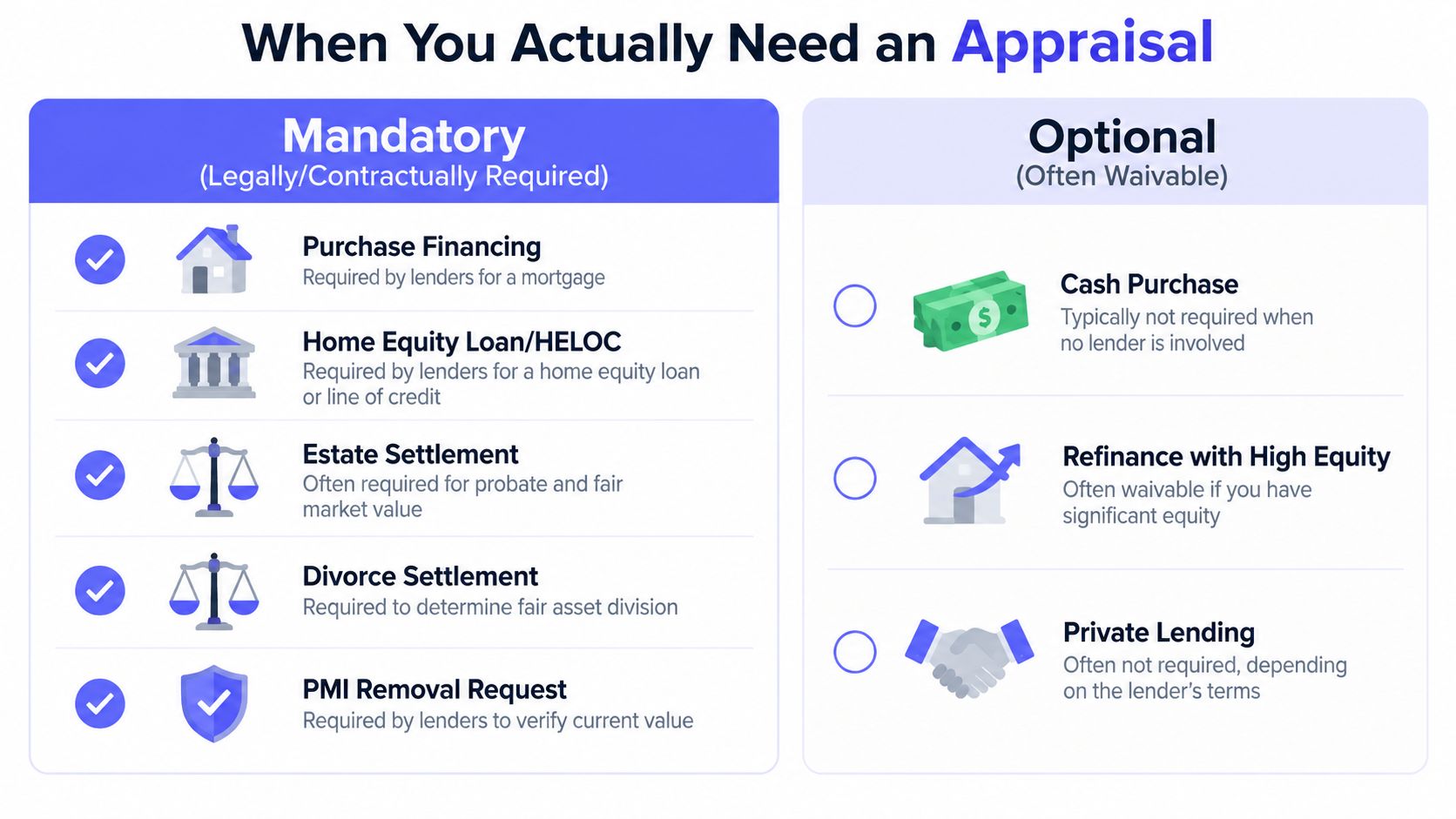
The lender usually decides whether an appraisal is required for a mortgage transaction. Purchase financing commonly triggers one because the lender needs independent support for the property's collateral value before approving the loan.
Refinancing can also require an appraisal, especially when the lender needs to verify equity or calculate loan-to-value risk. Home equity loans and HELOCs may require a valuation, although the lender could use another approved method depending on the property and program.
Situations that commonly trigger a valuation
- Purchase financing: The lender may require a licensed appraisal before closing.
- FHA, VA, and USDA loans: These programs have their own property and appraisal requirements, and borrowers shouldn't assume a conventional waiver applies.
- Estate and probate work: Executors may need a defensible value for administration, reporting, or distribution.
- Divorce proceedings: A neutral valuation can help establish an equitable division of property.
- Tax appeals: An appraisal may support a challenge to an assessed value.
- PMI removal: A lender may request evidence of current value before recalculating mortgage insurance.
- Portfolio lending: A bank holding its own loans may require a fresh risk review.
- High loan-to-value refinances: The lender may need updated collateral evidence even when the borrower has an existing appraisal.
The exact rule depends on the lender, loan program, transaction terms, and intended use. The mortgage refinance process can involve an appraisal, an automated valuation, or a waiver, so ask the lender before ordering anything yourself.
Cases where an appraisal may be optional
Cash buyers often choose whether to order an appraisal. A refinance with substantial equity may qualify for a waiver, and a lender may accept a recent appraisal within its permitted reuse window. Private lenders may request a valuation, but their standards can differ from those of a federally connected mortgage lender.
Use this decision rule: If a lender, court, tax authority, insurer, or estate process needs an independent value, assume an appraisal may be required. If no outside party requires it, ask whether a waiver, desktop valuation, or other method is acceptable before paying for a full inspection.
Beyond the Home, Auto, Jewelry, and Specialty Appraisals
The phrase “appraisal” covers several different services. The price depends on the asset, documentation, inspection, report purpose, and level of professional review.
Consider a classic car. A written market valuation may cost roughly $75 to $250, while a formal insurance or agreed-value report with an on-site inspection may run $350 to $600, based on the specialty comparison in the brief. The more formal report usually requires the specialist to verify condition, equipment, authenticity, and comparable market evidence.
A jewelry appraisal follows a different model. Documentation for a 2-carat diamond engagement ring may cost $150 to $300 when prepared by a credentialed GIA or ASA professional. Insurance replacement documentation may focus on replacement value, while an estate or resale valuation may use a different basis.
Fine art and antiques require still more judgment. A mid-range oil painting may cost $250 to $600 to appraise, while a high-value estate collection can cross $1,500, because the specialist may need to review provenance, condition, authenticity, artist history, and multiple pieces.
| Asset Type | Typical Fee Range | Turnaround | Common Use |
|---|---|---|---|
| Classic car | $75–$250 written valuation, or $350–$600 formal inspection report | Depends on inspection and report scope | Insurance or agreed value |
| Diamond jewelry | $150–$300 | Depends on documentation and examination | Insurance, estate, or records |
| Oil painting | $250–$600 | Depends on research and provenance | Insurance, sale, estate, or tax documentation |
| High-value estate collection | $1,500+ | Often requires broader research | Estate settlement and specialized reporting |
The payer also depends on the purpose. A lender usually charges the borrower, an insurer may require documentation from the policyholder, and an estate may pay from estate assets. Tax treatment depends on the transaction and applicable professional advice, so don't assume every appraisal fee is deductible.
The Appraisal Gap, the Hidden Cost Most People Miss
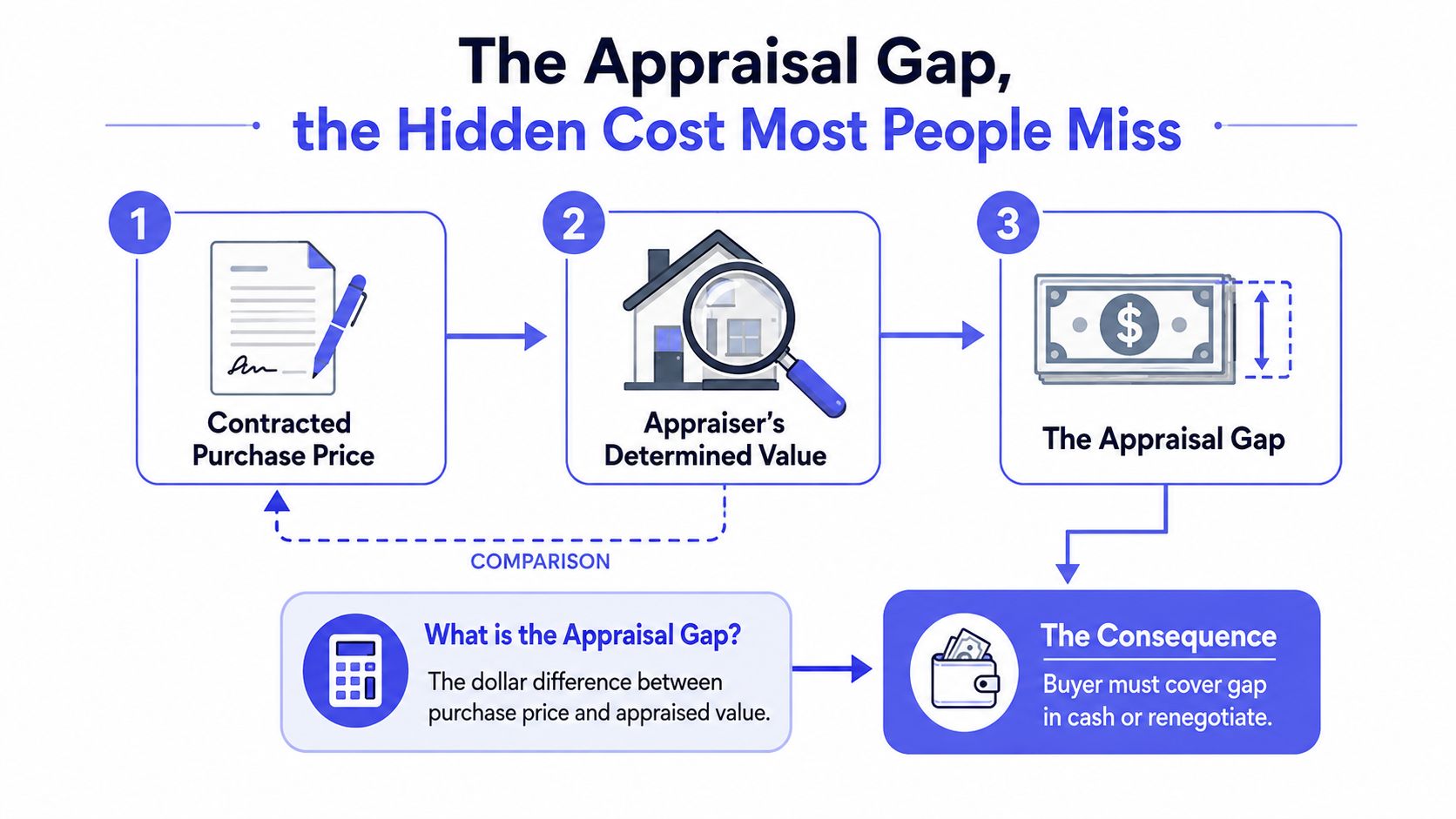
The appraisal fee is often the smaller financial issue. An appraisal gap is the difference between the purchase price in the contract and the appraised value accepted by the lender.
For example, a contract price of $525,000 and an appraised value of $500,000 create a $25,000 gap. The lender may base financing on the lower value, leaving the buyer to renegotiate, bring additional cash, split the difference with the seller, or walk away if the contract permits.
Market commentary summarized by the Colorado Division of Real Estate says some agents suggest capping appraisal-gap coverage at 3% to 5% of the purchase price. That isn't a universal rule, but it shows why the appraisal itself shouldn't be treated as the main risk.
Clauses that change your exposure
An appraisal contingency can give the buyer a path to renegotiate or cancel if the value comes in low. Waiving that contingency can make an offer more competitive, but it may leave the buyer responsible for a shortfall.
An appraisal-gap clause can promise that the buyer will cover some or all of the difference. Read the wording carefully. A clause may cap the buyer's contribution, specify whether the parties renegotiate first, or require the buyer to proceed regardless of the valuation.
Before waiving protection, ask: What value will the lender use, how much cash can you bring, can the seller reduce the price, and what happens if the appraiser identifies repairs or property issues?
A few-hundred-dollar appraisal can therefore lead to a much larger cash decision. Review the contingency with your real estate attorney or agent before signing, especially in a competitive offer situation.
Smart Ways to Prepare and Possibly Lower Your Fee
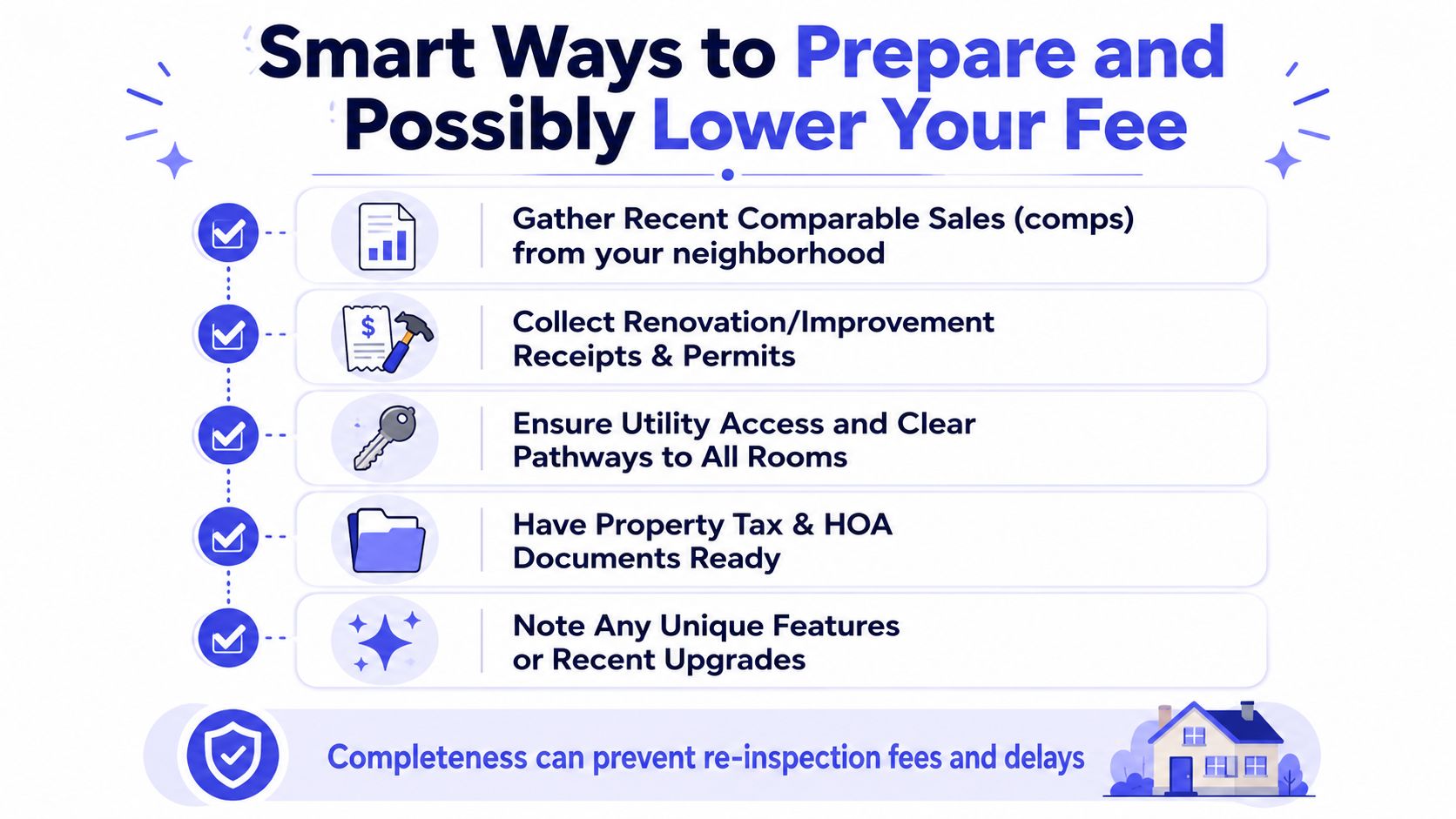
Preparation won't change the appraiser's independent conclusion, but it can make the assignment easier to scope and complete. Start with a clean property packet.
- Gather comparable sales: Provide recent nearby sales you believe resemble the property, but let the appraiser decide which comparisons are appropriate.
- Collect improvement records: Include permits, invoices, plans, and dates for major renovations.
- Clear access: Make every room, utility area, garage, attic, and exterior feature accessible.
- Organize property documents: Have tax records, HOA materials, leases, and parcel information ready when relevant.
- List unusual features: Flag additions, outbuildings, energy systems, accessibility improvements, and recent upgrades.
Photos can help specialists quote a non-real-estate assignment more accurately. For a classic car, jewelry item, or artwork, send clear images, serial numbers, receipts, provenance records, and condition details before requesting a fee.
Ask the lender whether a desktop or hybrid appraisal is permitted. Those options may cost less than a full interior inspection when the assignment and lender rules allow them, but the lender, not the borrower, generally determines eligibility.
You can also ask whether the appraisal management company will review its panel for a lower-cost qualified appraiser. If you're arranging a private appraisal, compare quotes from licensed professionals who handle the same property type and report purpose. A low quote isn't useful if it excludes the inspection, required addenda, travel, or lender review.
Use project-scoping questions to clarify the assignment before booking. The most useful next step is simple: ask your lender for the AMC fee schedule, then confirm the property type and loan program before anyone orders the appraisal.
If your appraisal connects to a refinance, HELOC, renovation, or another home project, Hand Vetted Co. can match you with one exclusive, licensed, background-checked professional with strong customer ratings. Visit Hand Vetted Co. to request a verified match instead of sorting through multiple unverified providers.