You've paid the deposit, the kitchen is gutted to the studs, and the contractor who promised daily updates has stopped answering. The work is stalled, your schedule is disrupted, and you're left wondering whether the next message will bring an explanation, another invoice, or nothing at all.
That's why how to find a reputable contractor isn't a matter of picking the nicest website or the lowest bid. It's a verification process. You need to confirm credentials, test communication, compare scopes, and preserve your negotiating position in the contract. The checks below are designed to catch trouble before it reaches your property or your bank account.
Table of Contents
- Why Finding a Reputable Contractor Feels Harder Than It Should
- Run a Five-Part Verification Gate Before You Talk Price
- Compare Written Bids Line by Line, Not Just by Total
- Interview Questions That Reveal How a Pro Works
- Red Flags Worth Walking Away From
- Contracts and Payment Schedules That Keep You Protected
- When a Matching Service Fits Into the Process
Why Finding a Reputable Contractor Feels Harder Than It Should
Contractor selection is difficult because the information you need is scattered. Licensing rules differ by state and municipality. Insurance documents can be outdated or altered. Review platforms show useful customer feedback, but they don't all verify reviewers or present complaint history in the same way.
The financial risk is real. The Federal Trade Commission has received 109,000 reported home-improvement scam cases since 2007, with estimated losses of $206.9 million over that period, according to this home-improvement scam trends report. That same analysis identified Nebraska and Minnesota among the states with some of the highest average losses per scam, while Colorado had one of the highest reported scam rates at six scams per 10,000 homeowners per year.
The cost isn't only the money you lose. A bad hire can consume weeks through missed appointments, incomplete work, repeated explanations, failed inspections, and arguments over what the original price included. A legitimate business can still encounter delays or uncover hidden damage, but it should explain the problem, document the change, and give you a clear path forward.
Practical rule: Treat contractor selection as risk management, not price shopping.
Regulatory records reinforce that approach. California's Contractors State License Board reported that 53% of complaints were contractor- or business-related, including unlicensed status, contract terms, and misrepresentation, while about 27% were workmanship-based, as shown in its enforcement committee packet. Credentials won't guarantee perfect work, but missing credentials tell you to stop before you sign.
The process that follows uses a five-part verification gate, line-item bid comparisons, pressure-test interview questions, stage-specific red flags, and contract terms that protect your money. That structure turns a hopeful search into a defensible hiring decision.
Run a Five-Part Verification Gate Before You Talk Price
Don't ask for a discount before you know whether the business is qualified to perform the work. Run these checks in order, and keep copies of what you find.
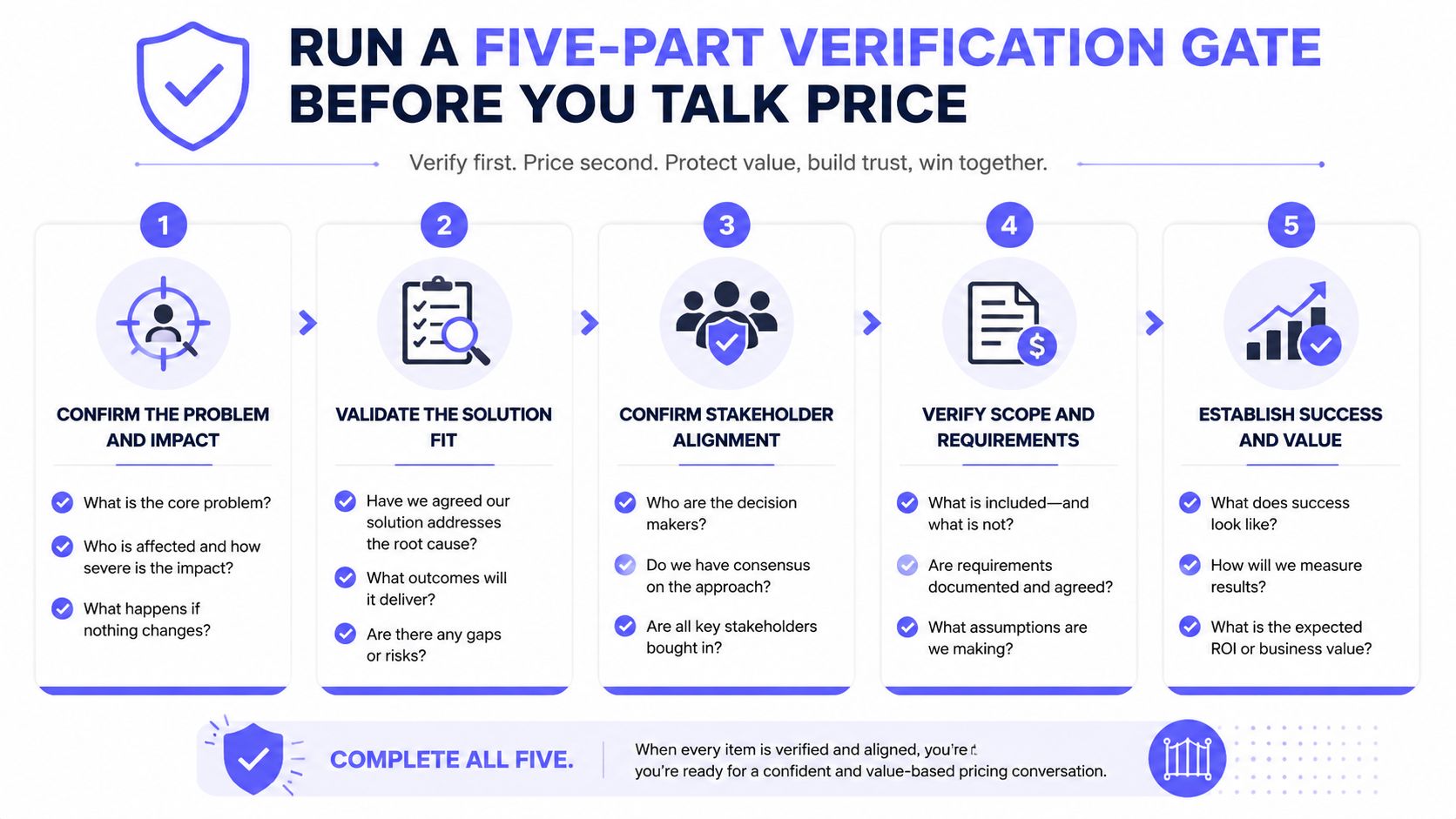
Start with the official license registry
Search the state contractor licensing board yourself. Don't rely on a license number printed on a truck, estimate, or website.
Confirm that the license is active and paid to date, matches the legal business name, covers your project type, and shows no restriction that would prevent the proposed work. Read any complaint disclosure, disciplinary history, or enforcement information available. California's lookup system, for example, can surface complaint disclosure, while Washington's contractor verification tool lets consumers check registration status and whether a workers' compensation account is active and paid to date.
California requires contractors performing work costing $1,000 or more in labor and materials to be licensed, according to the Washington hiring guide, which also recommends checking license history, lawsuits, and violations.
Confirm the business entity
Search the Secretary of State or equivalent corporate registry. The contractor's legal entity should exist and align with the name on the license, insurance certificate, estimate, and proposed contract.
A mismatch isn't automatically fraud. Businesses sometimes operate under a trade name. But the contractor should explain the relationship clearly and put the correct legal entity in the agreement. If nobody can tell you who you're contracting with, walk away.
Validate insurance with the carrier
Request a current certificate of insurance for general liability and workers' compensation. Then call the insurance carrier using contact information you locate independently, not only the number on a document the contractor supplied.
Ask whether the policy is active, whether the named business matches the company hiring you, and whether coverage applies during your project. A PDF or photograph proves only that someone sent you a document. It doesn't prove current coverage.
Check review patterns across platforms
Look for the same company name, phone number, service area, and project description across Google, the Better Business Bureau, Houzz, or Angi. Read recent reviews and complaints, including the negative ones. You're looking for consistency in communication, scheduling, workmanship, cleanup, and problem resolution.
A polished profile with different business names, recycled project photos, or inconsistent locations deserves extra scrutiny. Newer consumer guidance also recommends cross-platform consistency and reverse-image checks because forged portfolios and AI-generated listings can imitate legitimacy, as outlined in the Federal Trade Commission's scam guidance.
Call recent, relevant references
Ask for at least two to three recent references, ideally from projects similar to yours. Confirm that the references are real people at real addresses, not generic testimonials or shell websites. Ask how the contractor handled delays, change orders, cleanup, communication, and the final punch list.
AARP recommends requesting references from the last three jobs completed within the last three months, comparing bids that should usually fall within 5 to 10 percent of one another, and reading the contract carefully in its home-improvement scam guide. Those references should be requested before price becomes the main topic.
For another structured screening option, review Handvetted's contractor background check process. A matching service can narrow the field, but you still need to verify the documents and speak with references yourself.
Compare Written Bids Line by Line, Not Just by Total
Three bids can show the same total while describing three different projects. One contractor may exclude permits and disposal. Another may include mid-range fixtures but use subcontracted labor without disclosing the markup. A third may bundle everything and add a 22 percent overhead line. A 22 percent overhead line isn't unreasonable when it's transparent. Make sure every bidder breaks it out so you can compare.
Compare totals only after the scopes match. Alberta's consumer guide recommends written estimates that identify the work description, materials, project dates, itemized costs, total price, guarantees, and payment method. Manitoba's guidance also calls for dated estimates specifying labor, deposit, insurance, and warranty coverage, as summarized in this consumer estimate guide.
Judge the difference between bids by scope, not price alone. If the scopes match, a moderate gap can be reasonable. A dramatically lower bid usually signals an omission, an underpriced item, or vague wording. Require clarification before treating it as a bargain.
Normalize every estimate
Use a comparison sheet. Memory will miss the small exclusions that become expensive later.
| Line Item | Contractor A | Contractor B | Contractor C |
|---|---|---|---|
| Labor | Included or itemized | Included or itemized | Included or itemized |
| Materials and allowances | Brand, model, or allowance stated | Brand, model, or allowance stated | Brand, model, or allowance stated |
| Permits | Included or excluded | Included or excluded | Included or excluded |
| Preparation and protection | Detailed scope | Detailed scope | Detailed scope |
| Disposal and cleanup | Included or excluded | Included or excluded | Included or excluded |
| Timeline and milestones | Dates provided | Dates provided | Dates provided |
| Payment schedule | Draws and conditions stated | Draws and conditions stated | Draws and conditions stated |
| Change-order pricing | Process and markup stated | Process and markup stated | Process and markup stated |
Ask every bidder to revise unclear categories before comparing totals. “Complete bathroom remodel” is not a scope. It leaves questions about demolition, waterproofing, permits, fixtures, painting, ventilation, disposal, and final cleaning.
The contractor who answers clearly may not be the cheapest. Choose the bid that defines the work, identifies exclusions, and gives you a result you can compare in writing.
Interview Questions That Reveal How a Pro Works
An interview exposes the gap between a polished sales pitch and an operating business. Ask each finalist the same questions, then compare how specific, consistent, and accountable the answers are. Use this contractor interview question guide to prepare, but judge the responses yourself.
Ask who will do the work
You: “Who will be on site, and who supervises the crew?”
Weak answer: “Our team handles everything.”
Stronger answer: “I'll manage the project, our named site supervisor will be there during production, and identified subcontractors will handle electrical and plumbing. I'll provide their business details and confirm their licensing and insurance.”
Listen for names, roles, and a clear chain of responsibility. If the person selling the job cannot explain who controls the work, confusion is likely once construction begins. Ask who performs the work on site, who approves decisions, and who communicates with you each day.
Make the schedule concrete
You: “Walk me through the schedule. What start date are you proposing, and what could move it?”
Weak answer: “We're pretty flexible and should be done quickly.”
Stronger answer: “We're proposing a start date after permits are issued. Demolition comes first, followed by rough-in inspections, close-in work, finishes, and a punch list. Material availability and inspection timing are the main variables, and I'll notify you in writing if either changes.”
A useful answer names the start date, work sequence, dependencies, and communication process. Vague speed claims tell you nothing about planning.
Test change-order discipline
You: “What happens if we discover hidden damage or I want to change a fixture?”
Weak answer: “We'll figure it out as we go.”
Stronger answer: “We'll document the issue, price the labor and materials, explain the schedule impact, and get your written approval before proceeding.”
A verbal promise is not a change-order system. Require the process in the contract, including how pricing, approvals, and schedule changes will be documented.
Get warranty terms in months
You: “How long is your workmanship warranty, what does it cover, and how quickly do you respond?”
Weak answer: “We stand behind our work.”
Stronger answer: “The written warranty states the coverage period, exclusions, claim process, and response timeframe.”
Ask what falls under the contractor's workmanship warranty and what falls under a manufacturer's product warranty. If the answer stays broad, request the written terms before signing.
Ask about a failure
You: “Tell me about the last job that went sideways. What did you do?”
Weak answer: “Nothing like that has happened.”
Stronger answer: “A material arrived damaged, so we notified the client, reordered it, adjusted the sequence, and documented the schedule effect. We changed our receiving process afterward.”
Every working business encounters problems. Evaluate ownership, communication, and correction. Deflection matters more than a polished success story.
Ask two follow-ups: “Which part of this project is least similar to your usual work?” and “What would a recent client say you need to improve?” Then ask:
“What will you do personally if the project falls behind?”
The answer should identify a concrete action, not another promise. A contractor who explains responsibility, documentation, and recovery steps is giving you evidence about how the project will run.
Red Flags Worth Walking Away From
Warning signs appear in stages. Catching them early saves you from having to enforce protections later.
During the first inquiry
Walk away from a professional who refuses to provide a license number, insurance certificate, or written estimate. Same-day pressure is another bad sign, especially if the contractor claims a temporary discount, a leftover-material opportunity, or an urgent problem that you can't independently confirm.
A bid prepared without a site visit may be appropriate for a narrowly defined repair, but it's dangerous for work involving hidden conditions, structural changes, multiple trades, or permits. If the contractor hasn't inspected the conditions, the estimate may be guesswork.
During project scoping
Vague phrases create expensive arguments. “High quality,” “standard materials,” and “complete installation” need specific definitions, including brands, models, allowances, preparation, cleanup, and exclusions.
Be cautious with cash or wire-only payment requests, large upfront deposits above local norms, and anyone unwilling to identify subcontractors. The FTC's Consumer Sentinel data, as reported in a 2026 news summary, logged 81,925 home-improvement scam reports in 2024, reinforcing why payment pressure and missing documentation deserve immediate attention, as described in this consumer-safety report.
After signing
Material substitutions should require your approval, not appear as a surprise. Schedule drift should come with notice, a reason, and a revised plan. A contractor who demands final payment before the punch list is complete is trying to remove your influence before the job is finished.
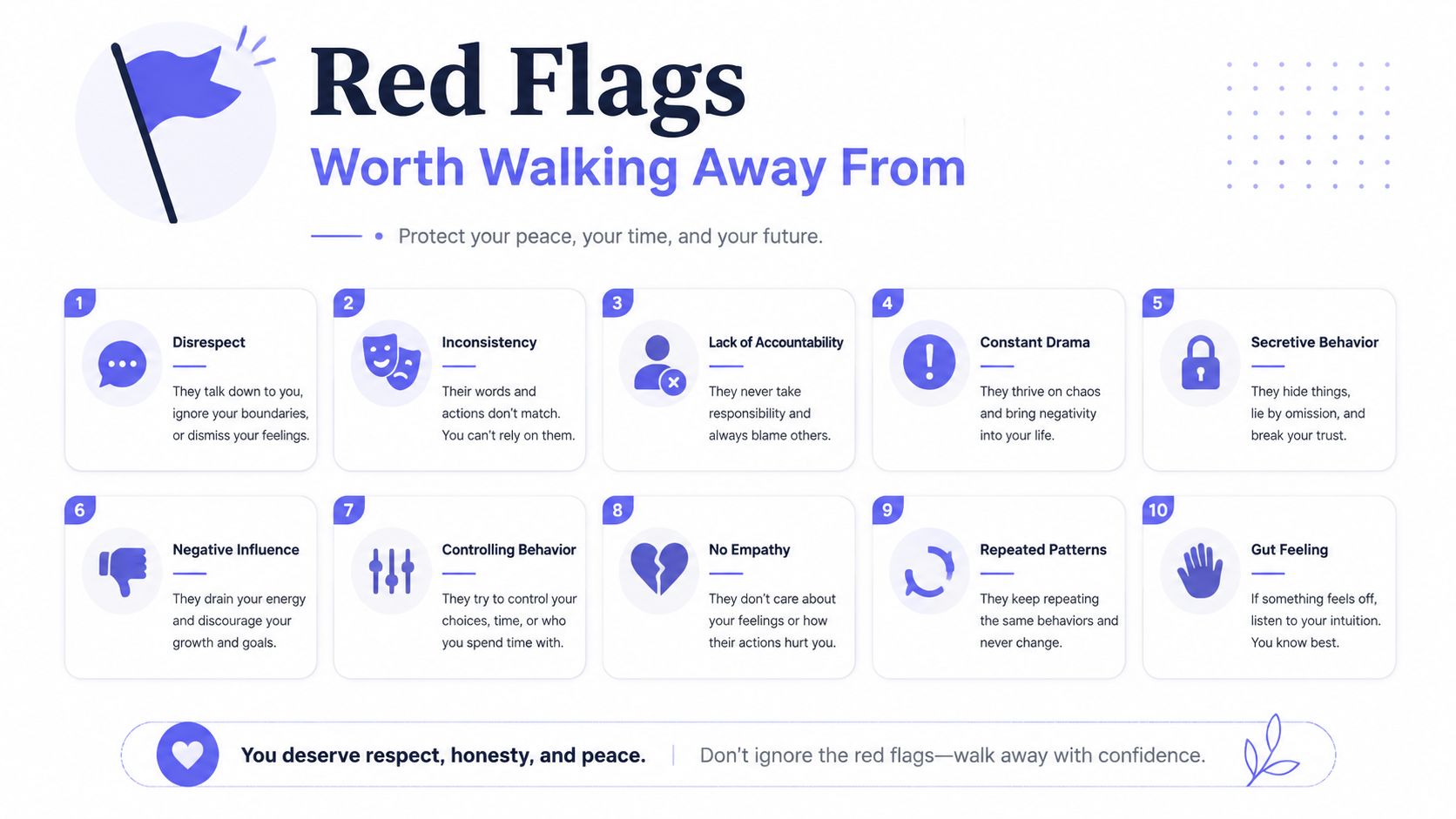
Two triggers should end the relationship regardless of the explanation:
- Permit manipulation: The contractor asks you to pull permits under their license or misrepresents who is performing the work.
- Reference failure: The contractor cannot produce a recent, relevant reference you can contact.
Pennsylvania requires registration numbers to appear in contracts, estimates, proposals, and advertisements, and requires contracts to include items such as approximate start and completion dates, work descriptions, materials, and the total sales price or a written time-and-materials provision, according to this consumer protection information sheet. Missing required paperwork isn't a minor administrative issue. It's evidence that the business may not operate with the discipline your project needs.
Contracts and Payment Schedules That Keep You Protected
A contract should make the project boring to administer. If the agreement leaves room for competing interpretations, you'll pay for that ambiguity later.
Before signing, confirm that it identifies the legal parties, contractor license numbers, exact scope, materials, allowances, exclusions, pricing method, start date, substantial completion date, and permit responsibility. The price should be fixed where possible. If the agreement uses unit pricing or time and materials, it should define the rates, markup, measurement method, and approval process.
Clauses that preserve leverage
Insist on written change orders that state the added or removed work, price adjustment, and schedule impact. Include lien waivers tied to each progress payment, and require the contractor to provide the documents needed to confirm that subcontractors and suppliers have been paid.
Your agreement should also address:
- Insurance: Current certificates, with any additional-insured language your attorney or insurer recommends.
- Warranty: Coverage period, exclusions, claim procedure, and response timeframe.
- Disputes: Mediation, attorney-fee provisions, venue, and escalation steps.
- Termination: A termination-for-cause provision covering abandonment, material breach, nonperformance, or failure to maintain required credentials.
- Completion: Punch-list procedure, final inspection, cleanup, closeout documents, and final payment conditions.
For more detail on documentation, review Handvetted's contractor insurance requirements. Use the information as a screening aid, not as a substitute for local legal or insurance advice.
Tie payments to verified progress
Never pay in full before the work is complete and the required lien waivers are in hand. A practical schedule ties each draw to a visible, documented milestone rather than to a calendar date or a contractor's cash-flow needs.
| Contract Clause | What It Protects | Healthy Payment Schedule | What It Funds |
|---|---|---|---|
| Exact scope and allowances | Prevents disputes over inclusions | Initial draw only after signed agreement and required pre-work documentation | Mobilization and approved material ordering |
| Milestone schedule | Ties money to completed work | Progress draw after each verified stage | Completed labor and installed materials |
| Written change orders | Prevents unauthorized cost increases | Separate payment only after written approval and completed change | Approved additional work |
| Lien waivers | Reduces lien exposure | Waiver collected with each progress payment | Payment to labor and suppliers |
| Punch-list and warranty terms | Preserves completion leverage | Retainage held until punch list and closeout are complete | Final correction and project closeout |
Read every page before signing. Don't accept a contractor's promise that “the standard contract covers it.” If a clause matters to your money, your property, or your exit rights, put it in writing.
When a Matching Service Fits Into the Process
Self-vetting makes sense for a simple job, a trusted referral, or a project where you have time to research several businesses. Use a different approach when the work is urgent, technically complex, or unfamiliar. A focused starting list can save time, but it does not remove your responsibility to verify the contractor.
A matching service should narrow the search using your project type, location, budget, timing, and required license category. Reject any service that forwards the first available business and labels it a match.
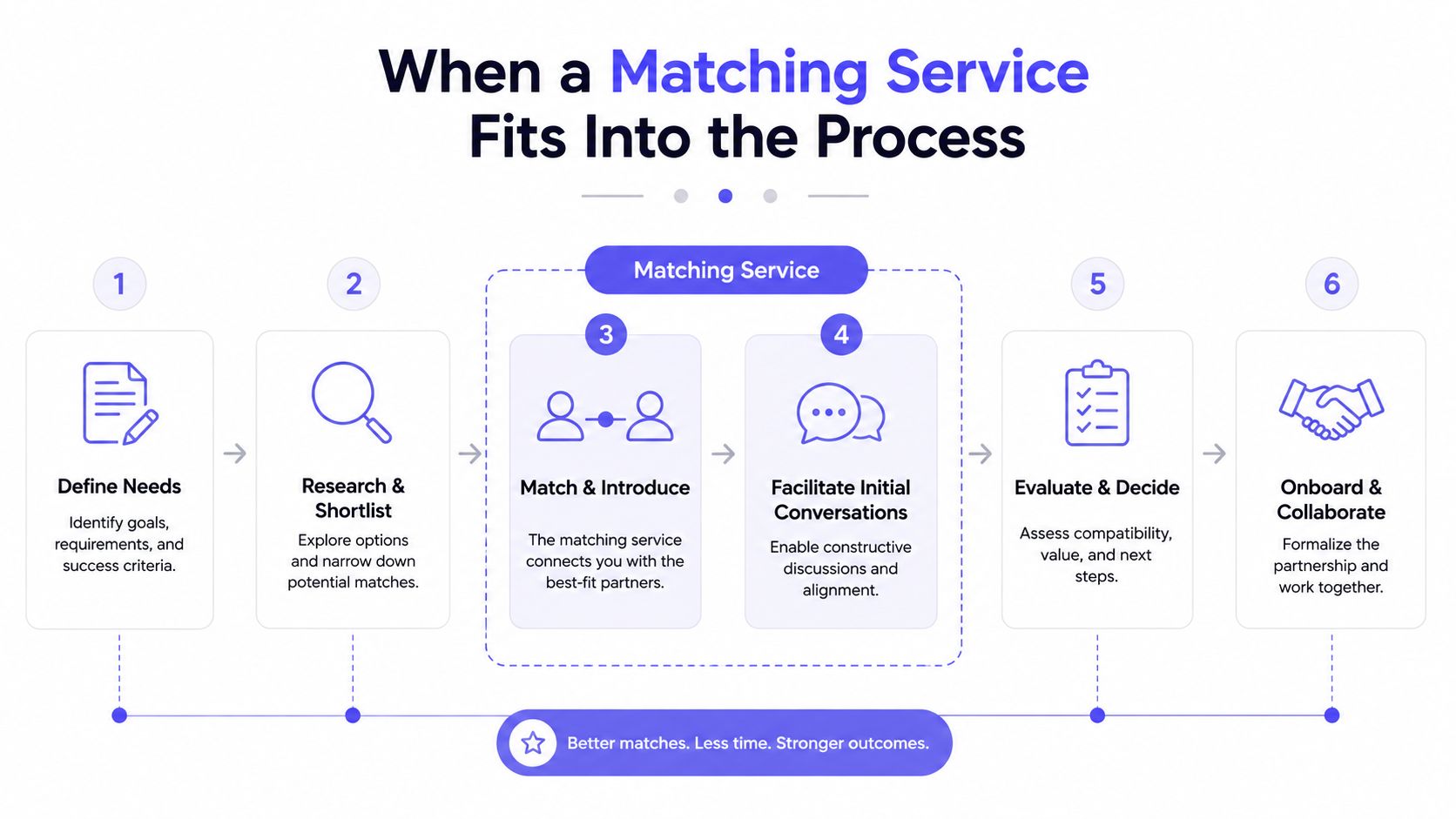
Use this workflow:
- Submit project details: Describe the work, location, timing, and budget.
- Review matched candidates: Ask why each professional fits the stated scope.
- Verify credentials: Check the official license registry, insurance, entity registration, complaints, and references.
- Interview the professional: Ask about staffing, scheduling, warranties, and problem solving.
- Compare written bids: Normalize the scopes before comparing totals.
- Sign only after verification: Complete the contract and payment schedule before work begins.
Hand Vetted Co. is one example of this model. It connects a person with one licensed, background-checked, 4.5+ star rated professional, and each match is exclusive rather than shared with multiple businesses. That can make the first search more focused. Treat the match as a candidate, not an endorsement. Independently confirm licensing, insurance, references, written pricing, and contract terms.
Do not outsource your judgment along with the search. A matching service can help identify a candidate. It cannot inspect the site, approve the scope, or sign the agreement for you.
Gather your project details, invite two or three qualified candidates, and keep verification records in one folder. If you prefer a focused starting point to an unfiltered list of names, visit Hand Vetted Co. to submit your project and receive one exclusive match with a verified professional. Run the license, insurance, reference, bid, and contract checks yourself before hiring.