You've received a contractor's total price, but you still don't know what it covers, when payments are due, or how much the final bill could change if someone discovers damaged framing, outdated wiring, or a permitting issue. A single number may look clean, yet it rarely gives you enough control to approve work confidently.
The right project budget example depends on the job. A simple line-item sheet may work for a smaller roof replacement, while a kitchen renovation or water-damage restoration project needs phases, trade details, risk reserves, and cash-flow tracking. The seven formats below show how to adapt your budget to the work, with practical examples for roofing, HVAC, remodeling, and restoration.
Renovation budgets commonly cluster in the five-figure range. The 2024 U.S. Houzz & Home Study reported that median renovation spend rose from $15,000 in 2020 to $24,000 in 2023, while the top 90th percentile increased from $85,000 to $150,000. A useful budget must show more than the total. It should explain scope, trade costs, contingency, payment timing, and quote assumptions. If you need a professional to price the work, Handvetted can connect you with one exclusive match who has passed its verification process.
Table of Contents
- 1. Simple Line-Item Budget Template
- 2. Phased Project Budget Template
- 3. Category-Based Budget Template
- 4. Contingency and Risk Budget Template
- 5. Detailed Cost Breakdown Template by Trade or Vendor
- 6. Cash Flow and Payment Schedule Template
- 7. Comparative Budget Template for Estimates, Actuals, and Benchmarks
- 7-Template Project Budget Comparison
- Turn the Example Into Your Working Budget
1. Simple Line-Item Budget Template
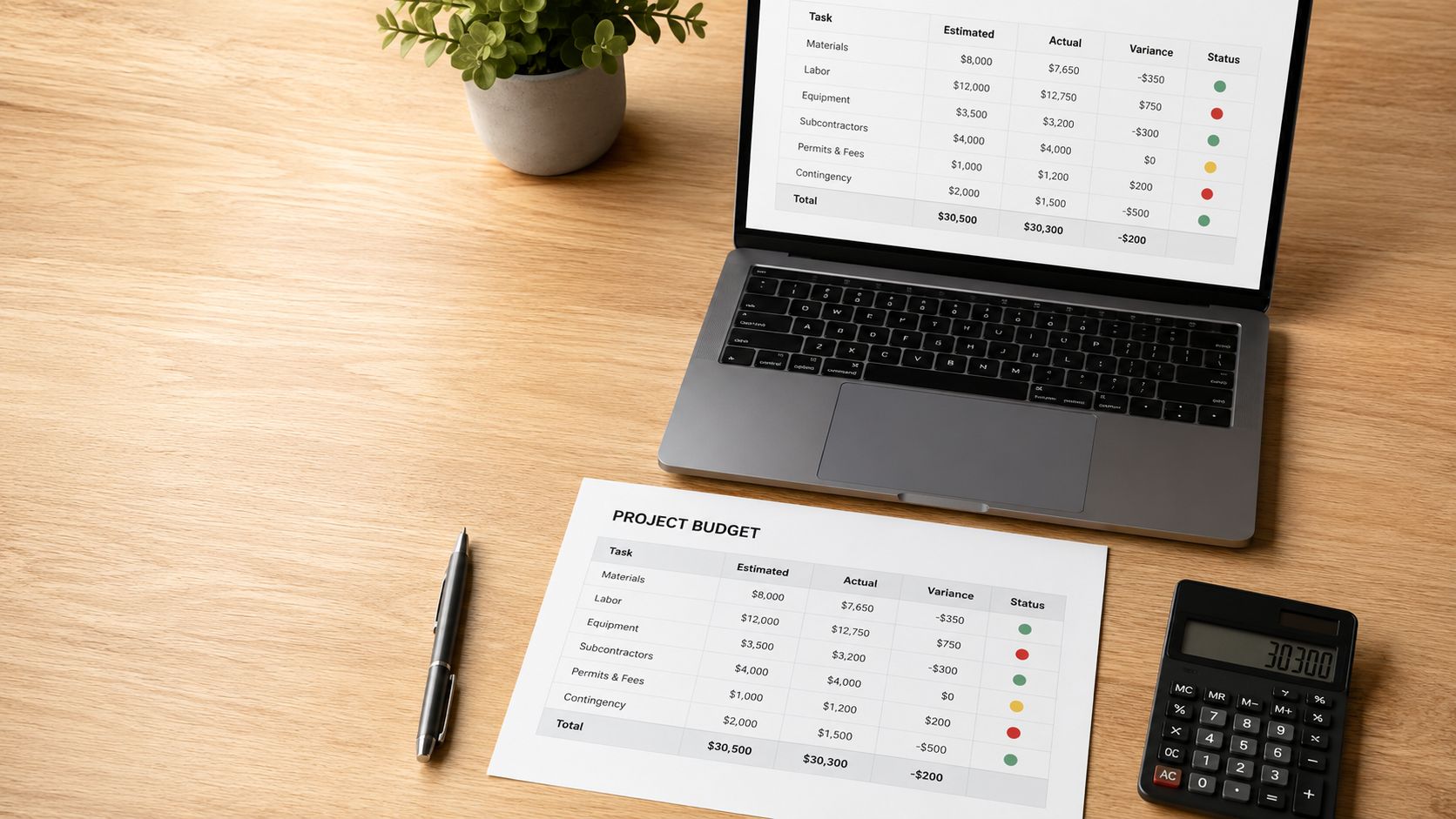
A simple line-item budget is the best starting point when the scope is clear and the number of moving parts is limited. Create one row for every major cost, then add columns for the estimate, approved amount, actual spending, and variance. Your lines might include materials, labor, permits, equipment rental, disposal, and contingency.
For a kitchen remodel, the working lines could be:
- Materials: $8,000
- Labor: $12,000
- Permits: $500
- Contingency: $2,500
A heating and cooling system replacement could use equipment at $4,000, installation labor at $1,500, and removal and disposal at $300. A roof replacement might list materials at $6,500, labor at $4,200, permits at $200, and dumpster rental at $400.
The value is visibility. You can see whether the project is going over because material orders changed, labor hours expanded, or a cost was omitted from the original scope.
Keep the sheet live
Update actual costs weekly. Waiting until the end of the project turns a manageable variance into a surprise. Use simple status colors, green for on budget, yellow for a minor variance, and red for a significant one.
A contingency line should reflect the project's uncertainty, not just a convenient round number. Engineers Australia's contingency guidance describes 10% as a normal allowance in many defined projects, with higher allowances for less-defined work.
Practical rule: Share the sheet with the professional before work starts. If the contractor's proposal uses different assumptions, reconcile the two documents before signing.
2. Phased Project Budget Template
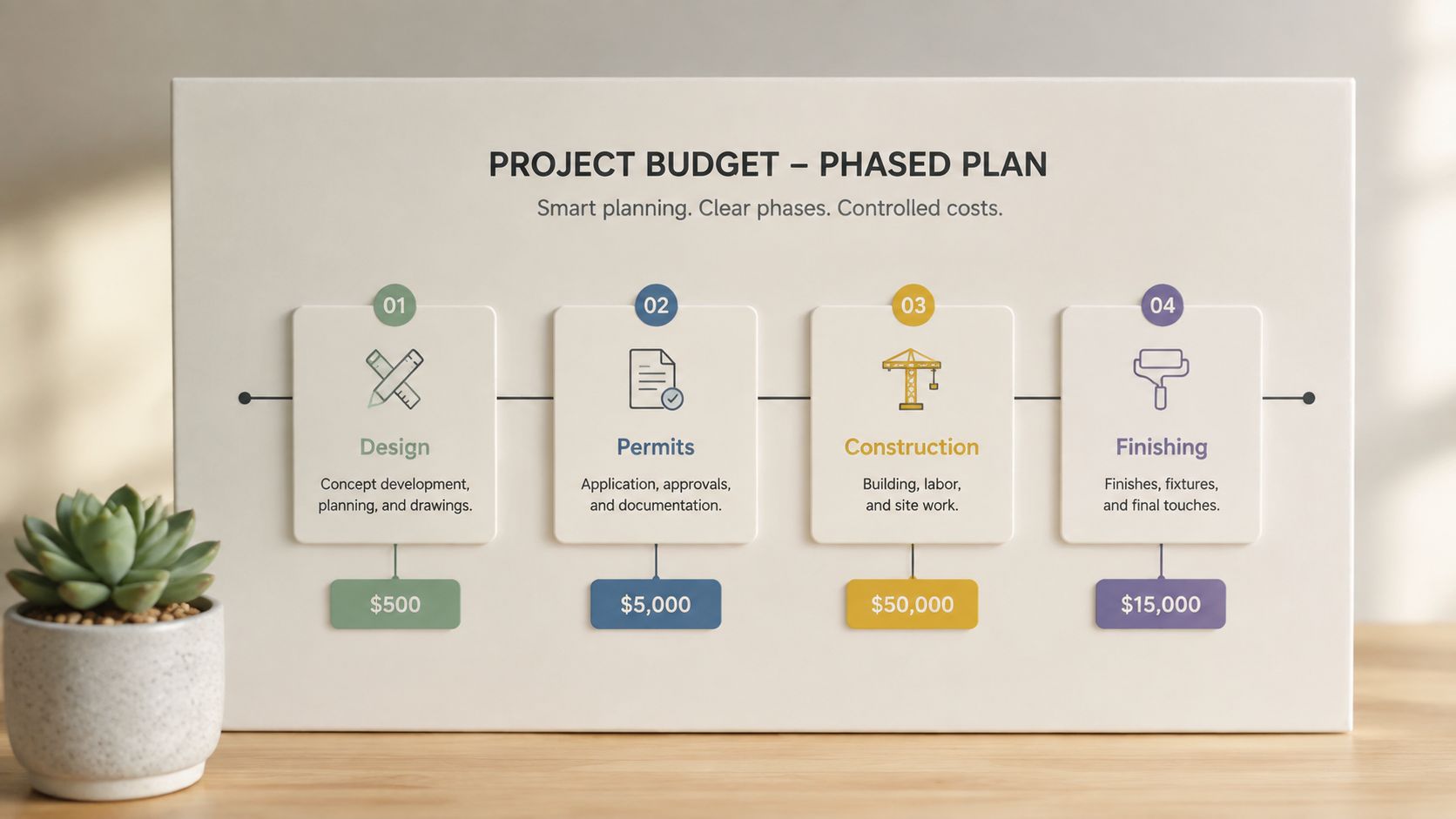
A phased budget divides the project into decision points. Each phase gets its own scope, budget, timeline, payment expectation, and approval status. This structure works particularly well for remodeling and restoration because you may not know the full condition of the property until demolition, drying, or inspection has taken place.
A roof replacement might be organized like this:
- Permits and inspection: $500
- Material delivery and preparation: $1,200
- Installation: $5,000
- Cleanup and final inspection: $800
For water-damage restoration, the phases could include assessment and emergency mitigation at $2,000, drying at $1,500, rebuilding at $8,000, and finishing at $3,000. An HVAC replacement might separate equipment procurement, old-system removal at $800, installation at $2,500, and testing and certification at $400.
The format makes scope boundaries visible. You can approve the assessment before authorizing reconstruction, or confirm that the roof deck is sound before committing to the final installation scope.
Define the handoff
Write down what “complete” means for each phase. For example, a drying phase isn't complete merely because equipment has been removed. It should include the agreed inspection or moisture verification required before rebuilding.
The Home Renovation Project Planner can help organize labor, materials, permits, soft costs, and contingency within a broader renovation plan.
Schedule a phase review shortly before the next phase begins. Discuss completed work, open decisions, approved changes, and the amount still available. A reserve can sit inside a separate contingency phase rather than being mixed into construction spending.
3. Category-Based Budget Template
A category-based budget follows the way money leaves your account. Instead of organizing spending by timeline, group it under labor, materials, equipment rental, permits, inspections, and waste removal. This makes it easier to identify which type of cost is consuming the budget and where a change might be possible.
For a kitchen renovation, your working categories might include labor at $16,000, materials at $14,000, equipment rental at $2,000, permits at $1,200, and waste removal at $2,800. An HVAC replacement could separate equipment at $2,400, labor at $1,200, permits and inspections at $200, and removal and disposal at $200.
A roof replacement might show materials at $8,000, labor at $6,400, permits at $480, and debris removal at $1,120. These figures are useful as a structure for discussion, not as a universal price list. Location, access, scope, product selection, and property condition can change the quote.
Use categories to evaluate quotes
Ask each professional to explain which costs are included in labor and which are included in materials. A low total may rely on a narrow material allowance, while a higher quote may include disposal, protection, cleanup, and warranty-related work.
Track actual spending by category each week. If materials are trending high, you may still be able to adjust selections. If labor is high because the scope has changed, the issue needs a documented change order rather than an unexplained overage.
Categories help you negotiate intelligently. They don't automatically make a quote cheap, and cutting the wrong category can create rework.
Keep owner-purchased products separate from the contractor's base proposal. That prevents you from comparing a quote that includes fixtures with one that excludes them.
4. Contingency and Risk Budget Template
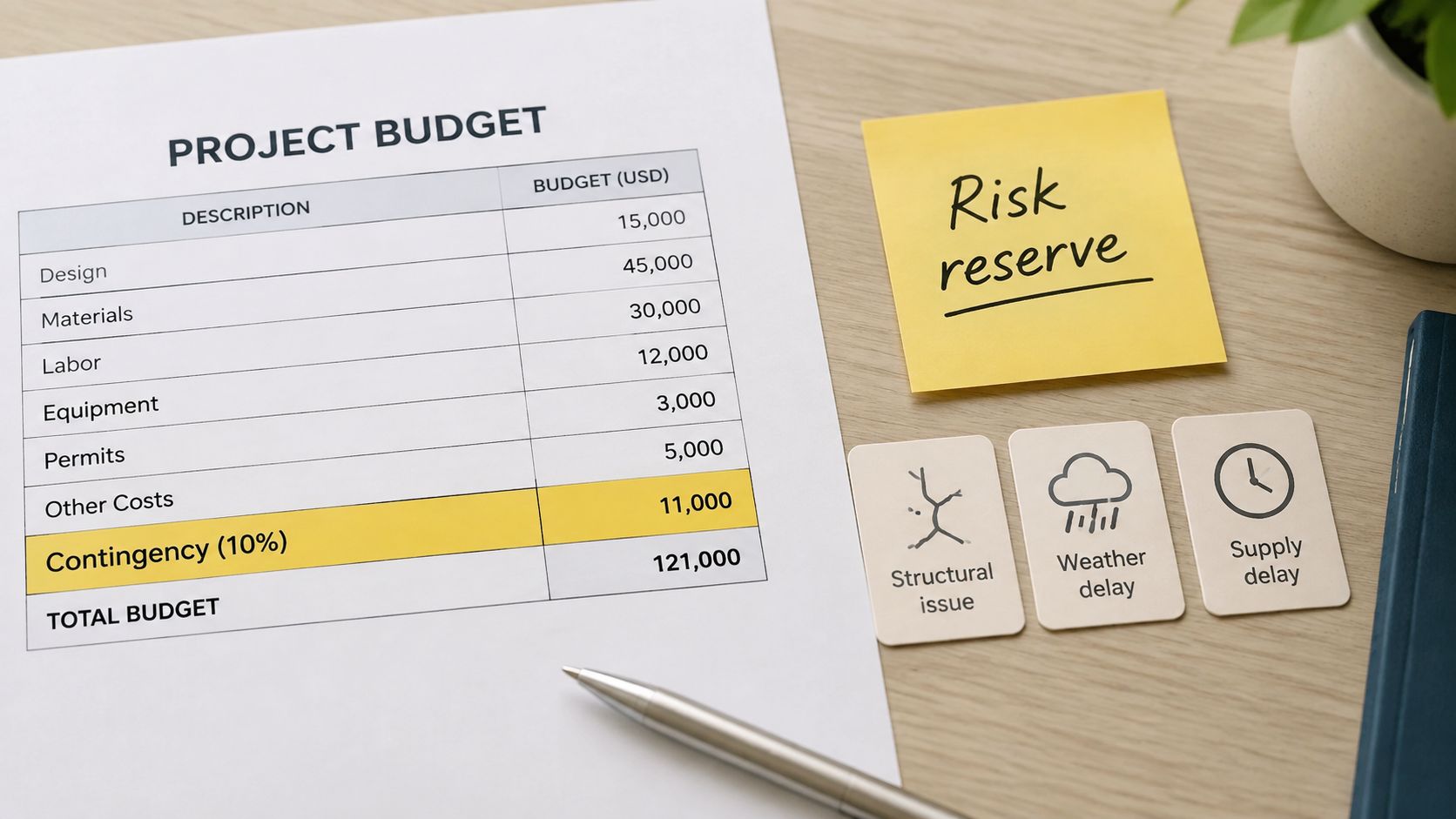
A contingency budget starts with a base estimate, then identifies the risks that could push the project beyond it. This is more useful than adding an arbitrary cushion and hoping it covers everything.
Consider a roof replacement on an older property:
- Base budget: $10,000
- General contingency: $1,000
- Structural-damage risk reserve: $500
- Hard cap: $11,500
For water-damage restoration in a 1970s basement, the working figures could be a $12,000 base budget, $1,440 in general contingency, and $960 reserved for possible mold discovery, creating a $14,400 hard cap. An HVAC replacement in an older home could use a $5,500 base, $550 in contingency, and $275 for ductwork issues, for a $6,325 hard cap.
Those examples separate known uncertainty from general risk. If the structural reserve is used, you can see why the budget changed and what evidence supported the additional work.
Match the reserve to definition
A mature scope may need a smaller reserve than an early estimate based on limited inspection. Engineers Australia's framework identifies allowances of approximately 14% at a 50% confidence level, and ranges of 25% to 40% for early-stage or high-uncertainty work. A renovation with open walls, uncertain structure, or damage restoration may therefore need materially more protection than a clearly defined replacement.
The history of construction budget overruns also supports treating contingency as a normal planning tool. A benchmark covering 258 transportation infrastructure projects found actual costs averaged 28% above original estimates, and a later synthesis reported that only 47.9% finished within the original budget.
5. Detailed Cost Breakdown Template by Trade or Vendor
A trade-based budget works best when several professionals contribute to one project. Give each trade its own section, then record the scope, pricing method, quantity or hours, materials, exclusions, and total. This makes quote comparison far more reliable than placing several lump sums beside one another.
A kitchen remodel could include:
- Demolition contractor: $3,000 fixed
- Electrician: $2,500 at $75 per hour
- Plumber: $2,000 at $85 per hour
- Carpenter: $4,000 fixed
- Cabinet supplier: $5,000 fixed
- Countertop installer: $2,000 fixed
A roof replacement might list the roofing contractor at $9,000, permit and inspection at $600, and debris removal at $1,200. An HVAC system swap could separate the equipment supplier at $4,000, installation contractor at $1,800, permit and inspection at $400, and electrical upgrades at $800 based on an hourly rate of $60.
Compare assumptions, not just totals
Two quotes aren't comparable if one includes tear-out, disposal, permits, flashing, protection, and final cleanup while the other doesn't. Ask every trade to state the included quantity, product grade, labor basis, and exclusions.
A useful vendor section contains:
- Scope: The exact work included
- Pricing basis: Fixed price, unit price, or hourly rate
- Materials: Supplied by the trade or purchased by you
- Schedule: Expected start and completion window
- Change process: Written approval before additional work
The quote itself should become a budget input, not the entire budget. Add owner purchases, design or professional services, permits, temporary living or storage, insurance effects, financing costs, approved changes, and unresolved risk separately. A renovation budget template with a complete category structure demonstrates how a proposal can grow from $96,000 to $120,000 once surrounding project costs are included.
6. Cash Flow and Payment Schedule Template
A total budget tells you affordability. A cash-flow schedule tells you whether you can pay at the right time. That distinction matters on projects where materials must be ordered before installation or where several trades invoice at different milestones.
A kitchen remodel payment schedule might show materials advance at $5,000 in week one, labor payment one at $3,000 in week two, labor payment two at $3,000 in week three, final labor and materials at $3,500 in week four, and final inspection or contingency spending at $1,500 in week five.
For restoration, you might schedule $2,000 for mitigation, $1,500 for drying, $8,000 for rebuilding split across three payments, and $500 at final inspection. An HVAC replacement could require $4,000 for equipment upfront, $1,800 for installation at completion, and $400 for permits and inspections at sign-off.
Put financing beside the calendar
Record the payment date, payee, amount, approval status, and expected account balance. If insurance is involved, track the claim decision, deductible, covered scope, and reimbursement timing separately. Don't treat an expected payment as cash until you know when it will arrive.
If you're financing the work, the home improvement financing options should be evaluated alongside the payment schedule. Confirm approval and disbursement timing before committing to a contractor's start date.
A payment schedule should protect both sides. You need enough cash to meet obligations, and the professional needs a predictable path to fund labor and materials.
Build a buffer for final invoices and surprise costs. A schedule that uses every available dollar on the planned dates leaves no room for a delayed inspection, revised invoice, or approved change.
7. Comparative Budget Template for Estimates, Actuals, and Benchmarks
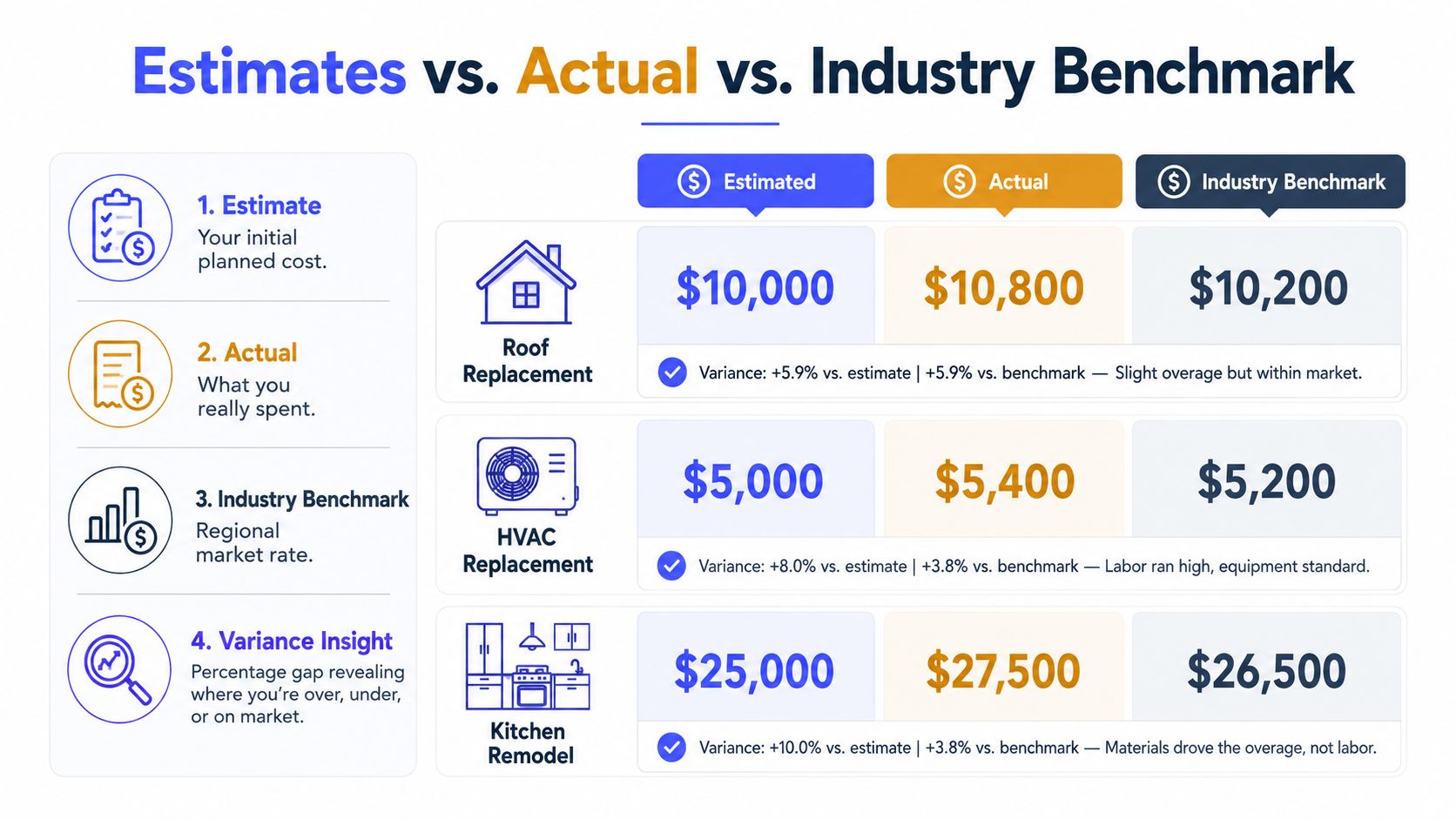
A comparative budget adds a third reference point to the usual estimate-versus-actual view. For every line, record your original estimate, actual cost to date, and a relevant benchmark from comparable local work or your own completed projects.
A roof replacement comparison might read:
- Estimate: $10,000
- Actual: $10,800
- Regional benchmark: $10,200
An HVAC replacement could show $5,000 estimated, $5,400 actual, and a $5,200 benchmark. A kitchen remodel could show $25,000 estimated, $27,500 actual, and $26,500 benchmark.
These examples don't prove that a particular quote is fair or unfair. They show how the format identifies the source of variance. If labor is high but equipment is aligned with the benchmark, ask about hours, access, or scope. If materials are high, review selections, allowances, quantities, and waste.
Make the comparison useful
Use regional construction cost databases, RS Means, written quotes, and your own completed project records. Make sure the comparisons have similar scope. A roof with structural repairs shouldn't be compared with a straightforward shingle replacement.
The home renovation cost calculator can provide a starting point for setting a working renovation budget, but a professional quote should still explain its assumptions and exclusions.
Save the completed file after the project closes. Your next estimate improves when you know what the last job required, including overlooked disposal, preparation, labor, or inspection costs.
7-Template Project Budget Comparison
| Template | 🔄 Complexity | ⚡ Resource requirements | ⭐ Expected outcomes | 📊 Ideal use cases | 💡 Key advantages |
|---|---|---|---|---|---|
| Simple Line-Item Budget Template | Low, single sheet, minimal formulas | Low, basic spreadsheet (Excel/Sheets/PDF) | ⭐⭐, quick visibility, basic cost tracking | Small projects (<$50k); homeowner–contractor alignment | Easy to set up and share; portable; minimal overhead |
| Phased Project Budget Template | Medium, multiple phases, approval points | Medium, timeline planning, phase-level data | ⭐⭐⭐, controlled spending by phase | Larger renovations/restorations with sequential phases | Prevents scope creep; clear decision checkpoints |
| Category-Based Budget Template | Medium, grouping by payee/category | Medium, vendor quotes, benchmark comparisons | ⭐⭐️⭐, clear category-level spend insight | Projects needing vendor/payee visibility and negotiation | Shows where money flows; simplifies vendor accountability |
| Contingency and Risk Budget Template | Medium, risk identification and tracking | Medium, risk assessment, reserve accounting | ⭐⭐⭐, reduces budget blowouts; realistic worst-case | Older homes or high-uncertainty renovations | Protects against surprises; justifies reserves to lenders |
| Detailed Cost Breakdown (By Trade/Vendor) | High, many vendor sections and line items | High, detailed quotes from each trade | ⭐⭐⭐, precise vendor accountability and comparisons | Multi-trade renovations requiring competitive bids | Simplifies quote comparison; prevents double-charging |
| Cash Flow and Payment Schedule Template | Medium, payment sequencing and updates | Medium, coordination with contractors/financing | ⭐⭐⭐, prevents cash shortfalls, clarifies timing | Projects lasting weeks/months where payment timing matters | Highlights financing needs; avoids payment bunching |
| Comparative Budget Template (Estimate vs Actual vs Benchmark) | Medium–High, needs benchmark/historical data | Medium, access to benchmarks, past-project data | ⭐⭐⭐, data-driven variance insights and learning | Projects where benchmarking improves cost control | Reveals estimate accuracy; informs future budgets |
Turn the Example Into Your Working Budget
Choose the format that matches the project, not the format that looks most polished. A clear roof replacement may need a line-item or trade-based budget. A multi-month renovation may need phases, categories, cash flow, and comparative tracking. Restoration and older-home work usually need a stronger risk structure because the visible damage may not show the full scope.
Start by copying every supplied cost from the proposal into your working file. Separate the base construction price from owner-purchased products, design and professional services, permits, inspections, temporary living or storage, financing, insurance effects, approved changes, and unresolved risk. That separation prevents a common mistake, treating the contractor's proposal as the complete project budget.
Then add three columns that should never be merged: estimated, approved, and actual. An estimate is a planning assumption. An approved amount is a decision. An actual cost is money committed or paid. Keeping those states separate shows whether the project is changing because the scope changed, the quote was incomplete, or spending exceeded the plan.
Set contingency after reviewing scope definition and project risk. PMI guidance on contingency reserves describes a practical rule of thumb for a well-developed project as greater than 3% and less than 15% of the estimate, excluding contingency. That isn't a universal answer. AACE's estimate classification guidance places Class 3 estimates at 10% to 40% definition, with typical accuracy bands of approximately -10% to -20% on the low side and +10% to +30% on the high side, which reinforces the need to connect reserve size to how much of the work is defined.
Map payment dates before approving work. Record deposits, progress payments, material orders, retainage if applicable, final invoices, financing disbursements, and insurance timing. Require written change orders that state the added scope, price, schedule effect, and funding source.
Review the budget weekly with the professional. Discuss completed work, pending decisions, open risks, committed costs, and the remaining balance. A useful project budget example is not just a total. It's a shared record of scope, costs, risk, and cash flow.
If you still need a professional, Handvetted matches people with one licensed, background-checked, 4.5-plus-star-rated professional, and each match is exclusive rather than shared with multiple businesses.
Hand Vetted Co. helps connect you with one verified professional for roofing, HVAC, restoration, and renovation work, so your budget discussion starts with a screened match rather than a list of competing pitches. Visit Hand Vetted Co. to submit your project details and find a professional who can review the scope, quote assumptions, and next steps with you.