A standard residential land survey runs $525 on average, with prices often ranging between $300 and $1,200 for a typical job. If your lot looks similar to your neighbor's but your quote is much higher, size probably isn't the primary reason.
That's the part most pricing guides miss. Two one-acre properties can produce very different bids because surveyors aren't just measuring land. They're researching deed history, hunting for old monuments, dealing with brush, slope, access problems, and deciding how much legal certainty your job requires.
Table of Contents
- Why Residential Survey Costs Matter
- Understanding Price Drivers
- Cost Ranges By Survey Type
- Sample Regional Cost Estimates
- How To Get Accurate Quotes
- Typical Timeline And Deliverables
- Tips For Hiring A Vetted Surveyor
Why Residential Survey Costs Matter
Your neighbor says they paid $600 for a one-acre boundary survey. You call around for your one-acre lot and get quoted $1,800. Same acreage, same street, same town. So what gives?
Usually, the quote gap isn't random. A standard residential boundary survey for a single-family lot under one acre typically costs $300 to $800 nationally, with costs often reaching $500 to $1,200, according to Apex Survey's residential survey cost guide. But that range only makes sense if the property is straightforward.
The problem with using one number
People often treat residential land survey cost like a flat menu price. It isn't. A surveyor may need to verify old legal descriptions, recover missing markers, or work around fences, trees, creeks, or poor access.
That means a “cheap” quote can be incomplete, and an expensive quote can be justified.
Practical rule: If two quotes are far apart, don't ask only “Which one is cheaper?” Ask “What work is one surveyor including that the other isn't?”
A survey affects more than a line on paper. It can shape a fence project, a refinance, a title issue, or a dispute with the person next door. If the boundary work is wrong, the cleanup is almost always more expensive than getting it right the first time.
Why people get caught off guard
A lot of buyers and property owners don't order surveys often. So they compare by acreage alone and miss the key variables. That's how people end up approving bids they don't understand, or rejecting solid bids because they look high at first glance.
If your survey ties into a larger property decision, it also helps to understand related protection issues like what homeowners insurance coverage actually includes. Survey mistakes and property line misunderstandings can spill into claims, repairs, and legal headaches fast.
Understanding Price Drivers
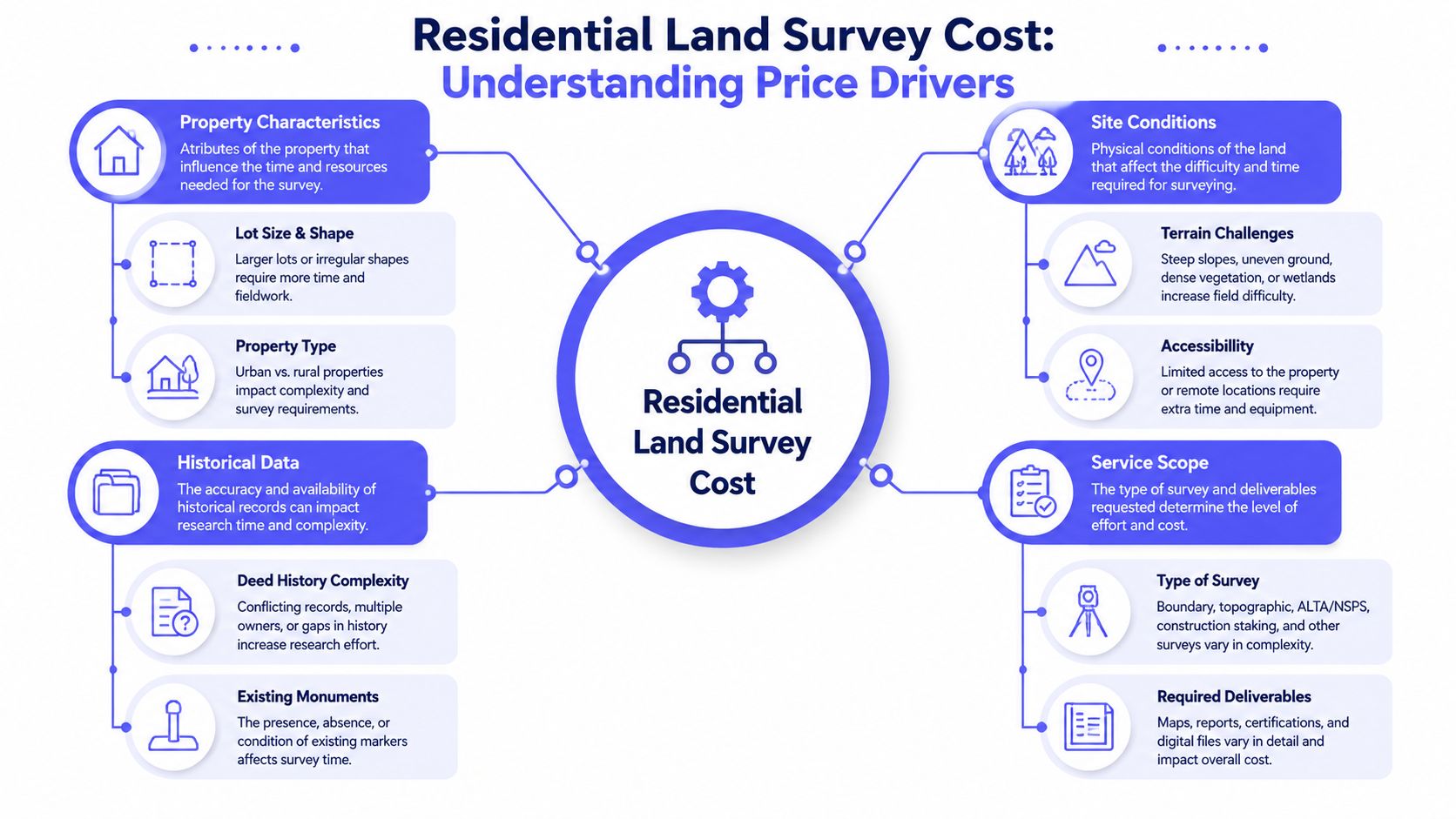
The primary driver of residential land survey cost isn't just how big your lot is. It's how hard the surveyor has to work to prove where the lines are.
Size matters, but it is not the whole story
Yes, acreage changes pricing. Small, simple residential jobs can cost less, while larger tracts cost more because they take longer to measure and document. But acreage is the obvious factor, not the sneaky one.
A clean half-acre lot in a recorded subdivision can be easier than a smaller parcel with old legal descriptions, unclear corners, and obstructed access. That's why two properties that look similar on Zillow can produce very different quotes in real life.
The hidden drivers that change the quote fast
The biggest blind spots are deed history complexity and terrain access. Lots with difficult access or complex deeds can push boundary survey costs from $600 to $1,800 to over $2,500, as noted in Ludlow Engineers' explanation of survey pricing questions.
Here's what commonly pushes a quote up:
- Old or conflicting deed descriptions: If the legal description is messy, the surveyor has to spend more time in records before fieldwork even starts.
- Missing monuments: When pins or markers can't be found, recovery takes longer and may require more judgment and documentation.
- Heavy brush or rough terrain: Dense vegetation and hard ground access slow measurement and staking.
- Limited site access: Locked gates, steep grades, water features, or neighboring obstacles create extra field time.
- Scope creep: A basic boundary survey costs less than work that also needs topography, easement verification, or detailed deliverables.
A one-acre lot isn't one product. It can be easy land, or it can be a research project with fieldwork attached.
One useful way to think about it is this. Surveyors are pricing uncertainty. The more uncertainty built into the records or the site, the more time they need to resolve it.
If you're budgeting a bigger renovation or site project, pair your survey estimate with a broader planning tool like this home renovation cost calculator. It helps put the survey in context instead of treating it like an isolated line item.
Cost Ranges By Survey Type
The phrase residential land survey cost gets messy because people use it to describe several different services. That's a mistake. A boundary survey, an ALTA survey, and a topographic survey are not interchangeable.
For larger or more complex residential properties, survey costs range from $1,500 to over $25,000, driven by acreage and survey type, with ALTA and topographic maps often costing $2,000 to $3,000 or more, according to Angi's land survey cost breakdown.
Typical Costs by Survey Type
| Survey Type | Price Range |
|---|---|
| Basic survey | Starts around $250 |
| Standard residential boundary survey | $300 to $800 for a typical single-family lot under one acre |
| Common residential survey spend | $500 to $1,200 for many standard jobs |
| ALTA survey | $2,000 to $3,000 or more |
| Topographic survey | $2,000 to $3,000 or more |
| Larger or more complex residential survey projects | $1,500 to over $25,000 |
How to choose the right survey
A boundary survey is the default choice when you need property lines confirmed for a fence, purchase, refinance, or general line verification. This is typically the survey referenced when inquiring about cost.
A topographic survey is different. It maps surface features and elevation changes. If you're planning drainage work, site design, grading, or building placement, this is often the right tool.
An ALTA survey is more documentation-heavy and usually tied to higher-stakes transactions or title requirements. If no lender, title company, attorney, or design professional is asking for ALTA-level work, don't volunteer yourself into that bill.
Bottom line: Order the cheapest survey that actually solves your problem. Ordering too little causes rework. Ordering too much burns cash for no reason.
If you're not sure what you need, ask the surveyor to state the deliverable in plain English. “Boundary only” and “boundary plus topo” should not appear on quotes with the same vague description.
Sample Regional Cost Estimates
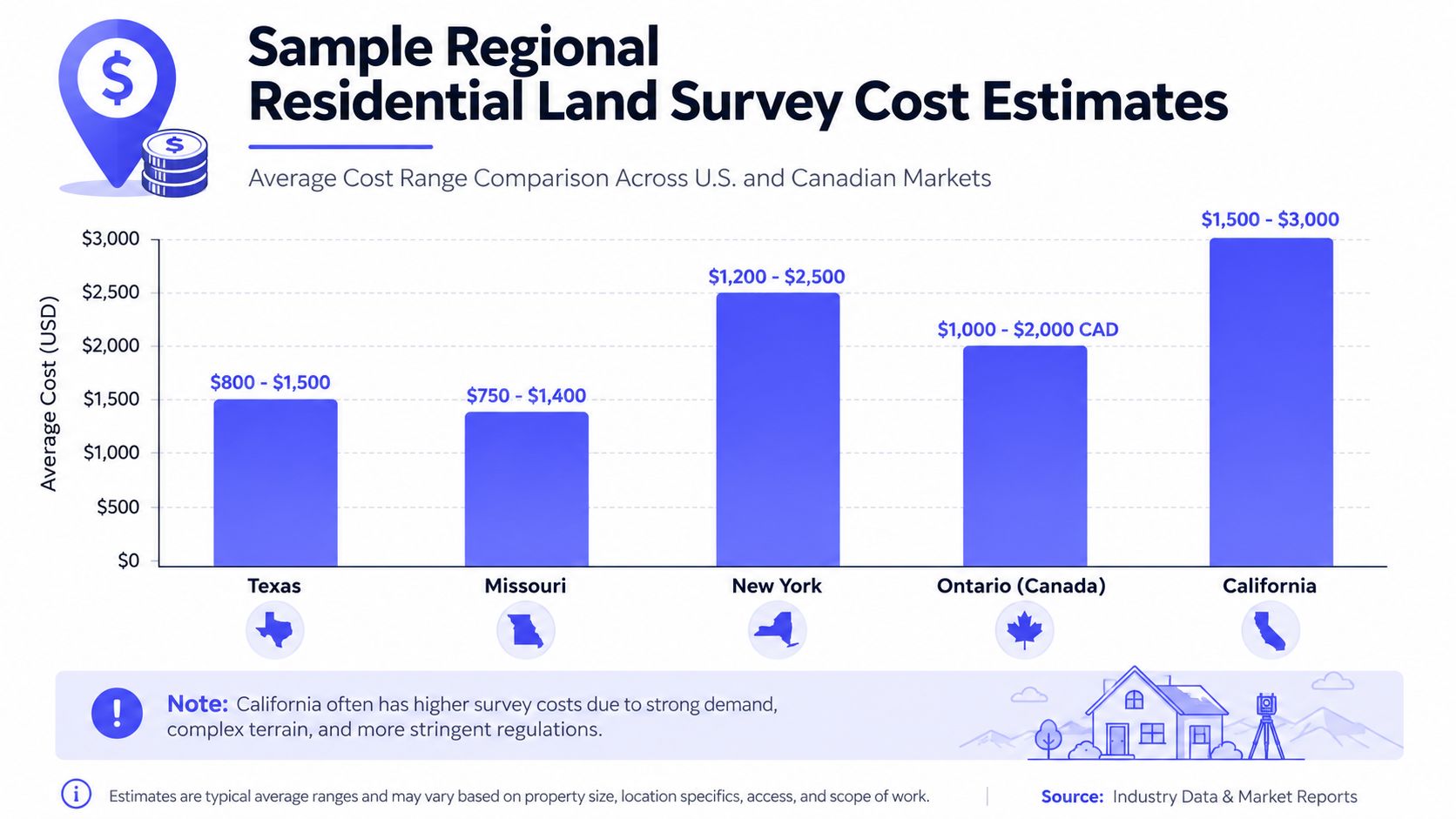
Location changes price more than many people expect. Labor markets, licensing rules, regional demand, and local record systems all affect the final number.
What regional benchmarks actually show
In markets like Toronto and the U.S. Southeast, boundary surveys carry benchmark prices of $550 to $850, while topographic surveys run $1,500 to $3,000 because they may require LiDAR or drone mapping, according to regional pricing examples collected by The Land Geek.
That same source shows big state-by-state variation. Residential surveys in Texas often start at $750. Missouri offers basic options near $600. New York ranges from $1,400 to $6,000 and Ohio from $900 to $3,800 for similar property types. In California, boundary surveys for homeowners typically fall between $1,200 and $5,500, with small suburban lots occasionally costing $100 to $700.
Why location changes the bill
Some regions have dense, easy-to-access suburban lots with clear records. Others have older parcels, more title complexity, higher labor costs, or stricter professional requirements. That alone can move a quote a lot.
You should treat local benchmarks as guardrails, not promises. If your quote lands outside the common range for your area, ask why. Sometimes the answer is inflated pricing. Other times, the property is harder than average.
A smart quote review sounds like this:
- Ask what's local: Is the price high because your market is expensive, or because your parcel is difficult?
- Ask what's included: Easement verification, monument recovery, and mapping can all shift the scope.
- Ask what could increase later: A low initial number can turn into a change order if the field crew discovers missing evidence.
How To Get Accurate Quotes
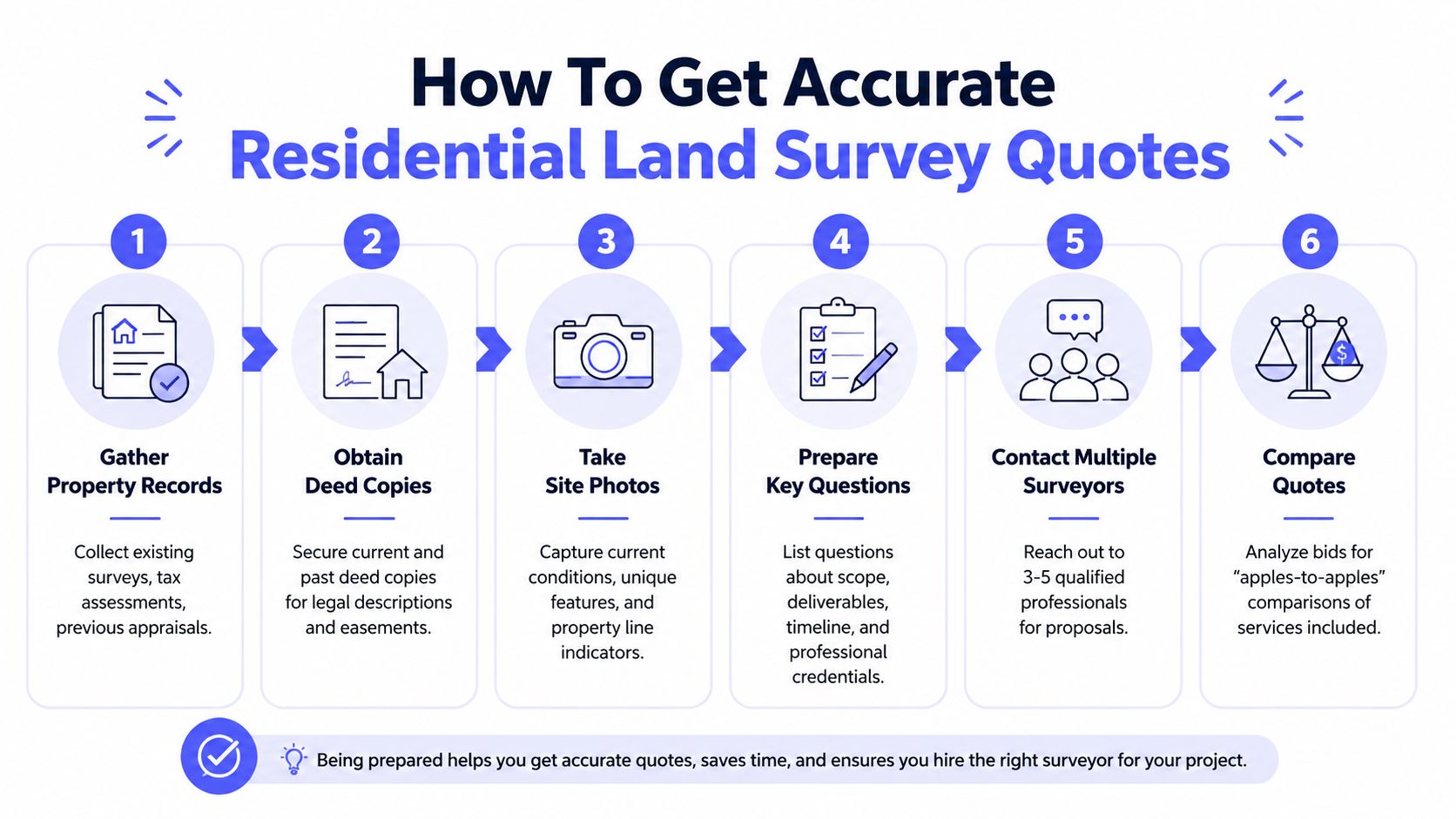
Bad survey quotes usually start with bad input. If you give three surveyors different information, you'll get three numbers that can't be compared.
Surveyors often charge by acreage at $50 to $500 per acre, which means a half-acre boundary survey can cost $200 to $700, according to This Old House's guide to land survey pricing. That pricing only helps if the scope is clear.
What to gather before you ask for pricing
Start with paperwork, not phone calls.
- Collect prior surveys if you have them. Even an old plat can help the surveyor understand what exists.
- Pull your current deed. If there are older deeds available, gather those too.
- Take site photos. Include fences, driveways, corners, tree lines, and any visible markers.
- Note access issues. Locked gates, dogs, dense brush, steep areas, and water crossings matter.
- State your purpose clearly. Fence, refinance, addition, dispute, lot split, or site planning all point to different scopes.
Questions that force clear quotes
Don't ask only, “How much is a survey?” Ask these instead:
- What type of survey is this quote for? Boundary, topographic, or something broader.
- What deliverables are included? Plat, legal description, digital file, stakes, monument recovery, or easement notes.
- What assumptions are built into the quote? Existing pins found, clear access, no major deed conflicts.
- What triggers added cost? Missing markers, bad records, overgrowth, weather delays, or expanded scope.
- Who signs and seals the final survey? You want a licensed professional, not vague office language.
The cleanest quote is the one that tells you what could go wrong before it goes wrong.
If you're comparing bids for a larger property project, keep your notes in one place and use the same job description for every surveyor. That's the only way to get apples-to-apples pricing.
Typical Timeline And Deliverables
It is often thought that a survey starts when the crew shows up with equipment. It usually starts earlier, with records research and map review.
What happens after you hire the surveyor
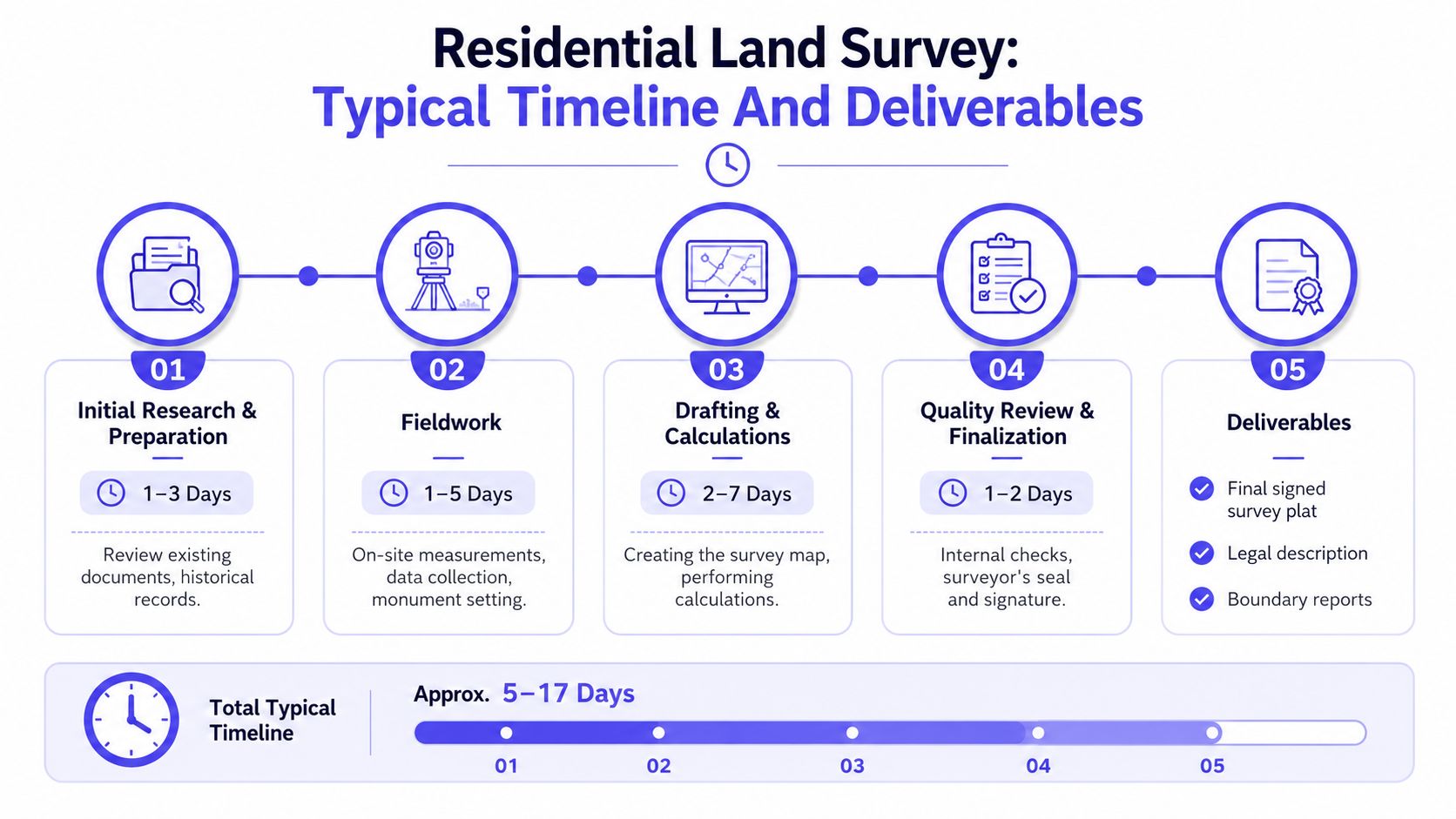
The work usually moves in five phases.
First comes research and preparation. The surveyor reviews deeds, prior plats, legal descriptions, and any visible record conflicts. Then comes fieldwork, where the crew measures the site, searches for monuments, and documents what exists on the ground.
After that, the office handles drafting and calculations. The surveyor reconciles the field data with the legal record. Then comes quality review and finalization, where the licensed professional checks the work and prepares the final signed product.
What you should expect to receive
Deliverables depend on the scope, but a standard residential job often includes:
- A signed survey plat: The map showing boundaries and key site elements.
- Boundary notes or a legal description: If your job requires formal written description.
- Markers or monument notes: Depending on what was found or set in the field.
- Digital files in some cases: Especially if the survey supports design or engineering work.
The exact turnaround depends on the surveyor's workload, your property's complexity, and whether the records are clean. The easiest jobs move faster. The messy ones don't.
Don't judge a timeline by the field visit alone. A one-day site visit can still require substantial office research and drafting.
Tips For Hiring A Vetted Surveyor
The right surveyor saves you money by preventing mistakes. The wrong one can leave you with vague boundaries, bad assumptions, or a document that doesn't solve the problem you hired them to fix.
A practical hiring checklist
Use a simple filter before you hire anyone:
- Check the license first: Ask for the professional license tied to the final signed survey.
- Ask about similar jobs: A surveyor who mostly handles open rural acreage may not be the best fit for a tight infill lot with old subdivision records.
- Review the sample deliverable: If they can't explain what you'll receive, keep looking.
- Confirm insurance and business standing: Professional work needs real accountability.
- Read reviews for clarity, not just stars: Look for comments about communication, accuracy, and whether the final survey arrived as promised.
What a good surveyor does differently
A strong surveyor doesn't just hand you a number. They ask questions about your deed, purpose, access, improvements, and timing. They tell you what assumptions are built into the quote. They warn you where costs can move.
That's the standard you should expect from any professional you hire, whether you found them through referrals, local search, or broader contractor-matching research like how to find a general contractor. Screening matters. Loose vetting creates expensive surprises.
Your next step is simple. Gather your deed, any prior survey, and a few site photos. Then ask for quotes that define the exact scope, deliverables, and conditions that could change the price. That's how you get a useful number instead of a guess.
If you want a simpler way to find a qualified pro for home-related projects, Hand Vetted Co. matches you with one licensed, background-checked, 4.5+ star rated professional. No shared leads. No spam. Just one exclusive match that's already been screened.