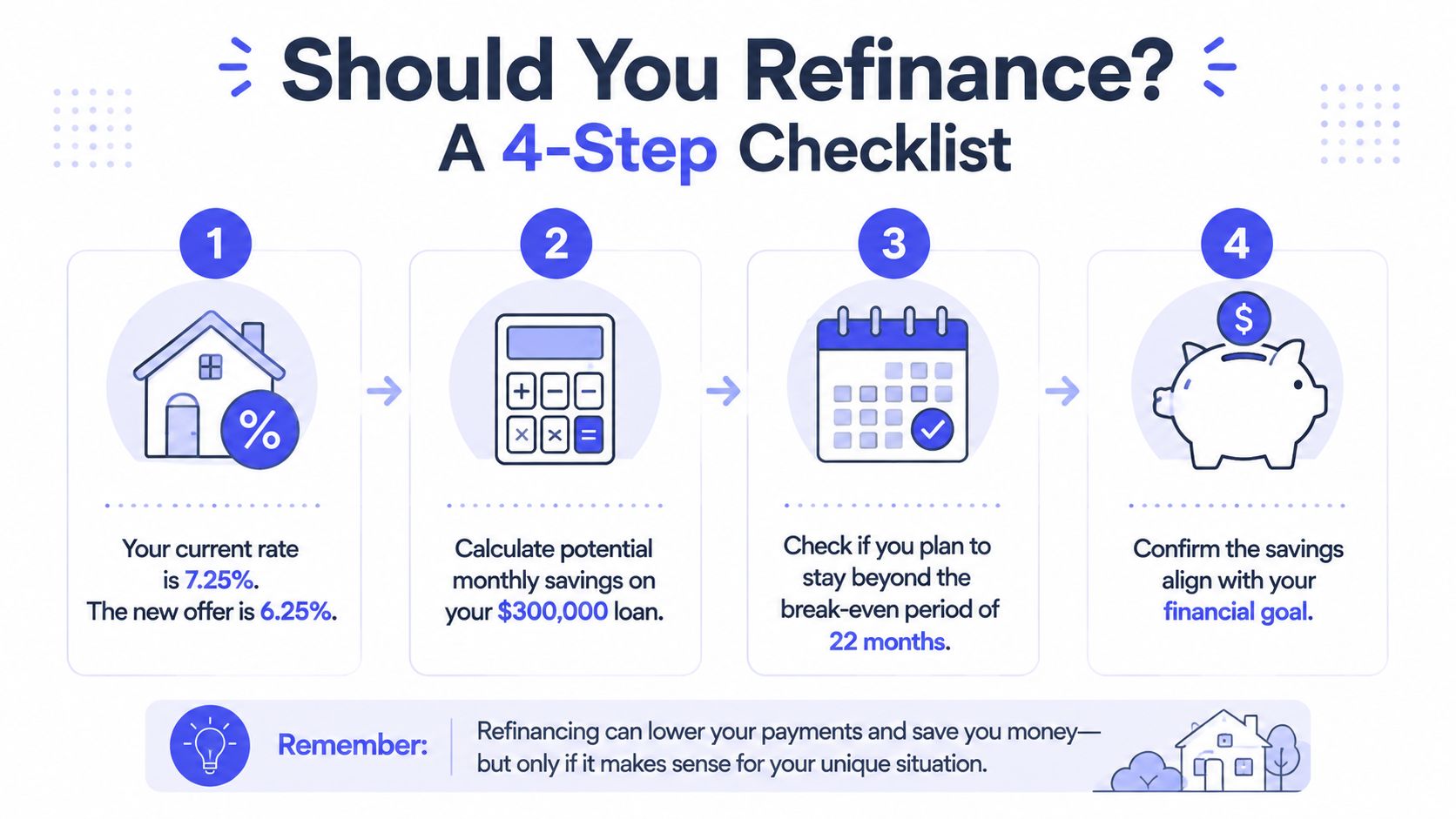
You're comparing a 7.25% mortgage with a 6.25% offer and wondering whether the lower rate is enough to justify starting over. On a $300,000 balance with 28 years left, the answer won't come from the rate alone. You need to follow the money from the new payment to the closing costs, then determine whether you'll still own the home after the refinance breaks even.
The mortgage refinance process replaces your existing mortgage with a new loan. The new lender uses the replacement loan to pay off the old balance, and you begin making payments under the new rate, term, and loan structure. That sounds simple, but the decision can be expensive if you ignore fees, reset the repayment schedule, or choose the wrong equity product.
Table of Contents
- Decide Whether Refinancing Fits Your Goal
- Compare Refinance Options for Your Situation
- Calculate Costs and Your Break-Even Point
- Move From Application Through Closing
- Finance Home Improvements With Equity
- Avoid Delays and Expensive Refinance Mistakes
- Choose a Vetted Lender and Take Action
Decide Whether Refinancing Fits Your Goal
Start with the reason you want to refinance. A lower payment, a shorter payoff period, a fixed rate, and access to equity are different objectives. They require different comparisons.
For a standard rate-and-term refinance, I'd investigate a rate reduction of roughly 0.50 to 0.75 percentage points, but I wouldn't approve a refinance based on that threshold alone. The savings still need to recover the transaction costs before you sell, move, or pay off the mortgage. Your remaining loan term matters too. Replacing a mortgage late in its schedule with a fresh long term can reduce the payment while increasing the total interest you pay.
Use this quick screen:
- Compare the rate and term. Put your current interest rate, remaining balance, remaining term, and new offer side by side. A lower payment achieved by stretching repayment can be less valuable than a higher payment that retires the balance faster.
- Estimate the monthly savings. Use the proposed loan amount and actual term, not an advertised payment that excludes taxes, insurance, or other items.
- Calculate break-even. Divide all refinance costs by the expected monthly savings. That result tells you how long the new loan must remain in place before the savings recover the fees.
- Test your likely holding period. If you might move before break-even, the refinance probably doesn't fit.
Read the market without chasing headlines
Refinance demand moves with borrower incentives. Freddie Mac reported about $2.8 trillion in first-lien refinance originations in 2021, down 7.6% from 2020, while the first and second quarters of 2023 produced only $75 billion and $80 billion, the lowest inflation-adjusted quarterly volumes since 1995, according to its refinance activity analysis.
That history matters because a refinance window can open and close quickly. ICE reported that refinance retention reached 28% in Q3 2025, a 3.5-year high, while rate-and-term loans represented 62% of refinancing activity in October, the highest share in almost five years. Nearly 95% of those rate-and-term refinances in September and October involved loans originated from 2023 to 2025, according to ICE mortgage refinance data.
Cash-out refinances and HELOCs use different mathematics. Don't compare them with a plain rate-and-term refinance just because all three involve home equity. If the projected savings don't clear break-even before your likely move or payoff, stop shopping and keep the existing loan.
Compare Refinance Options for Your Situation
These products aren't interchangeable. Choose the structure that matches the way you'll use the money.
| Option | Best Goal | Repayment Structure | Risk Profile | Typical Use Case |
|---|---|---|---|---|
| Rate-and-term refinance | Lower the rate, change the term, or replace an adjustable rate | One new first mortgage | Can restart the repayment schedule and add closing costs | Lowering a payment or moving to a fixed rate |
| Cash-out refinance | Access a larger amount of equity at closing | One larger first mortgage replaces the old loan | Converts equity into secured debt and can increase the payment or repayment period | A major renovation or large debt-consolidation need |
| HELOC | Fund expenses in stages | Revolving second lien with draws as needed | Adds a separate payment and may expose you to changing payment costs | A project with uncertain timing or staged invoices |
A rate-and-term refinance is the cleanest option when your goal is payment relief or a different payoff schedule. It can also make sense if you want to replace an adjustable-rate mortgage with a fixed-rate structure. You aren't borrowing additional cash, so the comparison should focus on the new payment, total interest, fees, and remaining time in the home.
A cash-out refinance replaces the existing mortgage with a larger first loan. The new balance pays off the old mortgage, and the difference is delivered to you after closing costs and other required adjustments. That can work for a large, clearly budgeted renovation, but it also changes the entire first-mortgage balance to fund the project.
A HELOC leaves the original first mortgage in place and creates a revolving second lien. You draw only what the project requires, which can be useful when contractors invoice in stages. The trade-off is a separate account, separate terms, and another payment obligation.
Practical rule: Don't use a full cash-out refinance for a small repair simply because the rate looks attractive. The closing costs can overwhelm the purpose of the loan.
For a more detailed structural comparison, review HELOC versus cash-out refinance options. A full kitchen remodel may need staged access to funds, while a small repair may not justify replacing a favorable first mortgage at all.
Calculate Costs and Your Break-Even Point
Build the worksheet before you ask a lender to sell you on a payment. The number that matters is the all-in cost, not the rate printed at the top of the quote.
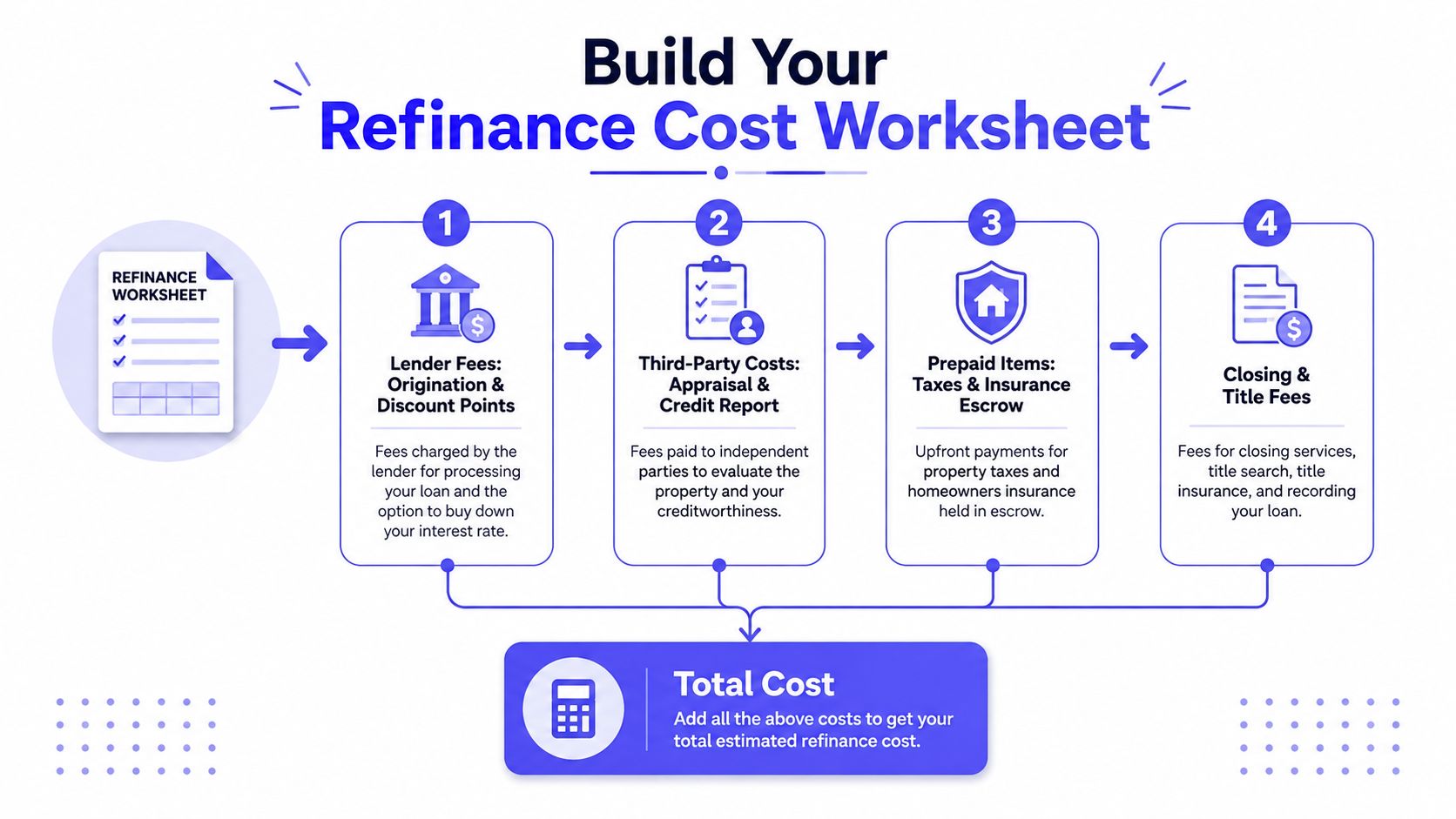
Include every item that can affect the transaction:
- Lender charges: Add origination fees, underwriting charges, and discount points.
- Third-party services: Include the appraisal, credit report, title search, and title insurance.
- Settlement costs: Account for recording fees, taxes, attorney or closing-company charges, and other settlement items.
- Prepaid amounts: Separate prepaid interest and escrow deposits from true loan costs, but still track the cash needed at closing.
- Equity cost: If you take cash out, account for the opportunity cost of tying equity to a project or debt payoff.
Recent neutral estimates put average refinance closing costs at about $2,207 in 2025, or 0.67% of the loan amount, while another 2025 report estimated $2,403, or 0.72%. Those figures come from LodeStar refinance closing-cost data reported by the American Land Title Association. Treat them as reference points, not promises. Your loan size, location, title work, points, and lender pricing can change the result.
Use one formula
Break-even months = total refinance costs ÷ monthly payment savings
Suppose the cost package is $5,000 and the new payment saves $150 per month. The break-even point is roughly 33 months, because $5,000 divided by $150 is approximately 33.
Then compare that result with your expected holding period. A three-year plan is tight. A five-year plan gives the savings more time to accumulate. Seven and ten-year horizons may support a refinance that would be unattractive for a short stay, but only if the new loan's total interest and repayment structure also fit your plan.
The refinance break-even calculator can help organize this comparison, but you still need to verify each input against the Loan Estimate and closing documents.
Stress-test the quote
Run the offer through three adverse scenarios before applying:
- Rate movement: Recalculate the payment if the available rate drifts upward by 0.25% before you lock.
- Low appraisal: Determine whether a lower value would change the loan-to-value ratio, pricing, cash-out amount, or approval.
- Delayed closing: Add a month of duplicate interest and check whether the savings still recover the cost.
Only advance an offer that remains financially positive under all three tests. A refinance that works only in perfect conditions is not a sound refinance.
Move From Application Through Closing
Once the numbers work, execution becomes the priority. A refinance still requires lender review of income, assets, debts, property value, title, and loan conditions. Treat the file like a purchase transaction, not a quick rate change.
Submit a complete application
Provide current pay information, asset statements, identification, insurance details, mortgage statements, and property information at the start. If you have variable income, a job change, self-employment, or a recent gap in employment, explain it before underwriting finds it.
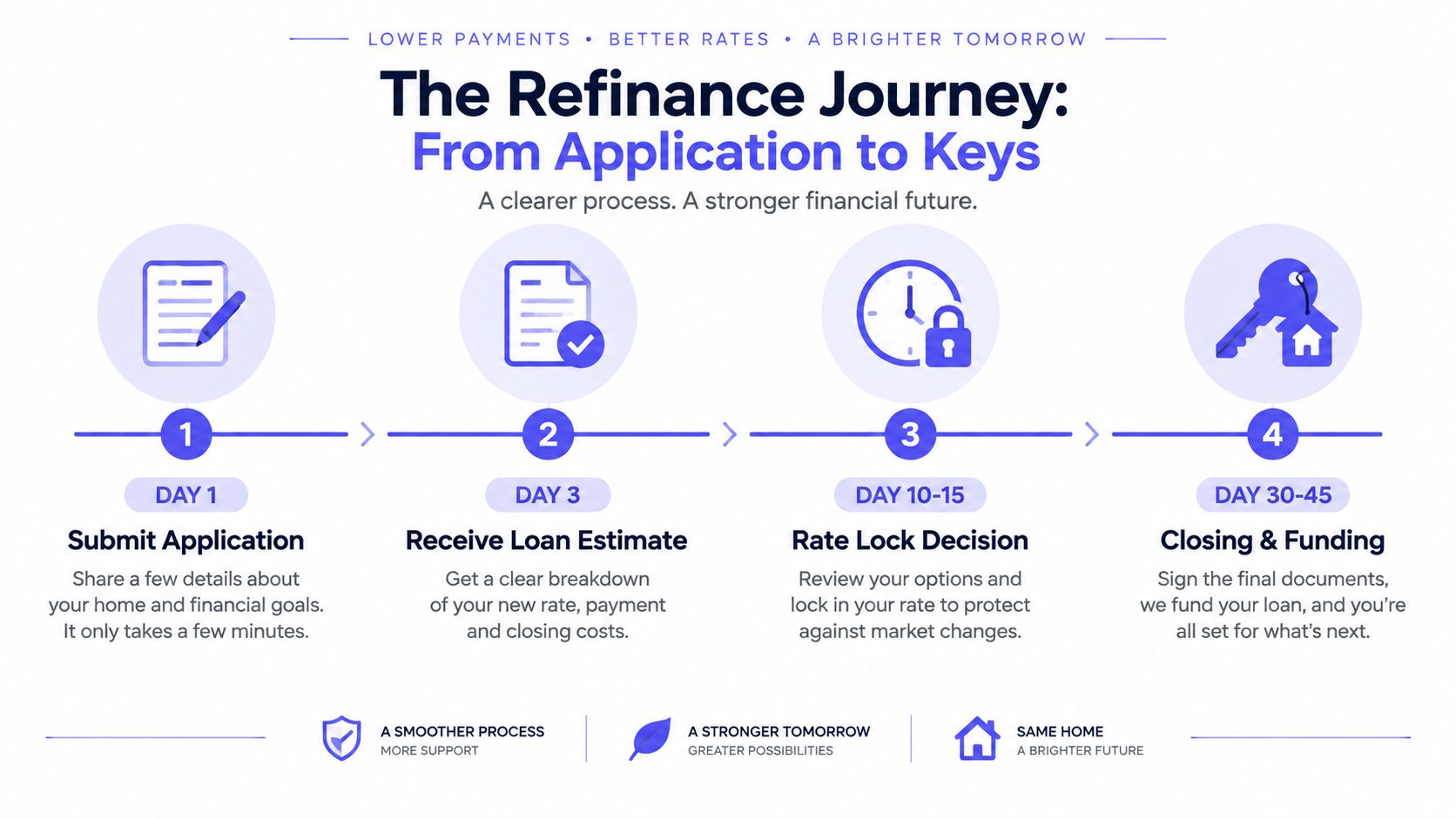
The lender must provide the initial loan cost details within three business days of application, giving you an early checkpoint for rate, payment, projected closing costs, and lender credits. Read the Loan Estimate line by line. Compare the offer with competing estimates using the same loan amount, term, points, and lock assumptions.
Decide whether to lock
A rate lock protects the quoted rate for an agreed period, but it doesn't eliminate the need to finish on time. Rate-lock periods commonly run from 30 to 60 days, and the right choice depends on the lender's processing capacity, your documentation, and the expected closing date.
Ask four direct questions before locking:
- What is the lock period? Confirm the exact expiration date, not just the number of days.
- What happens if the lender causes the delay? Ask whether an extension is free, discounted, or charged to you.
- What changes the price? Clarify how appraisal, credit, debt, occupancy, or loan-size changes affect the locked terms.
- When does underwriting begin? A lock without a clear review schedule creates avoidable timing risk.
A standard refinance usually takes about 30 to 45 days from application to closing, according to this refinance timeline breakdown. FHA and VA programs can move faster because they waive or reduce some underwriting steps, including appraisal requirements in many cases. Don't assume your file qualifies for expedited treatment until the lender confirms it.
Clear underwriting and property review
Underwriting verifies the story you told in the application. Respond to requests within 24 to 48 hours whenever possible. Upload clean, legible documents through the secure lender portal, and don't send sensitive financial records through an unverified email address.
Avoid new credit, large purchases, unexplained deposits, and employment changes while the file is active. If a family member provides gift funds, document the source, transfer, and required gift documentation before the money moves. The goal is consistency. The bank statements, income records, credit report, and application should tell the same story.
The appraisal confirms whether the property supports the proposed loan. Ask when it was ordered, who is handling it, and what happens if the value comes in below the lender's assumption. A low appraisal can force a lower loan amount, additional cash, revised pricing, or a new loan-to-value calculation.
Title work must also be clean. Unreleased liens, ownership errors, or mismatched legal descriptions can delay the payoff of the existing mortgage. Ask the closing company to identify title problems early, while there's still time to correct them.
Review disclosures and fund
The lender must deliver the Closing Disclosure at least three business days before consummation, giving you time to compare the final figures with the earlier estimate. Check the interest rate, loan amount, payment, cash to close, lender credits, prepaids, escrow, and payoff amount.
At signing, the new documents replace the old loan. In many refinance transactions, you also have a mandatory three-day rescission period after closing, so final funding may not occur at the signing table. Confirm exactly when the old loan will be paid off, when the new loan begins, and when any cash-out proceeds become available. The Federal Reserve refinance guide also emphasizes that attorney and closing-company fees can be part of the transaction.
Finance Home Improvements With Equity
A renovation loan should follow the project, not the other way around. Start with the property's current value, the existing mortgage balance, and a written scope of work. A common planning approach estimates usable equity at up to 80% loan-to-value minus the existing mortgage balance, but the lender's program, appraisal, income review, and credit profile determine the actual limit.
Suppose you're planning an addition rather than a cosmetic repair. Build the budget around contractor bids, permits, design work, materials, finishes, and a 10% to 15% contingency for unknown conditions. If the project budget only works when every estimate is perfect, the budget isn't ready.
| Factor | Cash-Out Refinance | HELOC |
|---|---|---|
| Existing first mortgage | Replaces it | Keeps it in place |
| Access to money | Usually delivered as one amount at closing | Drawn as needed |
| Best project fit | Large, defined project with a known budget | Staged work with uncertain timing |
| Main trade-off | Reprices and restructures the full first mortgage | Adds a separate second-lien payment |
| Equity risk | Increases the primary mortgage balance | Uses home equity as collateral for the line |
A cash-out refinance can bundle the renovation into one new first mortgage. That may simplify repayment, but it can also sacrifice a favorable existing rate and turn a project budget into long-term secured debt.
A HELOC preserves the original first mortgage and lets you draw funds as invoices arrive. That flexibility is useful for phased work, but the line has its own terms and payment exposure. Don't confuse a HELOC with a refinance. One replaces the first mortgage. The other generally sits behind it.
For a broader review of project funding structures, see home improvement financing options. Ask a tax professional about interest deductibility. The answer depends on how you use the proceeds, applicable tax rules, and your records.
Borrowing guardrail: Fund only work you can support with a real scope and documented budget. Don't borrow against projected appreciation, and keep the new total housing payment below 35% of gross monthly income as a personal risk limit.
Avoid Delays and Expensive Refinance Mistakes
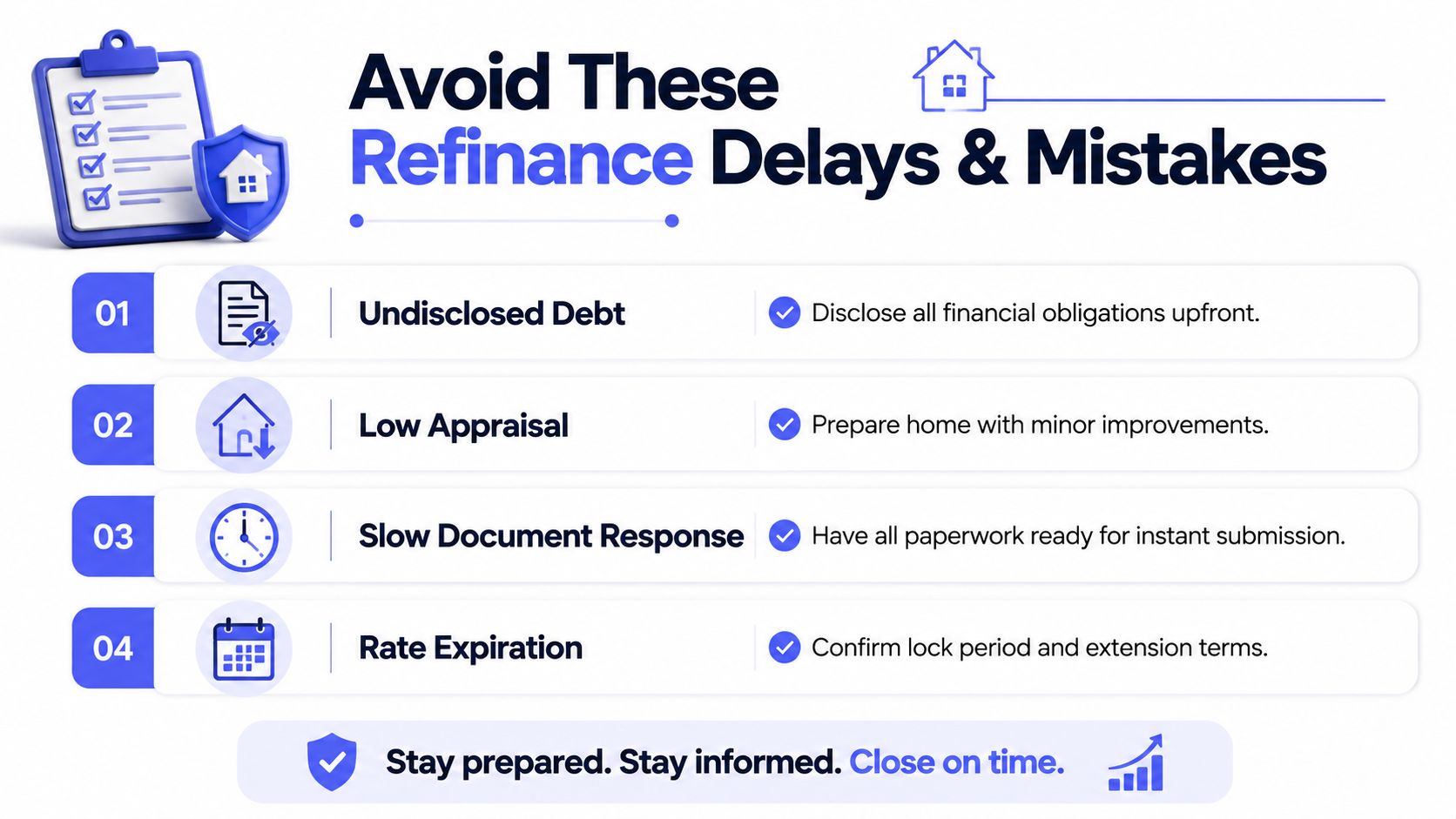
A refinance can stall even when the borrower qualifies. The usual causes are preventable inconsistencies, slow responses, weak title work, or a rate lock that expires before underwriting finishes.
Control the parts that belong to you
Disclose every debt on the application, including obligations that don't appear obvious from a credit report. Keep recent pay stubs and bank statements ready, monitor the lender portal, and respond quickly when the underwriter asks for clarification.
Don't open a credit account, finance a vehicle, make a large purchase, move money between accounts without documentation, or change jobs during the process unless you've discussed it with the loan officer first. A new obligation can change the approval even if your income hasn't changed.
Challenge the lender's process
Ask the loan officer what could delay the file and request a clear owner for each unresolved condition. If the appraisal is low, ask whether the lender will review comparable sales, accept a reconsideration, reduce the loan amount, or require additional funds.
Title defects need a different response. Request a written list of unreleased liens or ownership issues and confirm who is correcting each item. If underwriting is running late, ask about lock-extension costs before the expiration date arrives. Waiting until the final day leaves you with fewer choices.
Employment or income gaps deserve immediate explanation. Provide the records that establish what happened and how current income is supported. Silence creates suspicion. A documented answer gives underwriting something it can evaluate.
Fraud controls deserve equal attention. A 2025 Milliman study cited by the American Land Title Association found that fraud and forgery claims tied to refinance transactions represented over 40% of the total cost of refinance-related claims, with an average fraud or forgery claim cost of almost $207,000, nearly seven times the cost of other refinance claim types, according to ALTA's summary of the study. Verify identity, title information, payoff instructions, and wiring details through trusted channels.
Choose a Vetted Lender and Take Action
Select the lender that gives you the strongest apples-to-apples offer, not the one advertising the lowest headline rate. Request Loan Estimates from at least three lenders on the same day, then compare the rate, points, origination fees, lender credits, cash to close, and projected payment.
Verify the loan officer through the NMLS lookup, confirm state licensing, review complaint information in the CFPB database, and check that the company has verifiable contact and physical details. Ask each lender:
- How fast is the appraisal ordered and reviewed?
- Who handles underwriting conditions when the assigned processor is unavailable?
- What is the rate-lock period and extension policy?
- Which costs can change before closing?
- How will payoff and funding timing be confirmed?
For a large renovation, favor a lender with demonstrated experience in renovation financing or HELOC products. For a plain rate-and-term refinance, focus on transparent pricing, reliable communication, and whether the lender can close inside your holding-period assumptions.
A vetted matching platform can be a sourcing shortcut if personal research stalls, but you still need to independently verify every referral. Move to application only when the expected monthly savings recover the closing costs within a reasonable time, the documents are ready, and the selected terms outperform the alternatives on identical assumptions.
Lock the rate only after you understand the expiration policy. Put the appraisal, underwriting conditions, Closing Disclosure review, signing, rescission period, and funding dates on your calendar. Prepare the required closing funds at least three business days early, then verify the final wire instructions by phone using a trusted number.
A large refinance study found that roughly 20% of households positioned to benefit from refinancing hadn't done so, with an estimated present-discounted cost of about $11,500 for the median household, according to Federal Reserve Bank of Chicago research. Don't let indecision or paperwork create that outcome. Calculate the break-even point, compare the offers, protect the file, and proceed only when the numbers still work.
Hand Vetted Co. connects homeowners seeking mortgage, refinance, HELOC, or home-improvement financing with one verified lending professional, rather than sending the request to multiple businesses. Visit Hand Vetted Co. to request a focused match, then verify the lender's license, pricing, and terms before you apply.