A compressor fails on a hot afternoon. The technician quotes a major repair, then offers a replacement proposal that costs several times more. You're left staring at two numbers and one uncomfortable question: should you repair or replace the HVAC system?
Don't decide by age alone. Use the repair estimate, equipment type, failure history, refrigerant, safety, and replacement scope. A newer system with one failed component often deserves repair. An older system facing an expensive compressor, heat exchanger, or refrigerant problem may be a poor place to keep spending money.
| Decision factor | Repair usually makes sense | Replacement deserves serious consideration |
|---|---|---|
| Repair cost | Clearly below half the installed replacement price | At least half the installed replacement price |
| Equipment age | Early or middle part of its expected service life | Near or beyond its expected service life |
| Repair history | First significant failure | Repeated breakdowns and rising repair frequency |
| Refrigerant | Small, manageable issue on an otherwise sound system | R-22, major leak, or tightening R-410A availability |
| System condition | Safe, comfortable, and properly sized | Poor comfort, weak efficiency, unsafe operation, or incompatible ductwork |
Table of Contents
- When the Repair Quote and the Replacement Quote Both Show Up
- The Two Rules That Settle Most HVAC Decisions
- How Long Your System Should Actually Last
- Why Your System Might Not Need Replacing Yet
- The Refrigerant Transition Changes the Math
- Repair vs Replacement at a Glance
- Your Decision Checklist and Next Steps
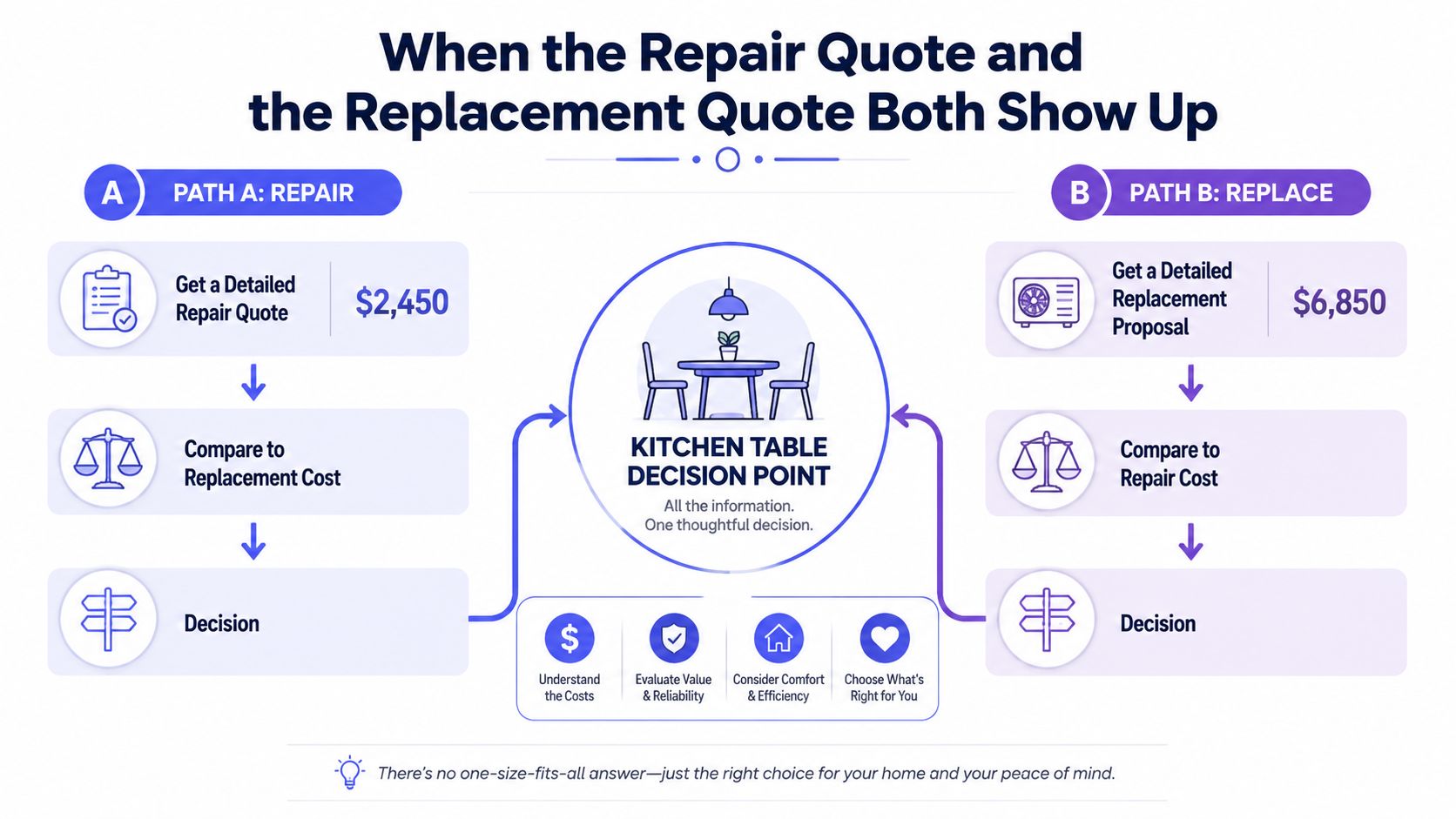
When the Repair Quote and the Replacement Quote Both Show Up
The two quotes land on the same kitchen table, but they solve different problems. One restores the system you already own. The other changes your comfort, efficiency, reliability, and future maintenance exposure.
Start with the diagnosis, not the sales pitch. Ask the technician to identify the failed component, show the test results, and explain whether the system is cooling or heating safely. A replacement recommendation without a clear diagnostic line item deserves a second opinion.
Read the scope before comparing prices
A repair quote should identify labor, parts, refrigerant, disposal, and warranty terms. A replacement proposal should spell out equipment, installation, permits, electrical work, thermostat, refrigerant lines, duct modifications, startup testing, and registration assistance. Two totals aren't comparable if one leaves major work out.
A repair can be the right call when the equipment is relatively young, the failed part is covered by warranty, and the system has a clean service history. Replacement becomes more persuasive when the unit has recurring failures, poor efficiency, comfort problems, or ductwork that can't support the proposed equipment.
For replacement pricing context, review this HVAC replacement cost guide and check whether the proposal reflects the home's actual requirements rather than a standard package.
Make the comparison about ownership
Recent market reporting places a full residential HVAC replacement at about $7,500 on average, with many projects between $5,000 and $12,500, while some complete system swaps reach $12,000 to $16,000 depending on home size, equipment, and installation complexity, according to ACR News coverage of repair versus replacement decisions.
That makes a large repair emotionally attractive because it costs less today. But the key question is how much reliable service you're buying. A successful repair may provide useful time. It won't reset the age of every other component in the system.
The Two Rules That Settle Most HVAC Decisions
Use two calculations before you let anyone push you toward a decision. They're screening tools, not automatic orders, but they cut through vague advice quickly.
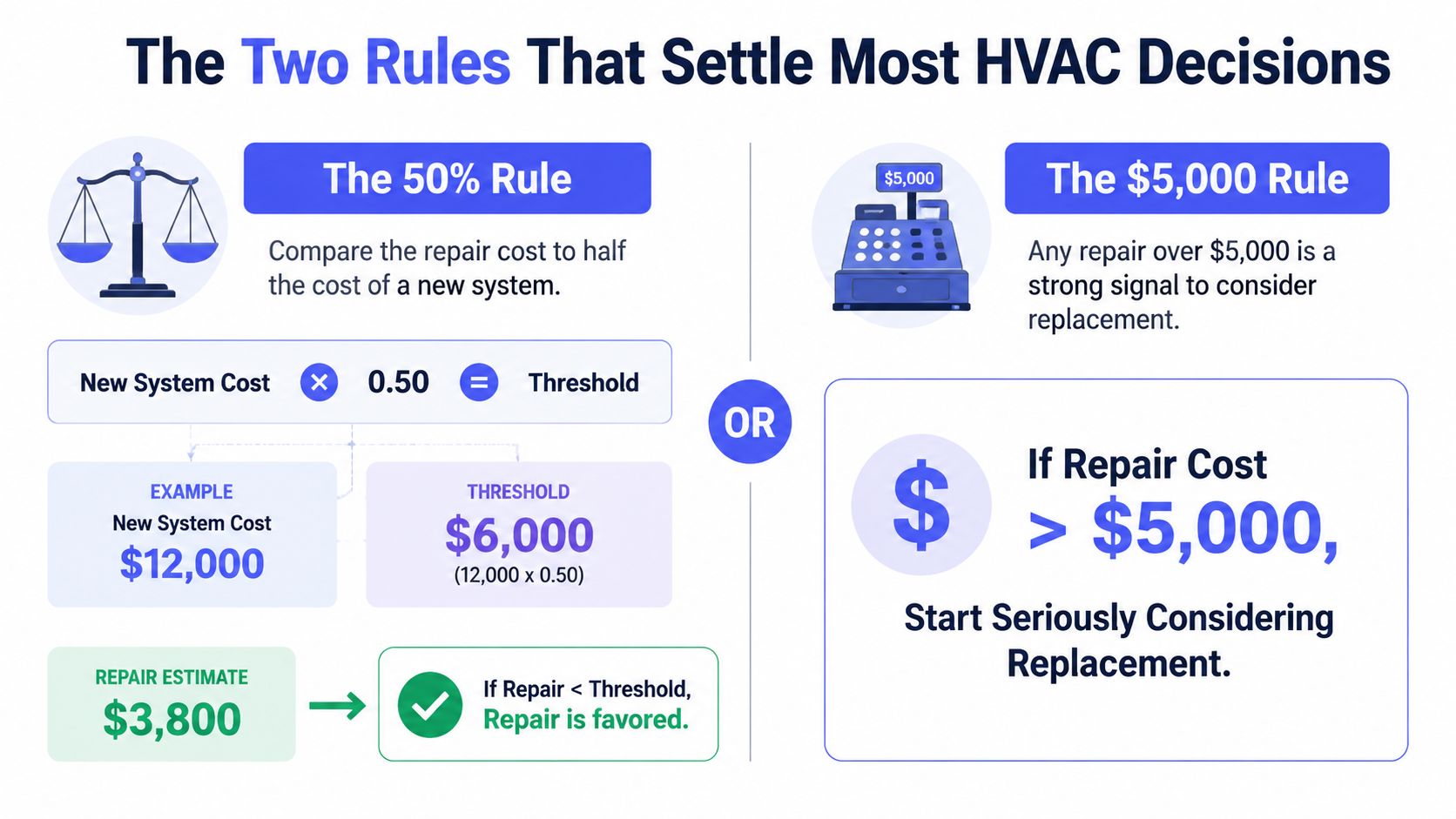
Start with the 50% rule
Take the installed price of a comparable new system and multiply it by 0.50. That gives you the repair threshold. If the repair is below that number, repair is usually reasonable. If it reaches or exceeds that number, replacement deserves serious consideration.
Suppose a replacement proposal totals $12,000. Half is $6,000. A $3,800 repair stays below the threshold. A $7,200 repair crosses it. The second quote doesn't automatically force replacement, but you'd need a strong reason to keep investing, such as substantial warranty coverage or an unusually reliable, well-maintained system.
This rule is especially useful for major component failures. A small electrical repair and a compressor replacement shouldn't receive the same financial treatment.
Then run the age-times-repair rule
Multiply the system's age in years by the repair estimate. If the result exceeds about $5,000, replacement is generally the stronger long-term investment, based on the HVAC lifecycle repair-versus-replace guide from Oxmaint.
A 9-year-old unit with a $4,500 repair produces 40,500 in the calculation, which is a strong replacement signal. A 12-year-old system with a $500 repair produces 6,000, but that result shouldn't override a minor, isolated failure on otherwise healthy equipment.
Practical rule: Use the formulas to identify the conversation you need to have. Don't use them as permission to ignore warranty coverage, system condition, or safety.
Adjust the calculation for covered parts, rebates, renovation plans, efficiency gains, and refrigerant compatibility. If the answer sits close to either threshold, compare likely future repair exposure with the value of new equipment instead of treating the formula as a verdict.
How Long Your System Should Actually Last
A furnace, central air conditioner, and heat pump can share the same installation date without sharing the same replacement logic. Equipment type, runtime, climate, installation quality, maintenance, and repair history all change how much useful life remains.
| Equipment type | Typical lifespan | What changes the outlook |
|---|---|---|
| Central air conditioner | 15 to 20 years | Maintenance, coil condition, compressor health, climate, and installation quality |
| Furnace | 15 to 25 years | Heat exchanger condition, burner performance, venting, maintenance, and safety |
| Heat pump | 10 to 15 years | Heating and cooling runtime, compressor condition, controls, climate, and maintenance |
These lifespan ranges come from HomeAdvisor's HVAC repair guidance. Other industry guidance places central air conditioners around 10 to 15 years, heat pumps around 12 to 17 years, and furnaces around 15 to 25 years, so treat age as a range rather than a hard expiration date, as described in this HVAC lifecycle analysis.
Calendar age isn't the whole story
A well-maintained 14-year-old air conditioner with one isolated capacitor failure can still be a sensible repair candidate. A 9-year-old heat pump with a failed compressor, recurring electrical faults, and declining comfort may be a bad bet despite being younger.
Heat pumps also provide both heating and cooling, so their workload can differ from that of a furnace paired with a separate air conditioner. The component that failed matters just as much as the date on the data plate. Replacing a burner or sensor doesn't mean the entire system is finished. A failed compressor can consume the value of several smaller repairs.
Track the model and serial number, installation date, maintenance history, repair frequency, and utility bills. Guidance from Money on HVAC replacement timing notes that systems often need more frequent repairs after roughly 10 to 15 years of service. That's a warning about trend, not a command to replace every older unit.
Why Your System Might Not Need Replacing Yet
“Replace the system” is sometimes a lazy diagnosis. A technician sees an older unit, finds one failed part, and jumps straight to a full installation proposal. That approach can waste money, particularly for people who have a repairable system and a tight budget.
A 2026 claims report found that half of HVAC and refrigeration equipment included in 2025 claims was repairable, while another 20% was working properly at assessment, according to Alpine Intel's claims report. That doesn't mean every repair is wise. It does mean “old” and “unusable” are not interchangeable.
Separate a failed part from a failed system
Capacitors, contactors, igniters, blower motors, sensors, thermostats, and controls can fail while the rest of the equipment remains serviceable. Ask for the exact failed component and the test that proved it failed.
Before authorizing work, perform a basic triage:
- Check the thermostat: Confirm it has power and the settings are correct.
- Inspect the breaker: Reset it only if it has tripped once. Repeated trips require professional diagnosis.
- Replace thermostat batteries: A dead battery can mimic a system failure.
- Check the filter: A severely restricted filter can cause airflow and coil problems.
- Look for condensate trouble: Water near the indoor unit or a blocked drain can stop operation.
- Read the data plate: Confirm the equipment age and refrigerant type before comparing quotes.
A contractor who recommends replacement without documenting the failure should explain the diagnosis or make room for a second opinion.
If the repair is below your calculated threshold and fixes a named failed part, default to repair, then reassess the system's performance and repair pattern later.
The claims data supports a repair-first question, not blind optimism. If the system has a cracked heat exchanger, unsafe combustion issue, severe corrosion, or a major refrigerant leak, the answer can change immediately.
The Refrigerant Transition Changes the Math
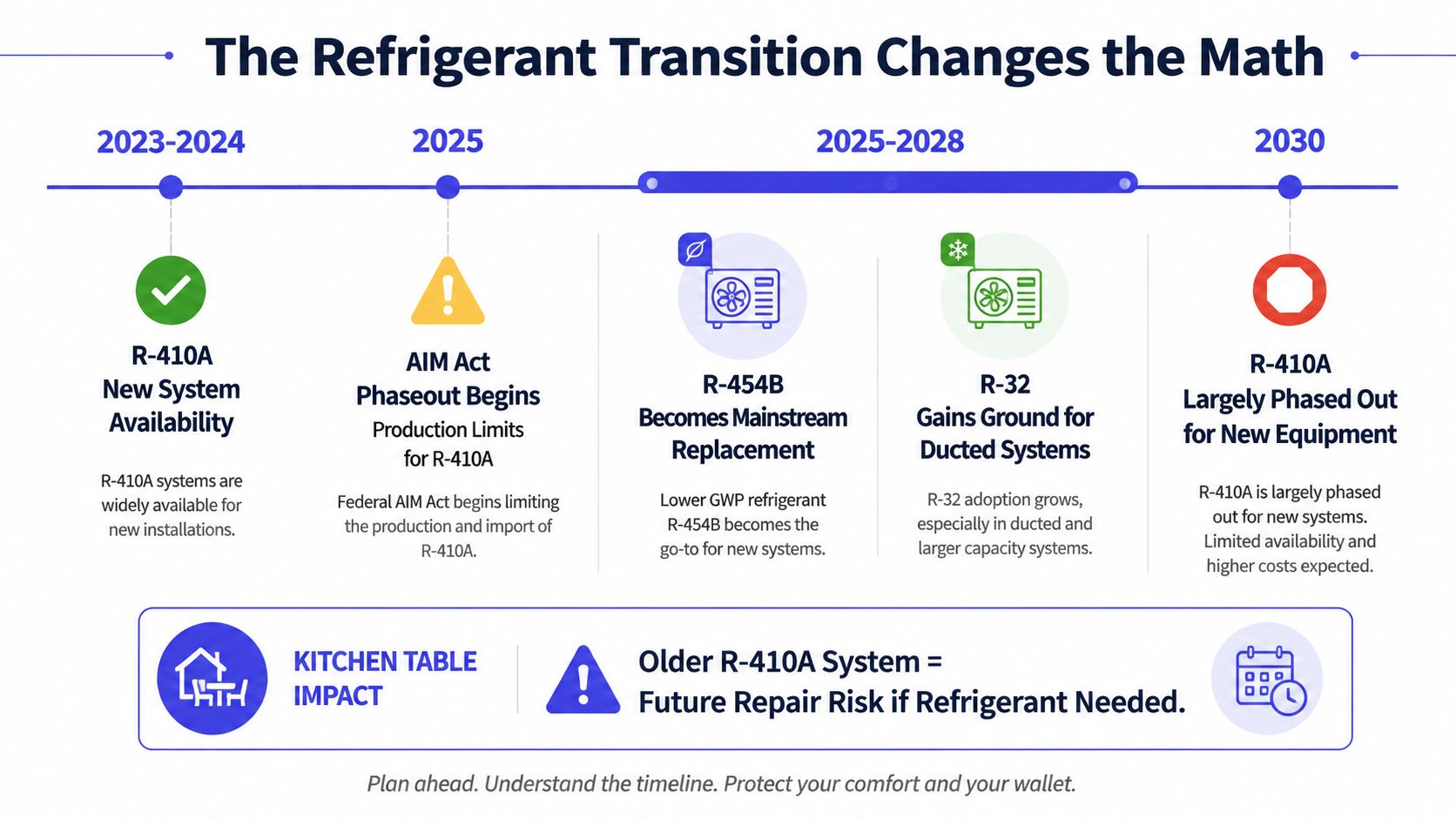
Refrigerant is no longer a side detail. It can decide whether an older system remains practical to repair.
Manufacturers stopped producing new HVAC equipment using R-410A in 2025, and newer systems are shifting toward lower-global-warming-potential refrigerants such as R-454B and R-32, according to Nex Level Services' 2025 HVAC industry overview. Your existing R-410A equipment doesn't become illegal or automatically useless. The concern is future repair logistics, including parts, refrigerant availability, and the cost of servicing an aging system.
Check the label before approving a recharge
Find the refrigerant designation on the outdoor unit's data plate. If the system uses R-410A, ask whether the proposed work involves a leak, how much refrigerant is required, whether the leak can be repaired, and whether the replacement parts remain available.
An R-410A system that's relatively young, comfortable, and dealing with a small repairable leak can still earn a repair. An older unit with a leaking coil, repeated refrigerant loss, or a repair approaching the replacement threshold deserves a replacement proposal.
A system using R-22 needs even more scrutiny because R-22 is no longer used in new equipment. Don't authorize an expensive recharge without comparing it with a properly scoped replacement.
Ask who handles the refrigerant
Refrigerant work must be performed by a professional who meets EPA Section 608 requirements. Don't accept a vague “top-off” recommendation. You need to know whether the technician found and repaired the leak, recovered refrigerant correctly, and documented the charge.
The transition changes the risk calculation. It doesn't justify panic replacement of a sound R-410A system, but it does make a major refrigerant repair on an aging unit harder to defend.
Repair vs Replacement at a Glance
Put the decision on paper before choosing a contractor's preferred equipment. Repair usually costs less immediately and causes less disruption. Replacement makes more sense when the system is near the end of its useful life, repairs keep recurring, comfort is poor, or the existing equipment cannot support the required refrigerant and components.
| Factor | Repair | Replacement |
|---|---|---|
| Upfront cost | Lower immediate expense, based on the failed part and labor | Higher project cost, including removal, installation, commissioning, and possible duct or electrical work |
| Remaining lifespan | Keeps the current system running, while leaving other aging components in service | Starts a new equipment cycle and may improve reliability |
| Efficiency impact | Preserves the current efficiency and its design limits | New equipment can improve efficiency, but only with correct sizing, airflow, and installation |
| Disruption | Usually limited to one service visit and follow-up work | A larger project that may require temporary loss of heating or cooling |
| Financing | Often paid from savings or short-term credit | May include HVAC financing, manufacturer programs, rebates, or eligible tax credits |
| Best fit | A clearly diagnosed failure on a safe system with useful life remaining | Systemic failure, repeated repairs, poor comfort, or equipment nearing replacement age |
A new system is not automatically a better investment. Poor sizing, leaky ducts, restricted airflow, and weak commissioning can erase much of the expected efficiency benefit. Require a load-based design, and ask the contractor to explain how the proposed equipment will work with the existing ductwork.
System compatibility matters more during the refrigerant transition. A repairable problem on a sound, relatively young system can justify keeping it in service. A major refrigerant repair on an aging unit deserves a replacement comparison, especially if parts or future service may become harder to obtain.
For an addition, difficult room, or home without suitable ducts, compare the scope with ductless mini-split installation costs. A ductless replacement may solve the comfort problem more directly than installing or modifying a conventional split system.
Replacement also gives you planning control. You can compare proposals, check incentives, select equipment, and schedule the work before an emergency. Repair is faster, but a quick fix has poor value when the same major failure returns. Use the repair estimate, system condition, refrigerant, and expected remaining life together, not age alone.
Your Decision Checklist and Next Steps
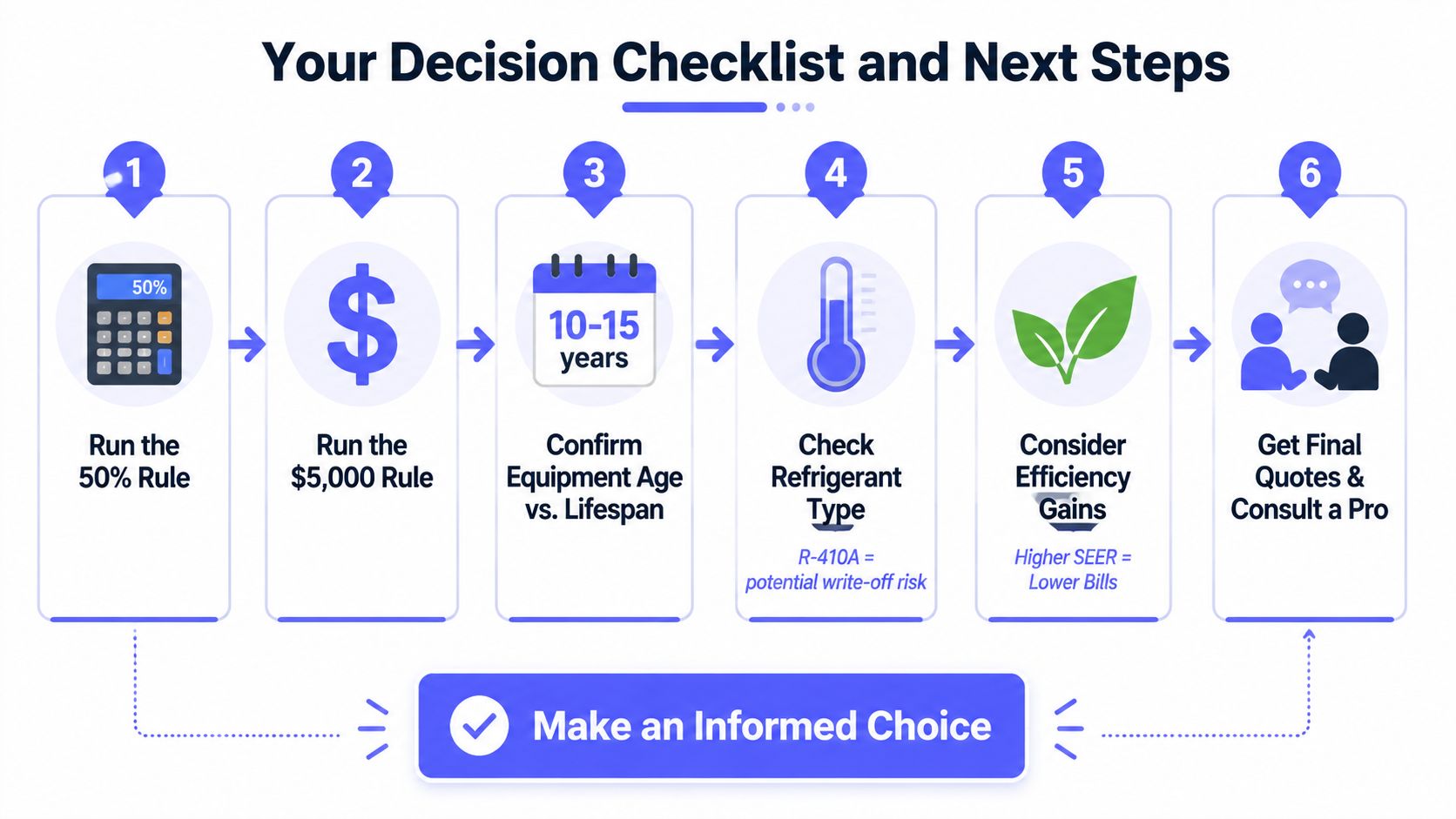
Use this order. Don't start with a contractor's preferred product or a neighbor's age rule.
Run the money tests first
Write down the repair estimate and the installed replacement price for a comparable system. Calculate half of the replacement price, then compare the repair against that threshold. Next, multiply the system's age by the repair estimate and compare the result with the $5,000 rule described in AC Direct's repair-or-replace guidance.
These calculations tell you whether you're looking at a reasonable repair or an expensive bet. They don't replace diagnosis. A covered component, a strong maintenance record, or a system that still delivers excellent comfort can justify repairing near a threshold. A recurring failure pattern can justify replacement below it.
Confirm age, condition, and refrigerant
Compare the equipment's age with its type-specific lifespan. Then inspect the evidence around the failure:
- Rising utility bills: Look for a persistent change after accounting for weather and usage.
- Humidity swings: Poor moisture control can signal sizing, airflow, or equipment trouble.
- Short cycling: Frequent starts and stops deserve diagnosis rather than a guess.
- Repeated repairs: Count the failures and costs, not just the latest invoice.
- Soot or ignition smells: Stop using a malfunctioning furnace and request an urgent safety assessment.
- Frozen coils: Find the cause, which may involve airflow, refrigerant, or blower operation.
- Water pooling: Treat indoor leaks as a drainage, coil, or condensate problem requiring inspection.
Check the outdoor unit's label for refrigerant. A pre-2025 R-410A system under 10 years old isn't an automatic write-off, especially if the leak is repairable and the rest of the equipment is sound. R-22 or a major coil failure shifts the conversation sharply toward replacement.
Gather documents before the technician arrives
Pull together the model and serial number, installation year, service records, previous repair invoices, recent utility bills, warranty details, and any indoor comfort complaints. A written history prevents the latest emergency from becoming the only evidence used in the decision.
Request a second opinion when the diagnosis conflicts with system behavior, the technician recommends replacement without test results, the proposed size differs from the existing equipment without explanation, or the quote leaves out major installation details.
Vet the professional, not just the equipment
Ask each contractor these questions:
- Are you licensed for this work in my state?
- Do you hold NATE certification or employ technicians who do?
- Are you authorized to handle refrigerants under EPA Section 608?
- Will you provide a written, line-item repair or replacement scope?
- Will you perform an ACCA Manual J load calculation?
- How will you evaluate the existing ductwork and electrical service?
- What parts and labor warranties apply, and will you help register them?
- Can you explain the diagnosis without pressuring me to decide today?
Get three written bids when replacement is under consideration. Compare the equipment model, capacity, efficiency, labor, permits, accessories, ductwork, electrical work, startup procedure, warranty, and disposal. A low bid that omits commissioning or required modifications isn't low. It's incomplete.
For more context on technician qualifications, review HVAC technician certification requirements. Then verify licensing through the relevant state authority and review the business's BBB profile and Google reviews.
Build the financing plan separately
Check utility rebates, manufacturer rebates, and applicable federal incentives before signing. The federal 25C credit can reach $2,000 for qualifying heat pumps, with a $600 heat pump sub-limit specified in the available guidance, so verify current eligibility, equipment requirements, and tax circumstances with a qualified tax professional or official program source.
You can also compare HVAC loans, promotional financing, and PACE where available. Don't let financing make an oversized or poorly designed system look affordable. Borrowing spreads the payment. It doesn't fix bad sizing or an incomplete proposal.
Your final action plan is simple:
- Diagnose the named failure.
- Run both financial rules.
- Check age against equipment type.
- Confirm refrigerant and repairability.
- Gather competing written scopes.
- Require load calculations for replacement.
- Compare total ownership value, not just today's invoice.
If you need help finding a qualified HVAC professional for a repair diagnosis or load-based replacement quote, Hand Vetted Co. can match your project with one verified professional rather than sending your contact details to multiple businesses.
Hand Vetted Co. offers exclusive matches with licensed, background-checked professionals who maintain 4.5+ star ratings, so you can request an HVAC assessment without managing a pile of competing calls. Visit Hand Vetted Co. to start with your location, project needs, timing, and budget.